This open problem taught me what topology is
Based on 3Blue1Brown's video on YouTube. If you like this content, support the original creators by watching, liking and subscribing to their content.
Recasting the rectangle problem as finding two distinct pairs of points with the same midpoint and the same distance reduces a four-point search to a collision problem.
Briefing
The core breakthrough is a topology-driven route to a classic geometric claim: every closed continuous loop in the plane contains a non-degenerate inscribed rectangle. The proof turns the rectangle-finding problem into a collision problem on a carefully constructed surface, then uses a key impossibility about Möbius strips and Klein bottles in three dimensions to force that collision.
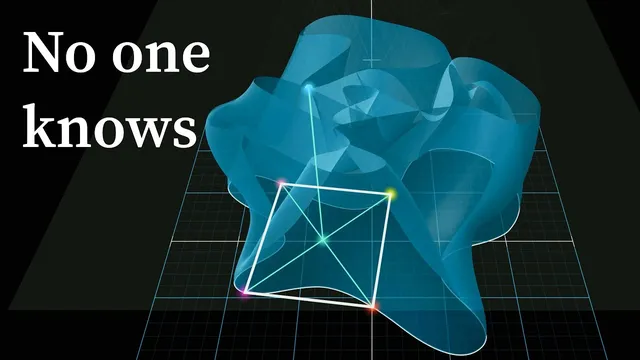
The argument starts by reframing what it means to have a rectangle on the loop. Instead of hunting for four points that form a rectangle directly, it looks for two distinct pairs of points whose connecting segments share the same midpoint and the same length. Those conditions force the four endpoints to be the vertices of a rectangle. To organize all possibilities, the proof packages each ordered pair of loop points into a single point in three-dimensional space: the x–y coordinates come from the midpoint of the pair, and the z-coordinate encodes the distance between the points. Because the midpoint and distance change continuously as the chosen pair moves along the loop, this “pair-to-3D” assignment is continuous.
Now comes the geometric heart of the method. The set of all outputs of this continuous assignment forms a complicated surface in 3D—described as something like a Frank Gehry design—whose self-intersections correspond exactly to the desired rectangle condition: two different pairs of points mapping to the same 3D point means they share midpoint and distance, hence form a rectangle. For a circle, the surface’s many-to-one behavior concentrates at the top of a dome; for an ellipse, that collision spreads into a line. Either way, the proof needs a general reason that self-intersection cannot be avoided for an arbitrary loop.
To force that reason, the proof builds a second surface that represents unordered pairs of points. Ordered pairs (a,b) and (b,a) are treated as distinct, but rectangles require the unordered version. Folding the unit square along its diagonal identifies (x,y) with (y,x), and the resulting quotient space becomes a Möbius strip. Crucially, the “edge” of this Möbius strip corresponds to degenerate pairs where both points coincide (x,x), and those must land back on the original loop in the plane.
A continuous mapping from the Möbius strip onto the earlier 3D surface is then unavoidable because each unordered pair determines a unique point on the rectangle-encoding surface. If the Möbius strip could be embedded in 3D without self-intersection while keeping its boundary confined to the plane, the rectangle collision might be avoided. But Möbius strips cannot be realized in 3D with their boundary staying in a plane without forcing self-intersection—an obstruction tied to the broader fact that non-orientable closed surfaces (like the Klein bottle that emerges from gluing two Möbius strips along their boundaries) cannot be represented in 3D without intersecting themselves.
That impossibility forces the rectangle-encoding surface to self-intersect. The self-intersection means two distinct unordered pairs share the same midpoint and distance, so the loop must contain a non-degenerate inscribed rectangle.
Finally, the discussion explains why the original unsolved problem—inscribed squares—remains open. Squares require not just equal midpoint and length, but also a 90-degree angle between the corresponding segments. For smooth curves, angle behavior is well-controlled, and mathematicians Joshua Green and Andrew Lobb proved in 2020 that smooth curves admit inscribed squares (and even rectangles of every aspect ratio). The difficulty persists for rough curves, where tangent directions can fail to behave continuously, leaving the square problem unresolved in full generality.
Cornell Notes
Every closed loop in the plane is guaranteed to contain a non-degenerate inscribed rectangle. The proof converts “find two segments with the same midpoint and length” into a collision problem on a continuous surface in 3D: each ordered pair of points on the loop maps to (midpoint x,y, distance). Self-intersections on that surface correspond to two distinct pairs sharing midpoint and distance, which forces rectangle vertices. To handle unordered pairs (so (a,b) and (b,a) don’t create trivial solutions), the space of unordered pairs is modeled as a Möbius strip. Because Möbius strips (and more generally non-orientable surfaces like the Klein bottle) cannot be embedded in 3D without self-intersection while keeping the boundary confined to the plane, the collision—and thus a rectangle—must occur.
Why does “same midpoint and same length” guarantee a rectangle on the loop?
How does mapping pairs of points into 3D turn rectangle-finding into a self-intersection problem?
Why is the Möbius strip the right model for unordered pairs of points?
What role does the impossibility of embedding a Möbius strip in 3D play?
How does the Klein bottle enter the logic?
Why does the square problem remain harder than the rectangle problem?
Review Questions
- How does the proof’s 3D mapping ensure that a self-intersection corresponds to a rectangle on the original loop?
- What identification turns the unit square of ordered pairs into a Möbius strip, and why does that matter for avoiding trivial rectangles?
- Why does smoothness help with inscribed squares, and what specific geometric control does it provide that rough curves may lack?
Key Points
- 1
Recasting the rectangle problem as finding two distinct pairs of points with the same midpoint and the same distance reduces a four-point search to a collision problem.
- 2
A continuous mapping from ordered pairs on the loop to 3D points—(midpoint x,y, distance)—turns rectangle existence into the inevitability of self-intersections.
- 3
Unordered pairs require identifying (a,b) with (b,a); folding the unit square along the diagonal produces a Möbius strip that models these unordered pairs.
- 4
The Möbius strip’s boundary corresponds to degenerate pairs (x,x), forcing that boundary to land on the original planar loop.
- 5
Möbius strips cannot be embedded in 3D without self-intersection while keeping their boundary confined to a plane; this forces collisions on the rectangle-encoding surface.
- 6
Gluing a Möbius strip to its reflection yields a Klein bottle, and the non-orientability obstruction behind Klein bottles underwrites the embedding impossibility.
- 7
Inscribed squares add an angle constraint; smooth curves make angle limits behave well, enabling results by Joshua Green and Andrew Lobb, while rough curves keep the general problem open.