This Paper Might Change How We See Gravity
Based on Sabine Hossenfelder's video on YouTube. If you like this content, support the original creators by watching, liking and subscribing to their content.
Entropic gravity gains traction when the framework specifies what physical degrees of freedom carry the entropy; this proposal assigns that role to spin qubits filling space.
Briefing
A new “entropic gravity” proposal tries to make the idea concrete by specifying what carries the entropy that could generate gravitational attraction. Instead of treating gravity as a fundamental force, the framework treats space as filled with quantum bits (“qubits”) whose spins can become slightly more aligned near a mass. That alignment lowers local entropy, but when two masses come together the region where spins align shrinks, raising the total entropy between them—an entropy increase that the authors argue produces an effective attractive force. The paper then claims this mechanism reproduces Newton’s law.
The entropic gravity concept has been floating around for years, but the missing piece was always “entropy of what?” Black holes offer a clue because they behave like thermodynamic objects with entropy and temperature, even though Einstein’s general relativity is usually framed in terms of spacetime geometry rather than thermodynamic variables. In the 1990s, Ted Jacobson showed that under broad conditions Einstein’s equations can be recast as thermodynamic relations involving entropy and pressure. A decade later, Eric Verlinde pushed the idea further by deriving Newtonian gravity from thermodynamics, using analogies like polymer-like materials that contract when warmed and thereby create an effective attraction. Verlinde’s approach, however, didn’t fully pin down the microscopic degrees of freedom responsible for the entropy.
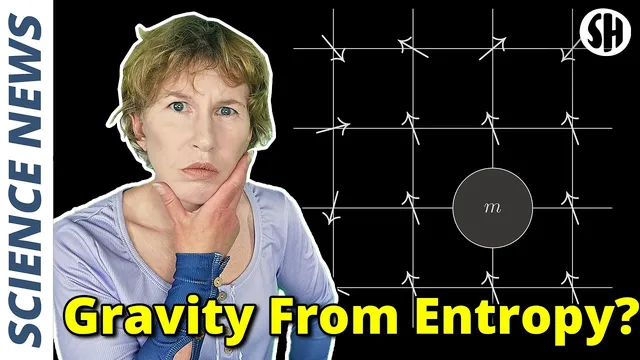
The new paper’s answer is to populate space with qubits—an “it from qubit” style program suggesting that information and quantum degrees of freedom underlie physical reality. In the model, each qubit has a spin (visualized as arrows). A mass slightly biases the spins to align, creating a more ordered state and thus lower entropy in the vicinity. When another mass is introduced, the overlap of the two “aligned” regions reduces the total volume with aligned spins. That overlap effect increases total entropy, and the authors interpret that entropy increase as the driver of attraction.
Crucially, the proposal also makes testable implications, at least in principle. It argues gravity itself would not be a quantum interaction with its own quantum properties; instead, it would emerge as an average, bulk effect from underlying qubit behavior. That distinction matters because experiments hunting for quantum-gravity signatures could potentially rule out the scenario. The qubit environment would also induce decoherence—an effect that, according to the proposal, might appear in ways that are not expected in standard quantum-gravity pictures.
Still, the idea is treated as a “toy model” rather than a complete theory. The construction lacks the symmetries needed to recover Einstein’s full general relativity, which means it cannot be the final word. The model’s value is therefore more methodological than definitive: it offers a concrete microscopic mechanism for entropic gravity and a path for further development, even as serious theoretical gaps remain. The broader debate—whether gravity is fundamental (with a hypothetical graviton mediator) or emergent—remains unresolved, but this work strengthens the case that entropy and quantum information could play a causal role in gravitational behavior.
Cornell Notes
The entropic gravity proposal aims to answer a long-standing question: “entropy of what?” It models space as filled with spin qubits. A nearby mass slightly aligns those spins, lowering local entropy, but bringing two masses together shrinks the aligned region and increases total entropy between them. The authors claim that this entropy increase yields an effective attraction consistent with Newton’s law. The framework also predicts gravity would behave as a non-quantum, bulk emergent effect, implying that quantum-gravity experiments and expected decoherence patterns could test or rule it out. The approach is explicitly a toy model and lacks the symmetries needed to reproduce full general relativity.
Why does entropic gravity need an answer to “entropy of what,” and how does this proposal supply one?
How does the model turn entropy changes into an attractive force between masses?
What earlier milestones in entropic gravity does the transcript connect to this new paper?
What experimental implications follow if gravity is an emergent bulk effect rather than a quantum interaction?
Why is the proposal still considered unlikely to be the full theory of gravity?
Review Questions
- What microscopic system is assigned the role of “entropy carrier” in the proposal, and how does a mass change its state?
- Describe the sequence of events (entropy decrease near one mass, entropy increase when two masses overlap) that leads to an effective attraction.
- What kinds of observations could, in principle, distinguish an emergent entropic-gravity scenario from a fundamentally quantum gravity model?
Key Points
- 1
Entropic gravity gains traction when the framework specifies what physical degrees of freedom carry the entropy; this proposal assigns that role to spin qubits filling space.
- 2
A mass biases nearby qubit spins to align, creating lower local entropy around the mass.
- 3
When two masses come together, the overlap reduces the aligned region’s volume, increasing total entropy between them and producing an effective attraction.
- 4
The authors claim the mechanism reproduces Newton’s law, but the setup is still a toy model.
- 5
The scenario predicts gravity behaves as a non-quantum, bulk emergent effect, which could be tested by quantum-gravity experiments.
- 6
The qubit environment would likely induce decoherence, offering another potential experimental handle.
- 7
The model lacks the symmetries needed to recover Einstein’s full general relativity, limiting its status as a complete theory.