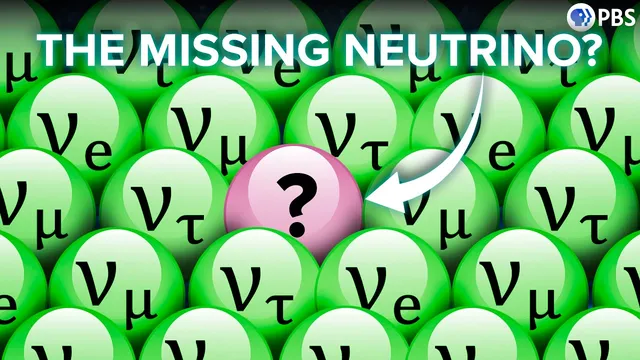
This Particle Solved Everything. We Just Found Out It Isn't Real
Based on PBS Space Time's video on YouTube. If you like this content, support the original creators by watching, liking and subscribing to their content.
Sterile neutrinos are hypothetical right-handed neutrinos that would not couple to the weak nuclear force, leaving them detectable only through extremely weak effects like gravity.
Briefing
A long-sought “sterile neutrino” — a right-handed neutrino that would barely interact with ordinary matter — is looking increasingly unlikely after new results from Fermilab’s MicroBooNE experiment. Earlier experiments reported an excess of electron-like events that could be interpreted as muon neutrinos oscillating into sterile neutrinos. MicroBooNE’s improved ability to separate genuine electron-neutrino interactions from lookalike backgrounds has now found no such electron excess, effectively emptying the most promising gap in the standard model.
The sterile neutrino idea starts with a symmetry puzzle in neutrino physics. In the standard model, neutrinos come in left-handed forms, while right-handed neutrinos have never been detected. Left-handed neutrinos interact via the weak nuclear force, which is vastly stronger than gravity but still hard to use experimentally because neutrinos must pass extremely close to atomic nuclei to trigger reactions. If right-handed neutrinos exist but do not couple to the weak force, they would only interact through gravity — making them “sterile” and nearly invisible to detectors.
That invisibility is exactly why sterile neutrinos became attractive. They could, in principle, help explain why neutrinos have tiny masses (through a mechanism often discussed as a “seesaw” effect) and why about 80% of the universe’s matter appears dark. For decades, physicists searched for sterile neutrinos by looking for anomalies in neutrino oscillations — especially transitions that would show up as unexpected electron-neutrino events.
The most influential early hints came from LSND at Los Alamos in the 1990s and later MiniBooNE at Fermilab. Both experiments saw an excess of fuzzy Cherenkov-ring-like signals consistent with electron-neutrino interactions, which could be produced if muon neutrinos oscillated into sterile neutrinos and then effectively reappeared as electron neutrinos. The implied sterile-neutrino mass scale was around 1 electron volt, placing it in a region that many models treat as experimentally testable.
But the sterile-neutrino story ran into contradictions. Other experiments did not observe the corresponding disappearance of muon neutrinos, and measurements from sources like the Sun (as tracked by IceCube) fit oscillations among only the three known neutrino types. One major worry was that the “electron-like” signals might not be electrons at all. Neutrino collisions can produce neutral pions that decay into gamma rays; overlapping electromagnetic showers from those gammas can mimic the fuzzy ring pattern expected from electron events.
MicroBooNE was built to resolve that ambiguity. Using a liquid argon time projection chamber, it reconstructs particle trajectories and identifies whether an electromagnetic shower begins right at the interaction vertex (as in true electron-neutrino events) or appears only after a gap (as in photon-induced backgrounds). MicroBooNE’s results — first published in 2021 and then updated with a final analysis released in December 2025 — confirm the absence of the electron excess once photon backgrounds are removed. The remaining anomaly from earlier gallium-related observations can be explained by photon events, and sterile neutrinos are ruled out as the cause within MicroBooNE’s sensitivity.
The implication is stark: the sterile neutrino, while still not logically impossible, has lost its leading experimental support. MicroBooNE is sensitive to sterile-neutrino masses roughly in the 0.1 to 10 electron volt range. Heavier sterile neutrinos could still evade detection, and the concept may still be relevant for neutrino-mass models and dark-matter scenarios — but proving that will require new strategies and experiments beyond MicroBooNE’s reach.
Cornell Notes
Sterile neutrinos are hypothetical right-handed neutrinos that would not interact through the weak force, making them extremely hard to detect. Earlier experiments (LSND and MiniBooNE) reported an excess of electron-like events that could fit a sterile-neutrino explanation with a mass near ~1 eV. MicroBooNE was designed to test that claim by removing a key background: photon-induced events from neutral-pion decays that can mimic electron-neutrino signals. MicroBooNE finds no electron excess after accounting for those photon events, and its updated December 2025 analysis confirms the earlier anomaly can be explained without sterile neutrinos. The result pushes sterile neutrinos back into speculation for the mass range MicroBooNE can probe, though heavier versions remain possible.
Why would a right-handed neutrino be “sterile,” and why does that matter for detection?
What experimental signature made LSND and MiniBooNE look like they might be seeing sterile neutrinos?
How can photon events imitate electron-neutrino events, and why did that threaten the sterile-neutrino claim?
What specific capability does MicroBooNE add to distinguish real electrons from photon-induced backgrounds?
What did MicroBooNE conclude about the earlier electron excess?
If light sterile neutrinos are disfavored, what remains possible?
Review Questions
- What physical interaction is missing for a sterile (right-handed) neutrino, and how does that change what detectors can observe?
- Why did photon-induced electromagnetic cascades create a false electron-like signal in earlier short-baseline neutrino experiments?
- How does MicroBooNE’s liquid argon tracking allow it to test whether an electromagnetic shower begins at the interaction vertex or after a gap?
Key Points
- 1
Sterile neutrinos are hypothetical right-handed neutrinos that would not couple to the weak nuclear force, leaving them detectable only through extremely weak effects like gravity.
- 2
LSND and MiniBooNE reported electron-like excesses that were consistent with muon-to-sterile-to-electron oscillation scenarios, implying a sterile-neutrino mass near ~1 eV.
- 3
A major alternative explanation is photon backgrounds: neutral-pion decays produce gamma rays whose overlapping electromagnetic showers can mimic electron-neutrino Cherenkov signatures.
- 4
MicroBooNE’s liquid argon time projection chamber reconstructs particle trajectories well enough to distinguish true electron events (shower at the vertex) from photon events (shower after a vertex-to-cascade gap).
- 5
MicroBooNE found no electron excess after removing photon backgrounds, and its December 2025 analysis confirmed that earlier anomalies can be explained without sterile neutrinos.
- 6
The sterile-neutrino hypothesis is strongly constrained in the mass range MicroBooNE can test (~0.1 to 10 eV), though heavier sterile neutrinos could still evade detection.
- 7
The remaining challenge is to find other experimental signatures or mass ranges where sterile neutrinos could still be present without contradicting these results.