This pattern breaks, but for a good reason | Moser's circle problem
Based on 3Blue1Brown's video on YouTube. If you like this content, support the original creators by watching, liking and subscribing to their content.
With n boundary points, the number of chords is because each chord corresponds to an unordered pair of points.
Briefing
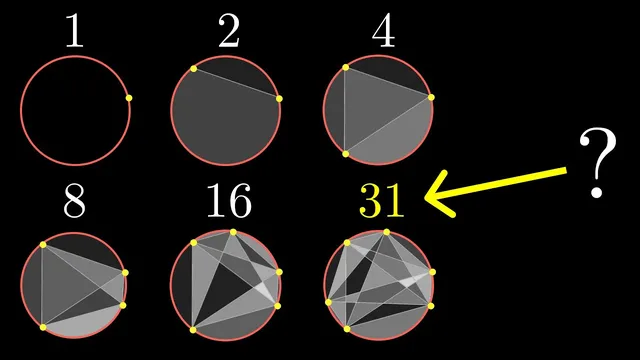
Moser’s circle problem starts with a tempting pattern: draw n points on a circle and connect every pair with a chord, then count how many regions the chords carve out. For n = 1 through 5, the region counts look like powers of two—2, 4, 8, 16—before the pattern “breaks” at n = 6, where the answer lands just one short of the next power of two. The core insight is that this near-miss isn’t random; it comes from a precise counting formula that links chord intersections to Euler’s planar-graph relation, and then connects that formula to partial sums inside Pascal’s triangle.
The setup begins with combinatorics. With n boundary points, the number of chords equals the number of unordered pairs of points: . Intersections are trickier because two chords intersect inside the circle exactly when their endpoints form a set of four boundary points: each choice of four points determines a pair of “diagonal” chords that cross. That yields intersection points.
To count regions, the method uses Euler’s characteristic formula, , but with a crucial adjustment: chords intersect, so the diagram must be treated as a planar graph by promoting each intersection point to a vertex. After “splitting” chords at intersection points, the effective edge count increases. Each original chord is cut at intersection points, and each intersection turns two crossing segments into four smaller ones—netting an increase of two edges per intersection. The resulting counts are: - vertices: - edges: The extra accounts for the circular arcs along the boundary.
Plugging into the rearranged Euler form for the number of bounded regions (excluding the outer face) gives a clean closed form: That formula immediately explains the early power-of-two behavior and the “one short” failure at n = 6.
The power-of-two pattern emerges when the expression is interpreted through Pascal’s triangle. Binomial coefficients appear as entries, and sums of consecutive entries correspond to sums of binomial coefficients. For small n, matches a full row-sum of Pascal’s triangle, which equals a power of two. The first time it fails is n = 6: the relevant partial sum covers all but one term of the corresponding row-sum, producing exactly “one less” than the next power of two. A later coincidence at n = 10 also follows from symmetry in Pascal’s triangle, where the needed partial sum becomes exactly half of a power-of-two total.
In short, Moser’s circle problem is a lesson in pattern recognition with proof: the region counts are governed by , and the near-powers-of-two arise because that expression behaves like a Pascal-triangle row sum—until the partial-sum boundary shifts just enough to miss by 1.
Cornell Notes
Moser’s circle problem asks how many regions a circle is cut into when n points on the boundary are connected by all possible chords. Counting chords gives , and counting interior intersection points gives because each intersection corresponds to a unique set of four boundary points. Treating intersections as vertices turns the picture into a planar graph, letting Euler’s formula produce an exact region count: . The early region counts look like powers of two because this expression matches full row sums in Pascal’s triangle for small n. The first break at n = 6 happens because the relevant Pascal-triangle partial sum misses exactly one term, yielding one less than the next power of two.
Why does the number of chords equal ?
How can the number of intersection points inside the circle be counted as ?
How does Euler’s formula apply when chords intersect?
What exact region-count formula results from the planar-graph counts?
Why do the answers resemble powers of two, and why does the pattern break at n = 6?
Review Questions
- Derive the region formula from the counts of chords, intersections, vertices, and edges.
- Explain why each interior intersection corresponds to a unique set of four boundary points.
- Using Pascal’s triangle, show how becomes a full row sum for small n but not for n = 6.
Key Points
- 1
With n boundary points, the number of chords is because each chord corresponds to an unordered pair of points.
- 2
Each interior intersection corresponds to a unique set of four boundary points, so the number of intersections is .
- 3
To use Euler’s formula, intersections must be treated as vertices so the resulting graph is planar.
- 4
After splitting at intersections, the region count simplifies exactly to .
- 5
The early power-of-two pattern occurs because entries in Pascal’s triangle sum to powers of two.
- 6
The first failure at n = 6 happens because the needed Pascal-triangle partial sum misses exactly one term, producing one less than the next power of two.
- 7
A later power-of-two coincidence at n = 10 follows from symmetry in Pascal’s triangle, turning the relevant partial sum into half of a row sum.