This Secret Principle Will Transform Your Notes
Based on Linking Your Thinking with Nick Milo's video on YouTube. If you like this content, support the original creators by watching, liking and subscribing to their content.
Architect thinking and gardener thinking are both required for creative progress; getting stuck usually means overusing one mode.
Briefing
The core insight is that creative work and problem-solving stall when people stay stuck in only one mental mode—either rigid, top-down “architect” thinking or curiosity-driven, bottom-up “gardener” thinking. Progress comes from deliberately oscillating between the two, and linked notes make that switching reliable by letting ideas move without forcing them into a folder hierarchy.
The talk starts with a Christmas Eve riddle about two trolls—one always truthful, one always lying—guarding two paths labeled happiness and sadness. The puzzle’s deeper point becomes a metaphor: solving requires the right kind of questioning, not just more effort. From there, the framework expands into a practical distinction between tasks and ideas. Tasks are finite and manageable like projects: they begin, end, and can be checked off. Ideas are fuzzy, reusable, and nonlinear—changing one part (like a character’s backstory in chapter one) ripples through everything that follows. Treating ideas like tasks—especially by forcing them into strict systems—tends to fail and can trigger “shiny object syndrome,” the search for a new tool instead of a better way to think.
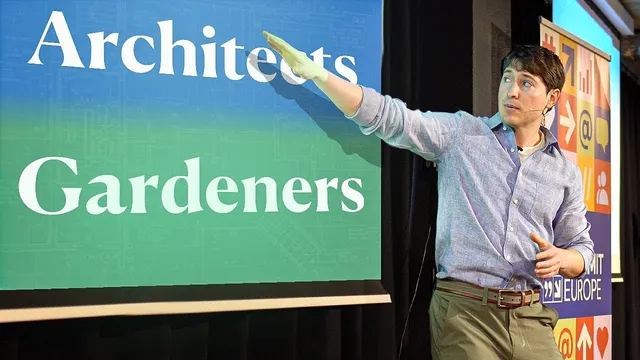
To ground the framework, the talk draws on a duality tradition: Apollo-style (ordered, logical) thinking versus Dionysian-style (emotional, chaotic) thinking. Modern practice maps this to “architects” and “gardeners.” Architects prioritize order, structure, and convergent sense-making—seeing the big picture, categorizing, and planning. Gardeners prioritize curiosity, exploration, and divergent sense-making—following enthusiasm, working with limited information, and generating connections. Both modes are necessary, but each becomes unhealthy when overused: fragile architects can become rigid or paralyzed without enough structure, while scattered gardeners can collect information endlessly without ever developing it.
The practical pivot is how note systems shape thinking. Folder-based organization can “double down” on architectural habits by forcing an idea into a single location, creating friction and delaying emergent insights. Linked notes, by contrast, form a network where ideas can grow in richness over time. Instead of asking “Which folder does this belong in?” linked notes encourage generative questions: “What is this a part of?” (architect), “What does it relate to?” (gardener), and “So what—why do I even care?” (sense-making). The result is “emergent thinking,” where a simple note can evolve into something like an “apple pie,” not just an isolated “apple.”
The talk then offers concrete habits and exercises for moving between modes: making notes actively (not passively copying), using prompts like “hm, that’s interesting because…” and “part of blank / similar to blank / different from blank,” naming notes to frame meaning, and revisiting ideas through a “Garden master” approach—cultivating sparks until they become publishable work. It culminates in a workflow for turning scattered notes into a “map of content,” where clustering creates tension, resolution fills gaps with new insights, and the map seeds future projects.
When people get stuck—confused, overwhelmed, bored—the prescription is mode-switching: if stuck in weeds, switch from gardener chaos to architect perspective by building a map and clustering; if lost in abstraction, stop adding structure and write to re-enter gardener momentum. The final takeaway reframes the opening riddle: the answer is less important than the ability to move between modes and keep solving problems and creative challenges through that oscillation.
Cornell Notes
The talk argues that creativity and problem-solving require both “architect” and “gardener” thinking, and that getting stuck usually means overusing one mode. Architects prefer order, structure, and convergent sense-making; gardeners prefer curiosity, exploration, and divergent sense-making. Folder-based note systems can trap ideas in rigid categories, while linked notes support oscillation by letting ideas connect without forcing them into one place. Linked notes also encourage high-value sense-making questions—what something is part of, what it relates to, and why it matters—so ideas can develop into new insights. The practical goal is to switch modes when stuck: build perspective with maps when overwhelmed, and write when abstraction stalls progress.
Why does the talk treat ideas differently from tasks, and what goes wrong when ideas are managed like tasks?
What are the “architect” and “gardener” modes, and how do unhealthy versions of each show up?
How do folders vs. links change the questions people ask while processing notes?
What does “emergent thinking” look like in a linked-note system?
What practical prompts and behaviors help people oscillate between modes while writing?
How should someone respond when they feel stuck—confused, overwhelmed, or bored?
Review Questions
- How would you diagnose whether you’re overusing architect thinking or gardener thinking in your own workflow?
- What specific questions should linked notes prompt you to ask instead of relying on folder placement?
- Describe a workflow for turning scattered notes into a “map of content” and explain how clustering leads to new insights.
Key Points
- 1
Architect thinking and gardener thinking are both required for creative progress; getting stuck usually means overusing one mode.
- 2
Ideas are nonlinear and fuzzy, so managing them like finite tasks (with rigid checklists and categories) tends to break development.
- 3
Apollo/Dionysian duality maps cleanly to modern practice: order/logic (architect) versus curiosity/exploration (gardener).
- 4
Folder hierarchies can increase friction by forcing exclusivity (“Which folder does this belong in?”), while linked notes support relational sense-making.
- 5
Linked notes enable oscillation through generative questions: “What is this a part of?”, “What does it relate to?”, and “So what—why do I even care?”
- 6
Healthy architect behavior uses convergent thinking with enough looseness for emergent insights; healthy gardener behavior uses divergent thinking that eventually resolves into emergent thinking.
- 7
When stuck, switch modes: build a map and cluster when overwhelmed, or write to regain momentum when abstraction stalls.