This Simple PhD Strategy Feels Almost Unfair…
Based on Andy Stapleton's video on YouTube. If you like this content, support the original creators by watching, liking and subscribing to their content.
Reverse-engineer thesis outcomes in the student’s field by measuring length, figure count, and number of studies, then convert those into a realistic weekly/monthly production cadence.
Briefing
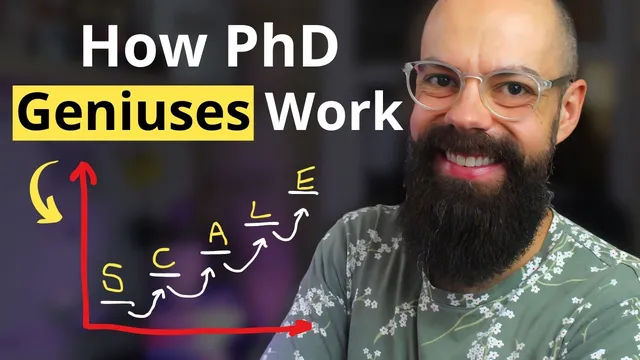
A PhD doesn’t have to feel like an unstructured scramble. A clear five-step “SCALE” blueprint—start with the end in mind, then create, automate, leverage, and exploit expertise—turns the work into a manageable production plan, and it’s designed to reduce stress while improving output.
The framework starts with “S: Start with the end in mind.” That means reverse-engineering what a thesis (or equivalent outcome) looks like in a specific field: typical length, page count, number of figures, and how many distinct studies appear across chapters. By breaking the thesis into components—say, several major studies and a predictable number of figures per study—students can translate an abstract goal into day-to-day targets (for example, producing a figure weekly or monthly). The second layer is career alignment: the PhD’s shape should match what comes after. Academia, industry, and other paths demand different outputs and networking, so students should decide early what “success” looks like at the end of the program and build toward it.
Next comes “C: Create,” which is treated as the engine of progress at three levels. Students must create ideas continuously, then convert those ideas into data, then turn results into publishable outputs—figures, graphs, and papers. The emphasis is on regular cadence: set aside time every week to generate new ideas and produce new data, especially when meeting supervisors regularly so progress is tangible and discussion stays grounded. Outputs are framed as research stories: each one should connect an idea, the supporting data, and a conclusion.
“ A: Automate” pushes the same production pipeline further by reducing repetitive work. The transcript highlights using AI tools for idea generation (semantic search and asking what directions to pursue), for first-pass data analysis and visualization (uploading data to tools like Julius AI to get initial charts and schematics), and for drafting outputs (using tools such as chat GPT canvas or Claude to generate first drafts of research narratives). The key boundary is ethical use—automation should support writing and creation, not replace original thinking or “creation from nothing.”
“L: Leverage” reframes the limited power of a PhD student as time and freedom. The recommended tactic is a multi-threaded project strategy: pursue parallel lines of inquiry so that if one track fails—because an experiment doesn’t work, equipment is unavailable, or results don’t pan out—other tracks keep momentum. This also functions as insurance against a single “book of failure.” The transcript adds the “80/20 principle” as a periodic check: identify which efforts produce most of the required results and cut low-yield work early.
Finally, “E: Exploit expertise” urges students to use the dense knowledge around them. Instead of relying only on reading and literature searches, students should actively seek critical feedback from adjacent experts—senior researchers, postdocs, or tenured professors—by sharing drafts or asking for review. Academics are portrayed as eager to be critical, and those conversations can surface alternative angles and improvements that accelerate readiness for publication.
Taken together, SCALE turns a PhD into a repeatable system: define the destination, keep creating, automate the grind, run multiple bets in parallel, and harvest expert judgment to move faster without wasting time chasing dead ends.
Cornell Notes
The SCALE framework reframes a PhD as a structured production process rather than an open-ended mystery. “Start with the end in mind” means reverse-engineering what a thesis looks like in the field (length, number of figures, number of studies) and aligning the work with the intended post-PhD path (academia vs industry). “Create” is treated as a weekly cycle: generate ideas, turn them into data, and convert results into publishable outputs (figures and papers). “Automate” uses AI tools to speed up idea generation, first-pass analysis/visualization, and draft writing—while keeping the student’s own thinking in control. “Leverage” uses multi-threaded projects and the 80/20 principle to protect time and reduce panic when experiments fail, and “Exploit expertise” means actively seeking critical feedback from nearby experts.
How does “start with the end in mind” translate a thesis into a concrete plan?
Why does the second “start with the end in mind” step change what students should do during the PhD?
What does “create” mean in practice, and how is it supposed to show up weekly?
What kinds of tasks does “automate” target, and what tools are mentioned?
How does multi-threading reduce the risk of a stalled PhD?
What does “exploit expertise” look like as an action students can take?
Review Questions
- What specific thesis characteristics (e.g., figures, studies, page length) should be measured to set production targets, and how do those targets become a weekly plan?
- Describe the three-part “create” pipeline and give an example of how an idea becomes an output (including figures).
- How do multi-threaded projects and the 80/20 principle work together to protect time and reduce failure risk during a PhD?
Key Points
- 1
Reverse-engineer thesis outcomes in the student’s field by measuring length, figure count, and number of studies, then convert those into a realistic weekly/monthly production cadence.
- 2
Align the PhD plan with the intended post-PhD path (academia vs industry vs other careers) so outputs and networking match the destination.
- 3
Treat progress as a continuous pipeline: create ideas, convert them into data, and turn results into publishable outputs (figures and papers).
- 4
Use automation to speed up first-pass work—idea generation, initial analysis/visualization, and draft writing—while keeping original thinking and ethics intact.
- 5
Run multi-threaded research tracks so one failed experiment doesn’t derail the entire PhD timeline.
- 6
Apply the 80/20 principle periodically to cut low-yield effort early and protect the time and freedom that make a PhD valuable.
- 7
Actively seek expert critique by sharing drafts or requesting feedback from adjacent researchers, senior postdocs, or professors.