This tests your understanding of light | The barber pole effect
Based on 3Blue1Brown's video on YouTube. If you like this content, support the original creators by watching, liking and subscribing to their content.
Polarized light entering sugar water experiences a polarization twist that varies with frequency, with violet rotating faster than red.
Briefing
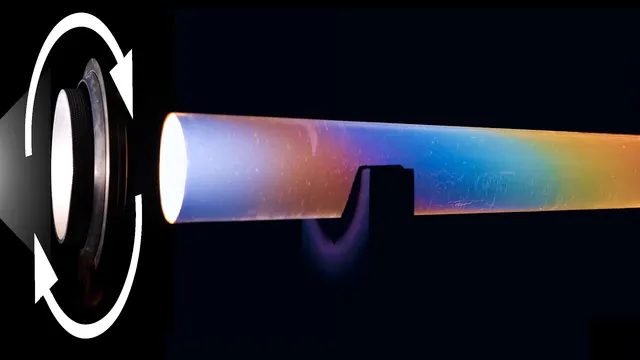
A cylinder of sugar water can turn ordinary white light into a striking pattern of moving color bands—diagonal stripes that seem to “walk” up the tube—after the light passes through a polarizer, the sugar solution, and a second polarizer. The key observation is that the sugar solution twists the polarization direction at a rate that depends on color (frequency). Because different colors rotate at different speeds, a second polarizer converts that hidden polarization separation into visible color changes, and rotating either polarizer shifts which hues dominate.
The setup begins with white light filtered into linearly polarized light, meaning the electric-field “wiggling” is constrained to a single direction (for instance, up-and-down). That polarized wave then travels through a cylinder filled with sugar water. As it propagates, the polarization direction does not stay fixed: it gradually rotates (twists) as you move along the tube. Crucially, the twist rate is frequency-dependent—violet light rotates faster than red. When white light enters, it is effectively a bundle of many pure frequency components. Each component twists at its own pace, so by the time the light reaches the far end, the polarization directions associated with different colors are no longer aligned with each other.
Despite this internal separation, looking straight through the tube toward the lamp would still appear white, because the overall amounts of each color remain balanced. The visible color only emerges when a second linear polarizing filter is placed after the sugar water. That filter acts like a selector: for each frequency component, the transmitted intensity is proportional to how well its polarization aligns with the filter’s axis. Colors whose polarization directions line up with the second filter pass strongly; those that end up more perpendicular pass weakly. The output therefore becomes an imbalanced mixture of frequencies—so the light leaving the tube is no longer white but colored.
Rotating the initial polarizer changes the starting polarization direction for every frequency component, which changes which colors later align with the second filter. Rotating the second filter has a similar effect, shifting the alignment criterion and producing a different output hue. The experiment can be replicated with dense sugar water and two polarizing filters.
The most puzzling part is not the color change itself but the geometry of the pattern: when viewed from the side, the tube displays diagonal stripes. That raises a deeper question because, at any fixed position along the tube, the light is still balanced across colors (white when viewed from the front). So why does the side view reveal color bands at all, and why do they come out diagonal rather than symmetric top-to-bottom? Addressing that requires more than the twist-and-filter story; it calls for intuitions about how sugar’s molecular handedness (sucrose is chiral) interacts differently with right- versus left-handed circular polarization, how refractive slowdown depends on frequency, and how scattering depends on polarization direction. The explanation is framed as a chain of optical principles that make the stripes feel like an inevitable consequence of what light and matter do to each other.
Cornell Notes
Polarized light entering sugar water experiences a polarization twist that depends on frequency: violet rotates faster than red. White light can be treated as a sum of many pure frequency components, and each component’s polarization direction rotates at its own rate as it travels down the tube. By itself, this doesn’t make the light look colored when viewed straight through, because the color intensities remain balanced. A second linear polarizer converts the polarization separation into visible color by transmitting each frequency according to how aligned its polarization is with the filter axis. Rotating either polarizer changes the alignment conditions and therefore changes the output hue. The side-view diagonal stripes add a further puzzle that points to polarization-dependent scattering and the chiral nature of sucrose.
Why does sugar water twist the polarization direction, and what role does chirality play?
How can different colors end up with different polarization directions even though the light still looks white straight through?
What does the second polarizing filter do that makes color appear?
Why does rotating the first or second polarizer change the observed hue?
What makes the diagonal side stripes especially puzzling, and what physics is likely behind them?
Why would the twist rate depend on frequency (violet vs. red)?
Review Questions
- How does a second linear polarizer turn polarization separation into a visible color change, even when the light would look white without it?
- Explain why violet and red can end up with different polarization directions after traveling through the sugar solution.
- What additional mechanism beyond “twist plus filtering” is needed to account for diagonal stripes seen from the side?
Key Points
- 1
Polarized light entering sugar water experiences a polarization twist that varies with frequency, with violet rotating faster than red.
- 2
White light can be treated as a sum of many pure frequencies; each frequency’s polarization direction rotates at its own rate along the tube.
- 3
A direct view through the tube can still look white because the color intensities remain balanced even when polarization directions separate.
- 4
A second linear polarizer makes the separation visible by transmitting each frequency according to how its polarization aligns with the filter axis.
- 5
Rotating either polarizer changes the alignment conditions and therefore changes the output hue.
- 6
Diagonal stripes in a side view suggest polarization-dependent scattering, not just front-view color selection.
- 7
Explaining the twist and its frequency dependence requires ideas tied to sucrose’s chirality and frequency-dependent propagation (refractive slowdown).