This Texture Pack Makes Minecraft Run Faster!
Based on MattVidPro's video on YouTube. If you like this content, support the original creators by watching, liking and subscribing to their content.
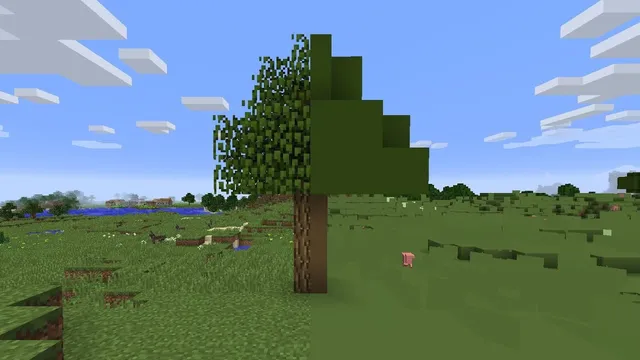
The “Pixel Pack 1.12” is a real 1x1 texture pack where most textures become single-color, one-pixel images rather than a visual approximation.
Briefing
A 1x1 “one pixel” Minecraft Java texture pack—specifically the “Pixel Pack 1.12”—turns nearly every block, item, and entity texture into a single solid color, creating a “Play-Doh land” look while dramatically reducing texture data. The core tradeoff is visual detail: up close, grass, dirt, animals, tools, and most world elements lose their pixel art shading and become flat, but from a distance the world can still read as “normal enough.” The pack is described as a real 1x1 texture set (not a fake approximation), downloaded at about 2 MB—far smaller than typical high-resolution packs that can reach hundreds of megabytes.
The most noticeable effects show up immediately. Water loses animation because there’s effectively nothing to animate beyond a single pixel. Particles are reduced to single-pixel effects, including torch particles and water-related visuals. Mobs and entities—like chickens—appear as solid-color shapes with minimal detail. Tools remain functional but look extremely simplified; tooltips become especially important because the visuals alone won’t reliably communicate what something is. Even gameplay readability in caves drops sharply: entering underground areas makes it hard to distinguish blocks, since textures no longer provide cues.
Despite the aesthetic downgrade, the performance case is the pack’s main selling point. With textures at the lowest physically possible resolution (1x1), the pack is presented as a way to maximize frame rate—particularly for players chasing the highest possible Minecraft performance. The creator also notes that this approach is unlikely to help for competitive PvP, where item and tool clarity matters; the diamond sword and armor look too crude to be useful compared with normal PvP-focused texture packs.
The transcript also highlights a few quirks and comparisons. Golden apple textures still show animation, suggesting not every element is strictly reduced to a static single pixel. Glass is mentioned as not appearing to be 1x1, implying some textures may behave differently or be handled in a way that preserves functionality. The pack’s look is compared to a similar “Minecraft plastic texture pack” associated with Mojang for console versions, which keeps the same general simplified style but stays at 16x16.
Beyond performance, the pack is framed as a creative tool: it could make green screens easier for showcasing builds or contraptions, and it can serve as a challenge mode by making blocks nearly impossible to identify without tooltips. The result is a Minecraft world that’s visually stripped to essentials—faceless pigs, single-pixel sun and clouds, and simplified lighting cues—while remaining playable, if more confusing and demanding for building and mining.
Cornell Notes
A 1x1 “Pixel Pack 1.12” replaces most Minecraft textures with single-color, one-pixel images, producing a flat “Play-Doh” look while keeping the game functional. The pack is small (about 2 MB) and is positioned as a performance boost because texture resolution is at the minimum possible level. Visual clarity drops sharply: caves become hard to read, mobs and tools look simplified, and many animations disappear—water has no animation and particles become single pixels. Some exceptions appear, such as golden apple animation and glass behaving differently than a strict 1x1 texture. It can also be used for creative experiments (like easier green screens) or as a challenge when tooltips are disabled.
Why does a 1x1 texture pack change gameplay feel so much, even when blocks still exist and mechanics still work?
What performance benefit is claimed for 1x1 textures, and what’s the logic behind it?
Which in-game effects are most visibly affected by the lack of texture detail?
Are all textures treated as strict 1x1, or are there exceptions?
Why might this pack be a poor fit for PvP compared with normal PvP texture packs?
What creative or challenge uses are suggested beyond performance testing?
Review Questions
- What specific visual cues disappear with 1x1 textures, and how does that affect tasks like mining or building?
- Which effects in the transcript are explicitly described as losing animation, and why would 1x1 textures cause that?
- What exceptions to the strict 1x1 rule are mentioned (e.g., golden apple, glass), and what do they imply about how Minecraft handles certain textures?
Key Points
- 1
The “Pixel Pack 1.12” is a real 1x1 texture pack where most textures become single-color, one-pixel images rather than a visual approximation.
- 2
The download size is about 2 MB, far smaller than many larger texture packs that can reach hundreds of megabytes.
- 3
Water animation disappears and particle effects (like torches) are reduced to single-pixel visuals, reflecting the limits of one-pixel textures.
- 4
Block and mob readability drops sharply—especially in caves—making tooltips more important for identifying materials and tools.
- 5
The pack is positioned as a performance-maximizing option because it uses the minimum possible texture resolution, which should reduce texture rendering workload.
- 6
It’s not recommended for PvP because simplified item visuals (e.g., diamond sword and armor) reduce clarity compared with dedicated PvP packs.
- 7
Beyond performance, the simplified look can support creative workflows like green screens and can function as a challenge when tooltips are disabled.