This Unstoppable Robot Could Save Your Life
Based on Veritasium's video on YouTube. If you like this content, support the original creators by watching, liking and subscribing to their content.
The vine robot grows from its tip by inflating folded airtight tubing with compressed air, enabling motion through tight, curvy spaces.
Briefing
A plant-inspired “vine robot” can extend from its tip using compressed air, letting it squeeze through tight spaces, keep moving even after punctures, and—when equipped with cameras or other tools—perform tasks that are hard or dangerous for people. The core breakthrough is a soft, inflatable structure that grows like a living tendril while staying compliant enough to avoid injuring obstacles, yet still capable of generating large forces through low pressure applied over a wide area.
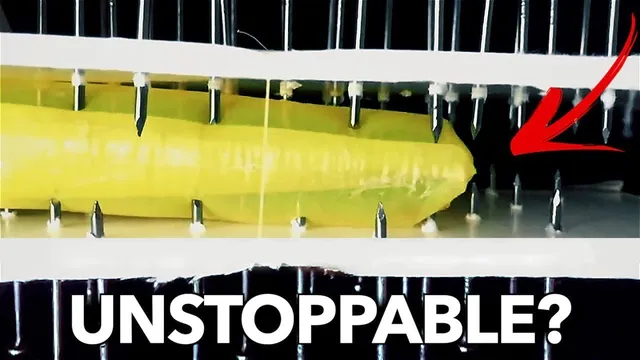
The robot’s backbone is simple: airtight tubing folded in on itself and inflated so that growth happens from the tip. That design lets it navigate curvy, twisted passages and pass over sticky surfaces where wheels or rigid probes would get stuck. Even if it’s punctured, it can continue as long as internal pressure remains sufficient. Steering is added by controlling how the robot’s sides inflate and deflate—either with artificial muscles or with pneumatic muscles made from ripstop nylon fabric—so shortening one side and lengthening the other bends the growing body toward the desired direction.
A key engineering challenge is attaching a camera to something that keeps extending. One solution uses an end cap that holds the camera at the front while the robot pushes it from behind. Another uses interlocking external and internal frames, similar to how roller-coaster wheels track along a rail, preventing the camera from slipping off as the robot grows.
The force capability is demonstrated with a “pillow” section that inflates as the robot extends. It can lift substantial weight—on the order of 1000 kilograms—using only about a tenth of atmospheric pressure over a large area. The explanation hinges on pressure physics: large overall force comes from multiplying low pressure by a sufficiently wide surface area, while the structure remains soft.
Those properties translate into real-world use cases. In Peru, the vine robot was deployed to explore narrow tunnels at an ancient Andean temple site dating between 1500 and 500 BC—tunnels too small for people to enter. The robot successfully investigated multiple ducts and returned video to the archaeology team. For medical applications, a miniature version targets intubation, aiming to make the procedure faster and safer by using passive mechanical intelligence: the robot grows down the esophagus and a flexible side branch naturally seeks the trachea opening. It has been tested in a cadaver lab and shown to intubate in an in-vivo setting.
The same tip-extension concept also tackles burrowing. By blowing compressed air, the robot can fluidize sand or soil enough to reduce resistance, allowing it to advance without relying on friction-heavy “hammering.” That matters for planetary science: NASA’s Mars InSight lander struggled with a heat probe that couldn’t penetrate cohesive material, partly due to insufficient friction. A vine robot’s approach—starting at the surface and extending downward—could avoid getting stuck in the same way.
Overall, the vine robot’s appeal is that one compact, low-pressure, soft-growing mechanism can be adapted for search and rescue, archaeology, medical procedures, and even exploration—without requiring the robot to be rigid, puncture-proof, or pre-shaped for every environment.
Cornell Notes
The vine robot grows from its tip by inflating folded airtight tubing with compressed air, producing a soft, compliant body that can squeeze through tight spaces and continue moving even after punctures if pressure is maintained. Steering comes from controlling side inflation using pneumatic muscles, allowing the robot to bend toward a target without becoming rigid. Large lifting forces are possible because low pressure over a large area can generate high total force while the robot still feels soft. With added tools like a camera, it has been used to explore narrow archaeological tunnels in Peru and is being developed for medical intubation using passive path-finding. The same principle also supports burrowing in sand and could help planetary missions where rigid probes get stuck.
What physical mechanism lets the vine robot keep moving through tight spaces and sticky obstacles?
Why doesn’t puncturing automatically stop the robot?
How is steering achieved in a robot that keeps extending?
How can a camera stay attached to something that grows continuously?
What makes the robot capable of lifting heavy loads while remaining soft?
How does the robot handle burrowing in sand or soil?
Review Questions
- How does tip-extension differ from rigid probe strategies when navigating unknown or narrow environments?
- What design choices allow a camera to remain attached to a continuously growing soft robot?
- Explain how low pressure can still produce large lifting forces in the vine robot’s “pillow” section.
Key Points
- 1
The vine robot grows from its tip by inflating folded airtight tubing with compressed air, enabling motion through tight, curvy spaces.
- 2
Soft compliance helps it avoid getting stuck on obstacles like sticky surfaces and reduces injury risk compared with rigid tools.
- 3
Steering is implemented by independently controlling side inflation using pneumatic muscles, bending the robot by shortening one side and lengthening the other.
- 4
A camera can be kept attached during growth using mechanisms such as an end cap or interlocking internal/external frames that prevent slippage.
- 5
The robot can generate large forces while staying soft because low pressure applied over a large area can produce high total lift.
- 6
In Peru, the robot explored narrow archaeological tunnels and delivered video to researchers where human entry was impossible.
- 7
Air-jet fluidization supports burrowing in sand and may offer an alternative to friction-dependent planetary probes that can get stuck.