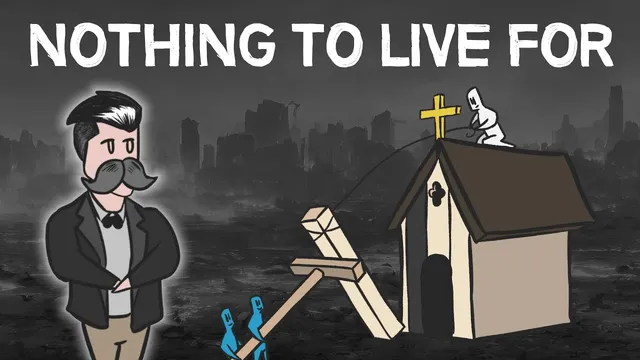
This world is a mess… and Nietzsche saw it coming.
Based on Einzelgänger's video on YouTube. If you like this content, support the original creators by watching, liking and subscribing to their content.
Nietzsche’s “God is dead” is treated as a warning about the loss of meaning, not just religious belief.
Briefing
Nietzsche’s warning about secularization is framed as a testable prediction: as Christianity fades, Western societies risk sliding into nihilism—an existence focused on safe, short-term gratification rather than enduring purpose. The core claim is that religion once supplied more than doctrine; it provided an overarching meaning system, a moral framework, and social cohesion. Without a comparable replacement, people may lose the “why” that organizes life, leaving a vacuum that can be filled by shallow substitutes or darker obsessions.
The discussion begins with Nietzsche’s feared consequence of “God is dead”: not merely religious decline, but the collapse of meaning into moral and existential emptiness. Even though Nietzsche criticized what he called “slave morality” in Christianity, he still treated religion as a stabilizing force. The argument is that once people free themselves from church authority, they often lack an equally robust alternative capable of delivering the same benefits—guidance, moral grounding, and a sense of belonging. In that vacuum, nihilism becomes plausible: life narrows to pleasure, comfort, and routine, with no higher purpose to justify sacrifice or growth.
To illustrate Nietzsche’s “Last Man,” the transcript draws on Thus Spoke Zarathustra’s image of a species that makes everything small and claims to have “discovered happiness.” The “Last Man” is portrayed as someone who prefers predictability and avoids meaningful challenges—working repetitive jobs, consuming entertainment, and treating contentment as enough. A modern cultural analogy is offered through Fight Club’s Narrator and Tyler Durden’s description of a world without great crises, where the “great depression” is spiritual and daily life feels empty.
The transcript then pivots to contemporary secular life, arguing that the old religious infrastructure once handled guidance, marriage, funerals, charity, and even everyday social contact. Today, those functions are scattered across therapists, books, online communities, podcasts, and competing spiritual options—ranging from astrology and new age movements to imported religions and even fitness culture. The same search for meaning can also turn unhealthy: an example is the internet’s fixation on appearance, where jawlines, height, and “chin strength” become moralized status markers, replacing character-based values with superficial traits.
Yet the conclusion is not a simple “collapse” narrative. Highly secular countries like the Netherlands are described as still thriving in areas such as technology, healthcare, innovation, and environmental awareness. Still, the transcript acknowledges real costs: rising depression—especially among younger people—and widespread struggles with meaning. The final question is left open: has Nietzsche’s nihilist future arrived, or is society adapting faster than his worst-case scenario predicted?
Cornell Notes
The transcript treats Nietzsche’s “God is dead” as a warning about what happens when religion stops supplying meaning, morality, and social cohesion. Nietzsche is presented as fearing not Christianity’s flaws, but the lack of a strong replacement once church authority fades. His “Last Man” becomes the emblem of nihilism: a life of safe routine, short-term pleasures, and no drive toward greatness. Contemporary secular life is used as evidence-by-analogy—religious guidance is replaced by therapy, podcasts, online content, and alternative spiritualities, while some people substitute superficial status markers (like appearance obsession) for deeper values. The ending balances concern with counterevidence: secular societies may not collapse, but mental health problems and meaninglessness remain serious risks.
Why does Nietzsche fear secularization even though he criticizes Christianity?
What is the “Last Man,” and how does it represent nihilism?
How does the transcript connect Nietzsche’s ideas to modern life?
What examples are used to show how meaning can be replaced—or distorted—in a secular world?
Does the transcript claim secularization has already produced catastrophe?
Review Questions
- How does the transcript distinguish Nietzsche’s critique of Christianity from his fear of religion’s disappearance?
- What behaviors and values define the “Last Man,” and why are they linked to nihilism?
- What evidence does the transcript use to argue that secular societies both avoid collapse and still face serious meaning-related harms?
Key Points
- 1
Nietzsche’s “God is dead” is treated as a warning about the loss of meaning, not just religious belief.
- 2
Religion is described as supplying moral grounding and social cohesion; secularization risks leaving a vacuum without an adequate replacement.
- 3
The “Last Man” symbolizes nihilism through safe routine, short-term pleasure, and avoidance of meaningful challenge.
- 4
Modern secular life replaces church-centered guidance with fragmented alternatives like therapy, podcasts, online communities, and competing spiritual movements.
- 5
When ultimate meaning is missing, some people substitute superficial status systems—such as appearance obsession—for deeper ethical values.
- 6
Secular societies are portrayed as still functioning and even thriving in areas like healthcare and innovation, but mental health concerns (notably depression) remain significant.
- 7
The transcript ends with an open question: whether humanity will adapt to a post-religious world or slide further toward nihilism.