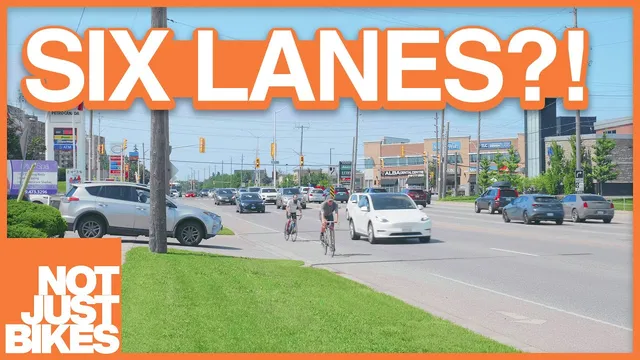
Throwing Good Money After Bad Car Infrastructure - Wonderland Road
Based on Not Just Bikes's video on YouTube. If you like this content, support the original creators by watching, liking and subscribing to their content.
London, Ontario planned to widen Wonderland Road to a larger multi-lane “strode,” with a latest estimate above $212 million, to address congestion.
Briefing
London, Ontario’s proposed widening of Wonderland Road—an eight-kilometre stretch planned to expand from a five-lane to a seven-lane “strode”—was framed as a major fix for congestion, but a climate-focused review and a decisive council vote moved the project toward cancellation. The core finding is that adding road capacity would likely trigger induced demand, worsening long-term traffic while locking the city into a costly, decades-long maintenance burden—an outcome that would undermine both climate goals and day-to-day street life.
Wonderland Road already carries more than 45,000 vehicles per day and functions as a hostile corridor for anyone outside a car: wide asphalt, minimal greenery, dangerous crossings, and a built environment that discourages walking and cycling. The planned expansion would have meant more space for general traffic, more construction, and a larger “maintenance liability,” with the project’s latest estimate coming in at over $212 million. Even if traffic improved briefly after construction, the logic of induced demand predicts that new capacity would attract additional trips rather than reduce congestion permanently.
The most consequential turn came when London city staff issued a report that evaluated upcoming transportation projects through a climate lens. The report flagged that widening to accommodate general traffic would increase greenhouse-gas emissions, produce induced travel demand without meaningful mode shift, and fail to address congestion in a lasting way. It also warned that widening to six lanes would harm the streetscape and reduce connectivity and accessibility across the corridor.
London City Council then voted 9–5 to cancel the road widening project and to treat congestion as part of a broader mobility master plan. That decision matters because it signals a shift from “paving the earth” toward planning that accounts for environmental impacts and street performance beyond vehicle throughput.
The transcript also contrasts Wonderland Road with a similar-width street in Amsterdam, where protected cycling space, frequent transit priority (bus/tram lanes), generous sidewalks, street trees, and safer crossing design make the corridor both more pleasant and easier to navigate. Using a transit street design guide graphic, the argument is that a single lane’s carrying capacity varies by mode—and that even conservative assumptions suggest the Amsterdam-style street can move far more people than a car-dominated strode while improving safety and attractiveness.
Still, the cancellation isn’t treated as a complete victory. The transcript criticizes “complete street” rhetoric that often results in car-first designs with token bike space, and it points to London’s broader transit challenges: buses stuck in mixed traffic won’t attract riders, and sprawling, single-family development patterns make high-quality, transit-supportive networks harder to build. The call is for transit with its own right-of-way and mixed-use, walkable development around it—so future mobility plans don’t keep repeating the same cycle of expensive road expansions that fail to solve congestion and deepen climate and quality-of-life problems.
Cornell Notes
London, Ontario’s plan to widen Wonderland Road from a five-lane to a larger multi-lane “strode” was challenged on climate and congestion grounds. The key claim is that added road capacity would be consumed by induced demand, leading to only short-lived traffic relief followed by a return to congestion—plus a long-term maintenance and environmental cost. A city staff report using a climate lens warned that widening would increase greenhouse-gas emissions, encourage additional trips, and worsen streetscape connectivity. London City Council voted 9–5 to cancel the widening and fold congestion into a wider mobility master plan. The broader lesson: congestion and climate goals require mode shift and transit-oriented street design, not more general-traffic lanes.
Why does widening a road often fail to reduce congestion long-term?
What makes Wonderland Road a particularly car-hostile corridor?
How did the climate-focused review change the political outcome?
What does the Amsterdam comparison add to the argument?
Why isn’t transit automatically a solution if buses share the same traffic as cars?
What broader planning issue does the transcript suggest London must confront?
Review Questions
- What is induced demand, and how does it predict the long-term outcome of road widening?
- Which specific design features in the Amsterdam comparison are presented as making streets safer and more efficient for non-drivers?
- Why does the transcript argue that transit needs its own right-of-way rather than relying on buses operating in mixed traffic?
Key Points
- 1
London, Ontario planned to widen Wonderland Road to a larger multi-lane “strode,” with a latest estimate above $212 million, to address congestion.
- 2
Wonderland Road already carries over 45,000 vehicles per day and is described as dangerous and uncomfortable for walking and cycling.
- 3
Induced demand is presented as the central reason widening would not solve congestion permanently, despite short-term improvements after construction.
- 4
A climate-lens staff report warned that widening would increase greenhouse-gas emissions, encourage additional trips, and worsen streetscape connectivity.
- 5
London City Council voted 9–5 to cancel the widening and treat congestion within a broader mobility master plan.
- 6
The transcript contrasts car-first corridor design with an Amsterdam-style street that combines protected cycling, safer crossings, street trees, and dedicated bus/tram space.
- 7
Transit is portrayed as ineffective when it shares the same congested lanes as cars; the solution requires right-of-way and transit-supportive, mixed-use development.