Time Travel in Fiction Rundown
Based on minutephysics's video on YouTube. If you like this content, support the original creators by watching, liking and subscribing to their content.
Time travel stories can be sorted by whether they preserve self-consistency (the traveler was always there) or create branching timelines (the traveler changes history).
Briefing
Time travel in fiction matters less for its “how” and more for what it does to causality—whether it preserves a single consistent history or splinters reality into new timelines. A useful way to sort stories is by two questions: does the time traveler exist at the moment history “first” happens (creating self-consistency), and who gets free will to steer events onto a different trajectory.
One major category keeps the timeline locked. In Orson Scott Card’s Ender’s Game, travelers experience slower time near light speed, so only days or months pass for them while years elapse on Earth and other planets. The key effect is rate-shifting, not paradox: the past can’t be “changed” because the events form one consistent historical trajectory. The original Planet of the Apes uses extreme time dilation for a similar outcome—astronauts arrive to a future that ultimately turns out to be Earth, implying the history they lived through is already baked into the universe.
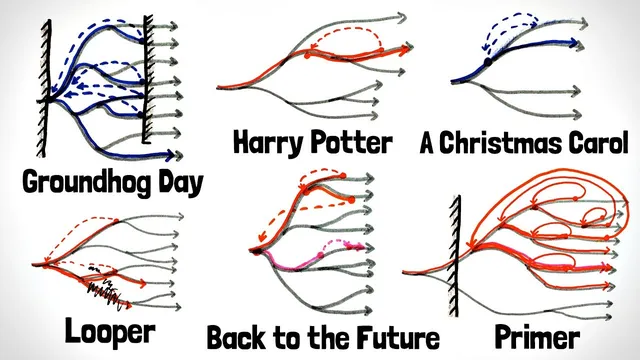
A second locked-in style is “do-over” time travel, where the traveler can replay events from the same starting point but only they retain memory of prior attempts. Groundhog Day relives the same day repeatedly: Bill Murray’s character can make different choices each loop, yet always returns to the same moment until he finds the exact set of actions that breaks the cycle. A Christmas Carol is treated as analogous because Scrooge can learn from a future he can’t directly alter while “visiting,” then apply that knowledge to change his behavior in the present—effectively getting a reset without rewriting the visited timeline.
Other stories branch. In Braid, rewinding can be limited by “immune” elements, and the game also features a split where the past self continues without free will while the time-traveling self can change outcomes. Corridor Digital’s Clock Blockers follows a similar logic: the act of going back creates a new causal path because the traveler’s earlier version is trapped in the original run.
“Anything goes” time travel makes branching the default. Bill & Ted’s Excellent Adventure, Back to the Future, and Star Trek First Contact allow rapid jumps to different eras, potentially creating multiple versions of the self. In Back to the Future, Marty’s interference with his parents’ relationship redirects history toward a future where he doesn’t exist, causing him to fade from photos and reality; even after correcting the big deviation, smaller interactions still shift who his parents become. Looper adds a recursive twist: when the future sends a younger version back, changes ripple in ways that can overwrite bodies and memories, including cases where a lost body part appears replaced by an older scar.
Primer pushes the branching idea to an extreme nested structure—time travel inside time travel—while also imposing practical rules: traveling back takes real time, and you can’t go earlier than the first activation of a given machine. Harry Potter and the Prisoner of Azkaban takes the opposite approach: it uses instantaneous jumps without new timelines by ensuring the “time-traveling clone” was already present doing the same actions. That overlap removes free will for the traveler during the shared interval, producing a single consistent timeline where the past can’t be changed because it already happened.
The throughline is that coherent rules make consequences believable. Without constraints, events become meaningless and character stakes collapse. That logic also underpins Corridor Digital’s YouTube Red Original Series Lifeline: deaths in the future trigger messages back to the present, enabling people to jump forward to moments just before a death and alter history—until the system inevitably goes wrong.
Cornell Notes
Fictional time travel is best understood through causality rules, not mechanics. A central split is whether time travelers are present when history “first” happens (self-consistency) or whether their actions create a new timeline. “Do-over” stories like Groundhog Day and A Christmas Carol let the traveler replay events from the same point while only they retain memory, so the reset changes choices without rewriting the visited future. Branching timelines appear in works like Back to the Future and Looper, where past actions redirect history and can even loop back into the present with recursive consequences. Harry Potter and the Prisoner of Azkaban avoids branching by having the past already contain the traveler’s future self, making the past unchangeable during overlap.
What two questions does the transcript use to classify time travel stories?
Why is Ender’s Game treated as “realistic” time travel in terms of plot causality?
How does “do-over” time travel work in Groundhog Day and how does it differ from branching timelines?
What causality problem does Back to the Future illustrate when timelines branch?
How does Looper add complexity beyond simple branching?
What makes Harry Potter and the Prisoner of Azkaban’s time travel logically consistent?
Review Questions
- Which causality model—self-consistency, do-over loops, or branching timelines—best fits a story where a traveler’s actions create a future that contradicts their original memories?
- In a self-consistent model, why does overlap between the traveler and their past self reduce or eliminate free will?
- What practical rule in Primer limits how far back a time machine can send someone, and how does that prevent certain paradoxes?
Key Points
- 1
Time travel stories can be sorted by whether they preserve self-consistency (the traveler was always there) or create branching timelines (the traveler changes history).
- 2
A second sorting axis is free will: some models restrict whose actions can redirect outcomes.
- 3
“Do-over” time travel (Groundhog Day, A Christmas Carol) replays the same starting point while only the traveler retains memory, making character growth hinge on repeated choices.
- 4
Branching models (Back to the Future, Looper) treat past actions as causal rewrites that can erase the traveler’s existence and alter who other people become.
- 5
Primer combines nested time travel with hard constraints: traveling back takes real time, and you can’t go earlier than the machine’s first activation.
- 6
Harry Potter and the Prisoner of Azkaban avoids new timelines by ensuring the future self’s actions were already part of the past, making the past effectively unchangeable during overlap.
- 7
Believable character stakes usually require consistent “rules” so consequences feel meaningful rather than random.