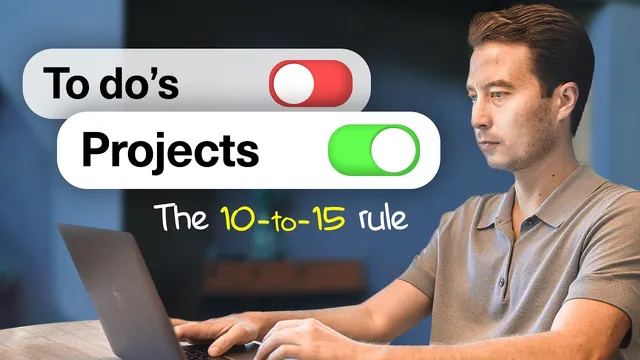
Too Many Projects? The 10-to-15 Rule Will Save You!
Based on Tiago Forte's video on YouTube. If you like this content, support the original creators by watching, liking and subscribing to their content.
Create a complete inventory of active commitments by brainstorming and then checking email, calendar, and to-do lists for hidden project signals.
Briefing
A practical project-listing method—capped at 10 to 15 active items—can restore focus by turning vague commitments into clear, time-bound outcomes. The core idea is simple: every active project needs a dedicated “place” in a project list, and that list must be small enough that progress stays visible week to week. Too many projects quietly kills momentum; too few can leave someone stuck when a task stalls, fatigue hits, or external factors intervene.
The process starts by generating a comprehensive inventory of current commitments. Instead of judging ideas immediately, the method has people brainstorm everything they’re working on—then mine other sources for additional project signals. Email threads can reveal ongoing work (like drafting an article with a collaborator or handling estate-planning paperwork with a lawyer). Calendar events and recurring items can surface larger goals hiding inside routine life (a visit to a kiteboarding school becomes a “learn kiteboarding” project; meetings about a home studio lead to an article about what was learned building it; a recurring fitness routine becomes a manageable project only if it has a defined outcome). A to-do list also serves as a trapdoor for “invisible projects,” such as taxes, home additions, reading goals, or time with a child.
Once the list exists, the 10-to-15 rule becomes the filter. The sweet spot matters because it balances two failure modes. With more than about 15 projects, visible progress becomes unlikely, belief erodes, and projects get abandoned. With fewer than about 10, motivation can’t always compensate for real-world stalls—so the list should include enough alternatives to switch to when one project hits a wall.
If the list is too long, the method recommends identifying “false projects” and removing them. Dreams, hobbies, and open-ended areas of responsibility often sneak in because they feel important, but they lack the structure required for project management. Dreams have no deadline; hobbies may have no concrete outcome; areas (like health, family, finances, or career) are ongoing responsibilities that never truly “finish.” The method also flags “mega projects” that are too big to manage as a single short-term item—writing a book, for instance, is treated as a collection of smaller sub-projects (finding an agent, securing an editor, developing a proposal). The fix is to replace the oversized item with a near-term, completion-based sub-project such as increasing book pre-orders.
After removing false projects and breaking down unwieldy ones, the list should land inside the 10 to 15 range. If it still exceeds 15, the least urgent items should be pushed to a future list to reduce distraction—or used as a prompt to renegotiate commitments and learn to say no. The end state is a project list with clearly defined, short-term outcomes and no open-ended placeholders that blur priorities.
Cornell Notes
The 10-to-15 rule keeps an active project list small enough to sustain momentum while still providing backup options when one project stalls. Start by collecting every current commitment from brainstorming, email, calendar, and to-do lists, then define each item as a project only if it has a clear outcome and a deadline or rough timeline. If the list is too long, remove “false projects” such as dreams (no deadline), hobbies (no concrete outcome), and areas (ongoing responsibilities that never truly end). Also break “mega projects” into smaller sub-projects with near-term completion points, like replacing “write a book” with a shorter step such as increasing pre-orders. The goal is a focused set of 10–15 achievable projects with visible progress each week.
Why does the method insist on a 10-to-15 range for active projects?
How does someone turn a messy set of commitments into a usable project list?
What counts as a “false project,” and how should it be handled?
Why are “mega projects” treated differently from normal projects?
What should happen if the list still has more than 15 items after cleanup?
Review Questions
- What two risks does the 10-to-15 rule try to balance, and how does each risk show up in day-to-day work?
- Give an example of an item that would be a false project (dream, hobby, or area) and explain what feature makes it fail the project definition.
- How would you break a mega project into sub-projects so that each sub-project has a clear next action and a near-term completion point?
Key Points
- 1
Create a complete inventory of active commitments by brainstorming and then checking email, calendar, and to-do lists for hidden project signals.
- 2
Treat an item as a project only when it has both a clear outcome and a deadline or rough timeline.
- 3
Use the 10-to-15 rule to keep enough projects for backup options while preventing progress from becoming invisible.
- 4
Remove false projects—dreams (no deadline), hobbies (no concrete outcome), and areas (ongoing responsibilities that never truly end).
- 5
Break mega projects into smaller sub-projects that can finish within weeks or months, then use each completion to trigger the next step.
- 6
If the list still exceeds 15, defer the least urgent items to a future list or renegotiate commitments to reduce scope.