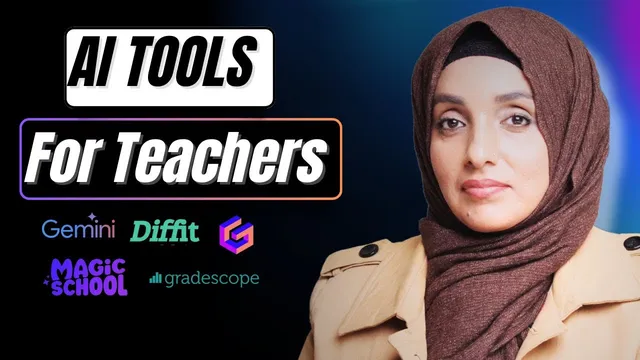
Top 5 Game-Changing AI Tools for Teachers (Use in FREE)
Based on Dr Rizwana Mustafa's video on YouTube. If you like this content, support the original creators by watching, liking and subscribing to their content.
Magic School AI can generate 5E lesson plans, science lab instructions, 3D dimensional science assessments, and real-world connection prompts from grade level and topic inputs.
Briefing
AI tools are moving quickly into classrooms, and five platforms stand out for helping teachers plan lessons, generate assessments, and speed up instructional materials. The biggest practical value across the list is automation paired with teacher control: lesson plans, lab instructions, reading-level adjustments, grading workflows, and slide decks can all be produced from prompts—then exported, edited, and reused.
Magic School AI is positioned as a teacher-focused workspace built around five core features: 5E model lesson plans, science labs, 3D assessments, and real-world connections. After signing up as a student or educator and selecting grade level and field of study, teachers can generate a complete 5E lesson plan by entering a topic and adding details. The output includes objectives, materials, an Engage-to-Explain learning flow, and assessment components such as quizzes and queries. For science, the science lab feature generates an instruction plan and conduction plan, including objectives, required materials, safety precautions, procedures, reflection questions, and assessment prompts—then allows export to Microsoft Word or PDF. The 3D dimensional science assessment feature adds scenario-based questioning: teachers choose grade level, number of questions, and stimulus type, then provide a topic (including NGSS standard information). The resulting assessment uses a stimulus scenario and asks questions that target specific understanding, with suggested questions and guidance on what information students should include for scoring. Real-world connection prompts extend the same topic into applications teachers can use in lectures or assessments.
DFT AI shifts the workflow toward comprehension and accessibility. It adjusts the reading level of text so students can understand materials more quickly, while also supporting instructors during assessment. Teachers can feed the tool a document type—such as a PDF, YouTube video, or web page—then receive structured outputs including key vocabulary, “three things you may learn,” answers to short questions, and reflection/discussion prompts. The platform also generates downloadable learning materials using templates like a “5 W’s workbook,” and it can produce cards, notes, and question sets for classroom use.
For assessment and feedback management, GD scope focuses on efficiency. After providing basic instruction, accounts are reviewed and approved, and the platform offers feature walkthroughs including advanced grading options, course roster management, and exam creation.
Gamma AI targets lecture preparation and presentation design. Teachers provide basic information about their field of study and institute, then follow a simple workflow—paste text, generate, and import—to create slide decks. The tool supports selecting templates and generating presentations with images and text, and it allows editing and customization of picture and text elements before downloading.
Finally, Gemini AI is framed as a free, flexible brainstorming and production assistant. It can generate quizzes, help design papers, synthesize information in structured formats, and support research ideas, lesson plans, and slide-wise materials. It also provides references via a three-dots menu on generated items, supporting research writing and academic workflows.
Overall, the list emphasizes that teachers can generate high-quality instructional assets—plans, labs, scenario-based assessments, reading-level scaffolds, grading workflows, and slide decks—then refine them to match their course needs.
Cornell Notes
The transcript highlights five AI tools that can streamline core teaching tasks: lesson planning, assessment creation, reading-level support, grading workflows, and presentation building. Magic School AI stands out for producing 5E lesson plans, science lab instructions, 3D dimensional science assessments (with stimulus scenarios), and real-world connection prompts, with export options to Word or PDF. DFT AI focuses on adjusting reading levels and generating structured learning materials (vocabulary, key takeaways, questions, and reflections) from inputs like PDFs, web pages, or YouTube videos. GD scope aims to make grading and feedback more efficient through roster and exam management. Gamma AI generates editable slide decks, while Gemini AI supports brainstorming, quizzes, papers, and research ideas with references.
How does Magic School AI turn a teacher’s topic into a ready-to-use lesson plan?
What makes Magic School AI’s 3D dimensional science assessments different from standard quizzes?
What kinds of inputs can DFT AI use, and what does it produce for students and instructors?
How does GD scope fit into the assessment workflow?
What is Gamma AI’s main value for instructors, and how customizable are the results?
What tasks does Gemini AI support beyond classroom materials?
Review Questions
- Which Magic School AI feature would you use to generate a stimulus-based science assessment, and what inputs are required?
- How do DFT AI and Gamma AI differ in their primary classroom outputs?
- What workflow elements are mentioned for creating presentations in Gamma AI, and what can be edited afterward?
Key Points
- 1
Magic School AI can generate 5E lesson plans, science lab instructions, 3D dimensional science assessments, and real-world connection prompts from grade level and topic inputs.
- 2
Magic School AI’s 3D assessments use stimulus scenarios and include guidance on what students should include in responses for scoring.
- 3
DFT AI adjusts reading levels and produces structured learning materials with vocabulary, key takeaways, short-question answers, and reflection prompts from inputs like PDFs, web pages, and YouTube videos.
- 4
GD scope focuses on assessment and feedback efficiency, including advanced grading options, course roster management, and exam creation.
- 5
Gamma AI generates editable slide decks from basic course/institution inputs using a template-based workflow and supports customization of text and images.
- 6
Gemini AI is positioned as a free tool for brainstorming and synthesis—supporting quizzes, papers, research ideas, and lesson plans—with references available on generated outputs.