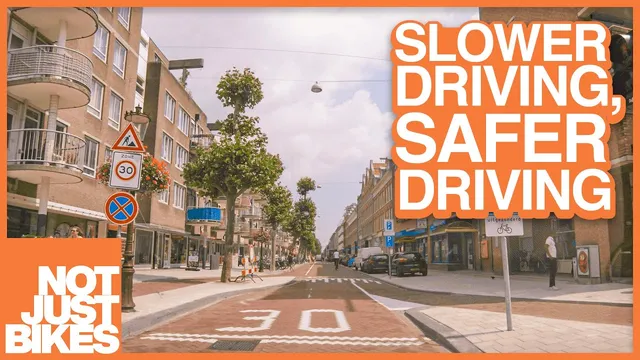
Traffic Calming is Everywhere in the Netherlands
Based on Not Just Bikes's video on YouTube. If you like this content, support the original creators by watching, liking and subscribing to their content.
The Netherlands embeds traffic calming into national road safety guidelines, making it a default feature rather than a rare intervention.
Briefing
Traffic calming in the Netherlands isn’t treated as a special fix reserved for problem spots—it’s built into everyday street design nationwide, so residents experience calmer speeds and safer crossings almost by default. In Canada and the U.S., traffic calming tends to arrive only after sustained pressure or clear evidence of danger, often through complex approval processes. The result is a patchwork: some streets get redesigned, while many others—especially in and around cities—still function like high-capacity roads that prioritize smooth vehicle flow.
A concrete contrast comes from signage and street form in a Dutch residential area: “traffic calm neighborhood” paired with a 50 km/h limit on a narrow two-way road. The street’s physical features are minimal—no elaborate one-way layouts, raised intersections, continuous chicanes, or dramatic road diets—yet the overall environment still signals and supports lower speeds. The point isn’t that Dutch traffic calming relies on one flashy technique; it’s that the expectation of calmer driving is embedded in the system.
That system is tied to national road safety guidance. Dutch streets—whether in major cities, suburbs, or smaller communities—are required to follow the same guidelines. Traffic calming can still be absent, but that typically happens when a street hasn’t been redesigned in decades; major construction projects bring roads up to current standards, including traffic-calming measures. Even where an arterial road meets minor residential streets, design choices can prevent through-motor-vehicle connections while preserving cycling access. Narrowed lanes, medians, and visual cues at crossings work alongside continuous sidewalks and cycle paths, turning safety into a spatial feature rather than a negotiated add-on.
The underlying policy difference helps explain why the Netherlands looks so consistent. In the U.S. and Canada, road performance is often judged by “level of service,” essentially how smoothly traffic moves and how much capacity a road can carry. Because traffic calming can reduce flow, it’s typically allowed only if it won’t significantly harm level of service—so many urban streets remain highway-like even when they pass through city centers. In the Netherlands, a policy introduced in the 1990s—“sustainable safety”—starts from a different assumption: people will make mistakes. Roads are designed to protect people through consistency and clarity, making it easier to do the right thing without relying on drivers to follow explicit instructions.
The practical payoff is felt in daily life. Walking and cycling become less stressful because crossings and street interactions are predictable, and families—especially children—face fewer moments of anxiety about being outside a car. Traffic calming may sound technical, but the transcript’s central claim is straightforward: when safety-first design is consistent at the national level, it changes how streets feel, not just how they function.
Cornell Notes
The Netherlands treats traffic calming as a default requirement, embedded in national road safety guidelines rather than applied only after crashes or complaints. Canada and the U.S. often require proof that calming won’t reduce “level of service,” so many streets remain highway-like and calming becomes a patchwork. Dutch design is linked to “sustainable safety,” which assumes humans will make mistakes and therefore shapes roads to be consistent and protective—helping drivers slow down and notice crossings without heavy signage. The result is a street environment that feels safer and less stressful for walking, cycling, and children playing nearby.
Why does traffic calming appear more widespread in the Netherlands than in Canada or the U.S.?
How do “level of service” priorities shape street design in the U.S. and Canada?
What is “sustainable safety,” and how does it change road design choices?
What does the transcript suggest about the relationship between construction and traffic calming in the Netherlands?
How can Dutch street layouts restrict car movement while still supporting cycling and walking?
Review Questions
- How does a “level of service” framework influence whether traffic calming is approved in the U.S. and Canada?
- What assumptions underlie “sustainable safety,” and how do those assumptions translate into physical road design?
- Why does the transcript argue that traffic calming feels different in daily life even when the visible features seem modest?
Key Points
- 1
The Netherlands embeds traffic calming into national road safety guidelines, making it a default feature rather than a rare intervention.
- 2
In Canada and the U.S., traffic calming often requires evidence or demand and must pass approval hurdles, which slows or limits adoption.
- 3
“Level of service” metrics prioritize vehicle flow and capacity, so traffic calming is frequently restricted to avoid harming traffic performance.
- 4
The Netherlands’ “sustainable safety” approach assumes human error and designs roads to protect people through consistency and clarity.
- 5
Dutch street redesigns during major construction typically bring older streets up to current traffic-calming standards.
- 6
Designs can restrict through-motor-vehicle travel while still allowing cycling and maintaining continuous sidewalks and cycle paths.
- 7
Consistent safety-first design reduces day-to-day stress for pedestrians, cyclists, and families with children.