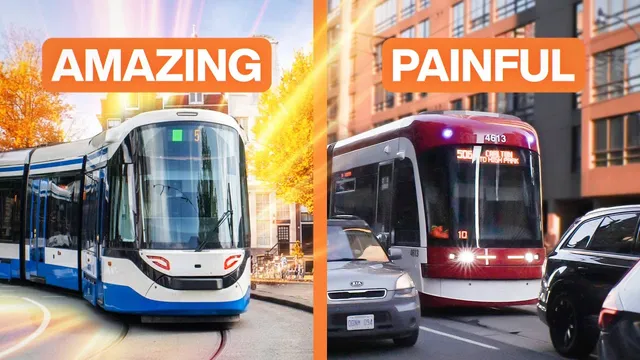
Trams are Great! So why are the Streetcars SO BAD!?
Based on Not Just Bikes's video on YouTube. If you like this content, support the original creators by watching, liking and subscribing to their content.
Toronto’s streetcars are portrayed as chronically underfunded and treated like inherited infrastructure rather than a modern transit network.
Briefing
Toronto’s streetcars are slow, unreliable, and poorly integrated with street design—largely because cars are treated as the priority and transit is forced to “fit around” them. The result is a system that routinely bunches, misses schedules, and traps riders behind red lights and traffic delays, even on routes that have dedicated lanes. The frustration isn’t just about today’s ride; it’s about what could be achieved with modern tram practices like signal priority, dedicated right-of-way, and true level boarding.
Amsterdam is held up as the contrast. There, trams often run in separated lanes and traffic signals automatically adjust to keep them moving through intersections. Toronto, by comparison, has a streetcar network that carries roughly 250,000 weekday riders (pre-pandemic higher), yet has seen only minor improvements for decades and remains chronically underfunded. The core complaint is that Toronto operates streetcars like a historic obligation rather than a functional transit system.
The most visible operational failures come from traffic interference and signal timing. Streetcars commonly crawl in mixed traffic—sometimes so slowly that walking is faster. On-street parking forces frequent delays as vehicles need to park, and service bunching creates long gaps followed by multiple cars arriving together. “Short turning” to recover from gaps can leave riders stranded short of their destination. Even when streetcars do travel in dedicated lanes, they often lack transit signal priority, meaning they still stop at nearly every red light.
Stop spacing and intersection design compound the problem. Toronto stop spacing is described as roughly 200–300 meters, compared with 300–400 meters in many European cities, so riders experience frequent stops. The near-side placement of stops at intersections can lead to a pattern of stopping to board, moving a few meters, then stopping again for a red light. Turning movements also create delays: streetcars are not given dedicated turning signal logic, and left-turn phases can hold transit for the convenience of drivers.
The accessibility story is equally damning. Toronto’s fleet uses Bombardier Flexity low-floor streetcars, but platforms are often not built for level boarding. Wheelchair access depends on a button that triggers the driver to extend a ramp—yet only one door carries the ramp, forcing precise timing. The transcript argues that Toronto removed streetcar islands in 2017 under the banner of “accessibility and safety,” claiming the islands were too small for wheelchairs; the workaround became curb boarding, which the narrator portrays as less safe and less accessible. A comparison is drawn to Amsterdam, where street redesign can remove car lanes and replace them with bicycle space to enable better tram stop geometry.
A key case study is the King Street Pilot Project. City data showed streetcar speeds at peak times were near walking pace and reliability was poor because cars occupied most of the space while carrying a small fraction of people. The pilot proposed redesigning blocks to reduce through car traffic, expand sidewalks and cycling, and improve transit priority. Suburban councillors and right-wing media pressure allegedly watered down the plan—most notably through a taxi exemption that limited physical barriers and kept the street usable for cars at night. Despite that, the pilot is described as successful: faster, more reliable service, higher rider satisfaction, ridership rising to about 84,000 passengers per day, and a large increase in cycling.
The broader thesis ties these failures to political incentives and outdated technology. The TTC is criticized for using antiquated single-point switches that require operators to stop, visually confirm switch positions, and crawl through at very low speeds due to derailment risk. The transcript also faults older overhead power practices—trolley poles instead of pantographs—linking them to disconnections, power limits, reduced air-conditioning use, and earlier vehicle retirements during wet weather.
The proposed fix is straightforward: dedicated lanes where possible (or streets that aren’t through routes for cars), consistent signal priority for streetcars, and level boarding as a network-wide standard. Without those changes, the transcript warns, Toronto’s streetcars remain vulnerable to political attacks and could eventually be replaced—despite being, in the narrator’s view, a transit “goldmine” that other cities have learned to unlock.
Cornell Notes
Toronto’s streetcars underperform because they’re repeatedly forced to yield to car traffic and outdated operating practices. Even where dedicated lanes exist, transit signal priority is often missing, producing frequent red-light delays, bunching, and unreliable service. Accessibility is also compromised: low-floor Bombardier Flexity vehicles still require ramps and careful door placement because platforms are frequently not built for level boarding, and curb boarding replaced island stops in 2017. The King Street Pilot Project is presented as proof that faster, more reliable streetcar service is achievable at relatively low cost when through car traffic is restricted and transit priority is improved. The transcript concludes that Toronto’s “cars-first” mentality—plus antiquated switches and overhead power choices—keeps streetcars from becoming a true alternative to driving.
Why does Toronto’s streetcar service often feel slower than walking, even though it’s rail transit?
How do stop spacing and intersection design make delays feel constant?
What accessibility problems persist despite low-floor streetcars in Toronto?
What did the King Street Pilot Project change, and why is it treated as evidence that streetcars can work well?
What outdated technologies are blamed for slowing Toronto streetcars at intersections?
How does overhead power equipment factor into reliability and rider experience?
Review Questions
- Which operational choices in Toronto most directly create bunching and long gaps in streetcar service?
- How does the transcript connect platform design to wheelchair boarding requirements on Toronto streetcars?
- What measurable outcomes from the King Street Pilot Project are used to argue that transit improvements can be both effective and relatively low-cost?
Key Points
- 1
Toronto’s streetcars are portrayed as chronically underfunded and treated like inherited infrastructure rather than a modern transit network.
- 2
Mixed traffic, on-street parking, and lack of consistent transit signal priority cause frequent red-light delays, bunching, and unreliable service.
- 3
Stop spacing and near-side intersection stop placement increase the number of times streetcars must stop and wait during a trip.
- 4
Low-floor Bombardier Flexity vehicles still face accessibility barriers in Toronto because many platforms aren’t built for level boarding, forcing ramp deployment via a button and a specific door.
- 5
The King Street Pilot Project is presented as a concrete example that restricting through car traffic and improving transit priority can increase speed, reliability, ridership, and cycling.
- 6
Antiquated single-point switches and trolley-pole overhead power practices are blamed for slow intersection movements and reduced reliability, especially in winter and wet conditions.
- 7
The transcript’s prescription is consistent: dedicated right-of-way where possible, signal priority for streetcars, and network-wide level boarding to make transit a viable alternative to driving.