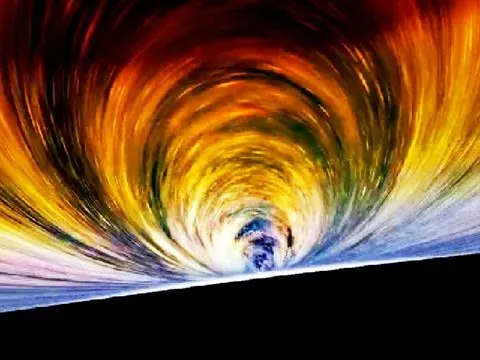
Travel INSIDE a Black Hole
Based on Vsauce's video on YouTube. If you like this content, support the original creators by watching, liking and subscribing to their content.
A black hole forms when mass is compressed inside its Schwarzschild radius, making escape velocity exceed the speed of light.
Briefing
Black holes aren’t just cosmic vacuum cleaners—they’re regions where gravity warps light and time so dramatically that even light can’t escape once it crosses a boundary. The key threshold is the Schwarzschild radius: if enough mass is compressed into a small enough space, the escape velocity exceeds the speed of light. That’s why a star that grows too large to support itself eventually collapses into an infinitesimally small point called a singularity, where density is treated as infinite and the gravitational pull becomes effectively inescapable.
From far away, a black hole doesn’t look like a simple “hole.” Its gravity bends space-time, distorting the paths of photons traveling past it. Stars behind a massive object appear shifted because their light is deflected; with larger systems, the distortion becomes extreme enough to smear images into arcs and rings. This effect—gravitational lensing—can make a background galaxy look like a distorted ring around the black hole, even though the galaxy itself isn’t being pulled apart. Simulations show the background light contorting as it passes behind the black hole, turning a normal view into a warped, fun-house-mirror pattern.
The distortion becomes even more striking when the black hole is treated as a moving “lens” relative to an observer. If Earth orbited a black hole, it would initially look normal, but as it passed behind the black hole, the light reflecting off Earth would be warped, changing how the planet appears from the outside. To make the physics more tractable, the discussion then narrows to an idealized black hole that is uncharged, non-rotating, and not actively consuming matter.
As an observer approaches such a black hole, the sky itself darkens. A growing fraction of the forward field of view is swallowed by the black hole’s gravitational influence, reaching the photon sphere—an orbit where photons can circle the black hole. Light doesn’t necessarily “fall in” immediately at this radius; instead, it can get trapped in a precarious loop. In principle, that geometry could allow an observer to see the back of their own head, because photons emitted backward could travel around the photon sphere and return.
Time dilation adds a second layer of drama. An outside observer watching someone fall in would not see a quick plunge; the infaller’s approach would appear to slow as the event horizon nears. The infaller would look increasingly red-shifted and dim, effectively freezing from the outside view. For the falling person, though, crossing the event horizon is not experienced as a sudden stop—everything continues forward toward inevitable death.
Closer still, tidal forces intensify across the body. The near-singularity stretching is dubbed spaghettification: the gravitational gradient pulls the near side more strongly than the far side, tearing molecules apart. What happens at the singularity remains unknown. Some theories suggest that a moving or spinning black hole could generate a wormhole-like shortcut through space, though that remains speculative.
Finally, the talk pivots to how scientists study black-hole-like behavior on Earth. Acoustic black holes, or dumbholes, mimic the key idea that a horizon prevents escape—here, sound waves can’t get out because of fluid flows moving at the speed of sound. By probing how sound behaves in these lab systems, researchers hope to glean insights into black-hole physics. The closing sections broaden the lens again, discussing what it would look like to travel at light speed and invoking the cosmological principle: in an expanding universe, every observer can treat themselves as the center of expansion, because the “center” is everywhere in a homogeneous cosmos.
Cornell Notes
A black hole forms when mass is compressed within its Schwarzschild radius, creating gravity so strong that light cannot escape. From outside, black holes reveal themselves through gravitational lensing: warped space-time bends background light into arcs, smears, and ring-like patterns. Near the black hole, the photon sphere traps photons in orbit, and the event horizon marks the point beyond which escape is impossible—appearing to outside observers as a slow, red-shifting fade. For the infalling observer, tidal forces intensify into spaghettification as the singularity is approached, though the singularity’s ultimate fate is unknown. Scientists also study black-hole analogs on Earth using dumbholes, where sound can’t escape an acoustic horizon.
What exactly is the Schwarzschild radius, and why does it matter for whether light can escape?
Why doesn’t a black hole look like a simple dark “hole” from far away?
What are the photon sphere and the event horizon, and how do they differ in what happens to light and observers?
What is spaghettification, and what physical mechanism causes it?
How can dumbholes help scientists study black-hole behavior without going anywhere near a real black hole?
Why does the transcript claim that every observer is effectively at the center of the universe?
Review Questions
- How do gravitational lensing effects change the apparent shape of a background galaxy when it aligns behind a black hole?
- What observational differences arise between an outside observer watching someone approach an event horizon and the infalling observer experiencing the same process?
- In what way does the photon sphere allow photons to behave differently than they do at the event horizon?
Key Points
- 1
A black hole forms when mass is compressed inside its Schwarzschild radius, making escape velocity exceed the speed of light.
- 2
Gravitational lensing distorts background light into arcs, smears, and ring-like patterns rather than producing a simple dark silhouette.
- 3
The photon sphere is a special radius where photons can orbit the black hole, allowing light to linger in a trapped path.
- 4
The event horizon marks the last point of no return; outside observers see infallers slow and fade due to time dilation and red-shift.
- 5
Near the singularity, tidal gravity gradients stretch matter through spaghettification, tearing molecules apart.
- 6
Dumbholes mimic black-hole horizons for sound waves in laboratory fluids, enabling experimental study of horizon-like physics.
- 7
In a homogeneous expanding universe, the cosmological principle implies every observer can treat themselves as the effective center of expansion.