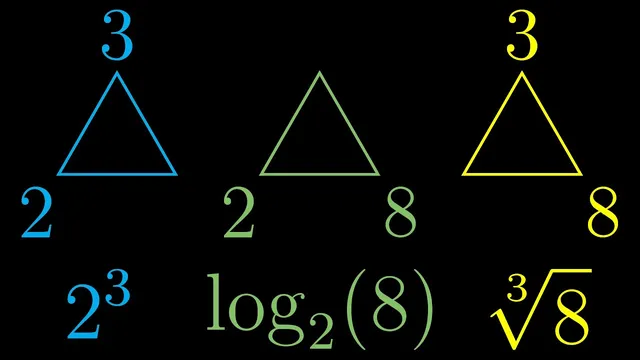
Triangle of Power
Based on 3Blue1Brown's video on YouTube. If you like this content, support the original creators by watching, liking and subscribing to their content.
Current notation treats exponentiation, roots, and logarithms as separate syntactic worlds even when they express the same underlying relationship.
Briefing
Math notation usually matters less than the underlying visual relationships it tries to represent—but notation becomes a real educational bottleneck when it forces students to learn the same idea three different ways. A single relationship like 2 cubed = 8 can be written as 2^3 = 8, ∛8 = 2, or log base 2 of 8 = 3. In today’s conventions, those forms don’t look like siblings; they behave like separate “languages,” each with its own rules and memorization burden. That mismatch makes logarithms feel especially confusing at first, and it turns what should be one coherent mental picture into multiple disconnected facts.
A proposed fix reframes the three operations using one symmetric diagram: the “triangle of power.” For 2^3 = 8, place 2 in the lower left, 3 at the top, and 8 in the lower right. Then define each operation by removing a corner: to express 2 cubed, remove the bottom-right corner (the missing value is 8); to express log base 2 of 8, remove the top number (the missing value is 3, answering “2 to the what power equals 8”); to express the cube root of 8, remove the bottom-left corner (the missing value is 2). The key idea is that the whole symbol always represents the missing corner’s value, making exponentiation, logarithms, and radicals share the same structural logic.
That symmetry pays off when inverse operations are compared. In standard notation, there are six common inverse-style expressions that students often memorize as unrelated items, with no clear pattern linking them. The triangle of power instead makes those operations follow one consistent scheme, reducing both error rates and the cognitive load of learning multiple syntaxes for the same underlying relationship. The payoff isn’t just efficiency; it also matches how human brains latch onto patterns and build “smooth mental images,” which can keep students engaged long enough to develop intuition.
The triangle also helps unify deeper algebraic identities. For example, the exponent rule a^x · a^y = a^(x+y) corresponds to the logarithm rule log(xy) = log(x) + log(y). In the triangle framework, the top expression and the lower expression become two views of the same missing-corner logic: multiplying quantities associated with the bottom-right corner corresponds to adding quantities associated with the top. The diagram can even suggest how to draw internal annotations—when one corner stays fixed, the remaining corners “like” to add or multiply depending on the operation.
When a different corner is held constant, the pattern can require introducing a new operation. The transcript names it O+, defined by A O+ B = 1/(1/A + 1/B), and notes that this harmonic-mean-style operation appears naturally in physics, such as parallel resistance. The broader claim is that many relationships involving exponents, logarithms, and radicals become more discoverable when notation mirrors the true asymmetries of the underlying equation a^b = c, rather than inventing artificial asymmetries through symbols and words.
The recommendation is practical: try using the triangle of power in notes, and—especially for teachers—introduce it so students can reason from the structure itself. The ideal learning path still starts with “why,” but better notation can make the first “why” questions easier to ask and easier to connect to the math’s essence.
Cornell Notes
The triangle of power is a symmetric notation that unifies exponentiation, logarithms, and radicals. Place 2 in the lower left, 3 at the top, and 8 in the lower right; then each operation is defined by removing a corner, with the whole symbol representing the missing value. This design reduces the need to memorize separate inverse forms that currently look unrelated, making patterns easier to see and mistakes less likely. It also clarifies how exponent and logarithm identities correspond (like a^x·a^y = a^(x+y) matching log(xy) = log(x)+log(y)). With the triangle, holding different corners constant reveals consistent “add vs multiply” behavior and even motivates an operation like O+ that matches physics examples such as parallel resistance.
Why does the transcript criticize current notation for 2^3 = 8, ∛8 = 2, and log_2(8) = 3?
How does the triangle of power encode exponentiation, logarithms, and roots?
What problem does the triangle of power solve regarding inverse operations?
How does the triangle of power connect exponent rules to logarithm rules?
What does the transcript mean by introducing O+ when a different corner stays constant?
What learning principle does the transcript insist on even while promoting better notation?
Review Questions
- How does removing different corners in the triangle of power change which operation you’re representing?
- Explain, using the triangle’s logic, why a^x·a^y = a^(x+y) corresponds to log(xy) = log(x)+log(y).
- What is the definition of O+, and what physics context is given as an example of where it naturally arises?
Key Points
- 1
Current notation treats exponentiation, roots, and logarithms as separate syntactic worlds even when they express the same underlying relationship.
- 2
The triangle of power places the three numbers (base, exponent, result) in fixed corners and defines each operation by which corner is removed.
- 3
Because the whole symbol always represents the missing corner’s value, the three operations become structurally symmetric and easier to relate.
- 4
The approach reduces memorization of multiple inverse forms by making their relationships follow one consistent pattern.
- 5
Holding different corners constant reveals consistent “add vs multiply” behavior and can motivate new operations like O+.
- 6
O+ is defined as A O+ B = 1/(1/A + 1/B) and is linked to parallel resistance in physics.
- 7
Better notation should accelerate reasoning, not replace it; students should still re-derive and ask why the rules hold.