Trigonometry fundamentals | Ep. 2 Lockdown live math
Based on 3Blue1Brown's video on YouTube. If you like this content, support the original creators by watching, liking and subscribing to their content.
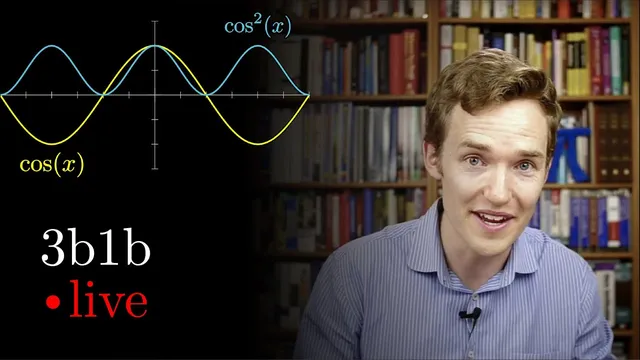
Graphing cosine and then squaring it reveals a non-obvious identity: .
Briefing
Trigonometry’s “simple” graphs hide identities that are anything but obvious—especially once cosine is squared. By starting with nothing more than graphing (e.g., Desmos) and then predicting what happens to on , the lesson lands on a surprising result: squaring inside the cosine doesn’t just distort the curve; it produces a shifted, rescaled cosine wave. The live prediction game narrows the correct shape to a standard-looking cosine oscillation, and that empirical observation becomes the gateway to a concrete identity: The key idea is geometric and functional: the “squared” cosine graph matches a cosine with doubled frequency, then shifted upward and scaled to fit. That’s the first major takeaway—graph tinkering can reveal non-trivial structure before any formal definition of trig functions.
From there, the lecture builds a bridge between two ways of thinking about trig. One path is the unit-circle view: sine and cosine come from the coordinates of a point moving around a circle of radius 1, with the input interpreted as arc length (radians). The other path is the right-triangle view, where SOH CAH TOA ties sine to opposite/hypotenuse, cosine to adjacent/hypotenuse, and tangent to opposite/adjacent. A leaning tower problem makes the triangle approach feel practical: when a 100-meter tower leans so the sun’s angle is 80°, the shadow length becomes the adjacent side, giving .
The unit-circle framing then turns into a computational toolkit. Using symmetry and special angles, the lesson derives classic values like and , and it emphasizes how Pythagorean geometry forces the identity . It also demonstrates how signs and periodic placement on the circle determine results for angles like , where cosine becomes negative and equals .
A major conceptual payoff arrives with the half-angle identity, built directly from the earlier “cosine squared” observation. The lecture uses the identity to compute a harder value like (15°) without relying on a calculator—then checks numerically to confirm. Finally, the tangent function is interpreted geometrically: tangent corresponds to a length from a right triangle formed by drawing a line perpendicular to the radius, explaining why blows up as .
By the end, the “where do identities come from?” question is answered in a new way: trig functions are not just triangle ratios. They’re coordinate geometry on a circle, and the algebraic identities (like half-angle and Pythagorean relationships) reflect that geometry. The lecture also foreshadows a deeper connection—these patterns hint that trigonometry is tightly linked to complex numbers and exponentials, even when that relationship isn’t obvious at first glance.
Cornell Notes
The lecture uses graphing and geometry to show that squaring and scaling inside trig functions creates identities that aren’t intuitive from definitions alone. A key discovery is that , which turns a “faster oscillation” cosine into a shifted-and-rescaled version of the original. The unit-circle model interprets sine and cosine as y- and x-coordinates of a point moving around a radius-1 circle, with inputs naturally measured in radians (arc length). Right-triangle SOH CAH TOA provides a parallel, practical way to compute values and shadow lengths, while Pythagorean geometry yields . These tools make it possible to compute values like and to understand why diverges near .
Why does squaring a cosine-related expression produce another cosine wave with doubled frequency?
How do radians connect to the unit circle, and why does that matter for signs?
What’s the practical difference between the triangle view (SOH CAH TOA) and the circle view?
How do special angles like and get computed without memorizing everything?
How does the half-angle identity help compute ?
What geometric reason explains why blows up near ?
Review Questions
- Using the unit-circle model, determine whether is positive or negative for , and estimate whether it’s closer to 1 or 0.
- Derive from the idea that squaring cosine produces a shifted, rescaled cosine with doubled frequency.
- Compute using an identity approach (hint: relate it to a double-angle expression).
Key Points
- 1
Graphing cosine and then squaring it reveals a non-obvious identity: .
- 2
Doubling the angle inside cosine doubles the oscillation frequency; the “+1” and division by 2 shift and rescale the squared curve.
- 3
Sine and cosine can be defined geometrically as y- and x-coordinates of a point on the unit circle, with inputs naturally interpreted in radians as arc length.
- 4
SOH CAH TOA provides a triangle-based method for computing trig ratios and solving applied problems like shadow lengths.
- 5
Pythagorean geometry on the unit circle forces the identity , linking sine and cosine.
- 6
Special angles (like ) can be computed from 30-60-90 triangles derived from equilateral-triangle symmetry.
- 7
Tangent corresponds to a geometric length ratio that diverges as , explaining the vertical asymptote behavior.