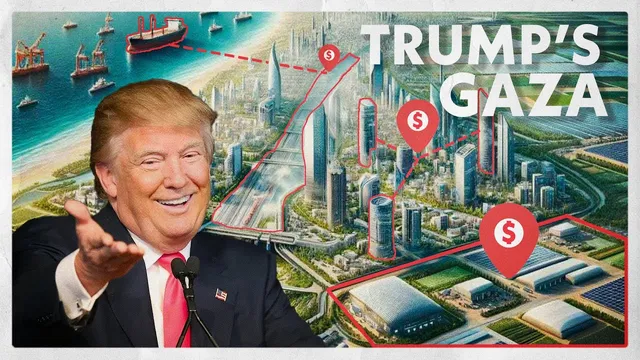
Trump's Insane Plan For Gaza
Based on Second Thought's video on YouTube. If you like this content, support the original creators by watching, liking and subscribing to their content.
Trump’s Gaza “Riviera” framing is presented as redevelopment that presupposes mass displacement rather than reconstruction for Palestinians.
Briefing
A sweeping Gaza “Riviera” plan—framed as real-estate development and economic renewal—rests on the assumption that Gaza’s population must be emptied out, a premise critics say amounts to ethnic cleansing. The central claim is that proposals from Donald Trump and allied regional and Israeli actors treat the territory not as a homeland for Palestinians but as a purchasable, redevelopable asset—something to be “owned,” leveled, and rebuilt for outsiders.
The transcript traces how this logic has been building for years. It points to a January 2024 “Victory of Israel” conference where attendees were encouraged to place small wooden house models on a map divided into planned neighborhoods—an exercise presented as “the new Gaza.” The same development mindset appears in earlier proposals such as “Gaza 2035,” which would hand control of Gaza to external regional states, and an Arab League plan featuring major infrastructure like a new airport, seaports, and an industrial zone. Against that backdrop, Trump’s statements are portrayed as the most direct: the U.S. would take over the Gaza Strip, “own it,” dismantle unexploded ordnance, level destroyed buildings, and then create an economic engine of jobs and housing.
Critics argue the plan’s “economic” promise is inseparable from forced displacement. Kareem Rabia, an anthropology professor at the University of Illinois at Chicago, is quoted describing Trump’s concept as beginning with “emptying out” the strip—described as ethnic cleansing on a massive scale. The transcript also links this moment to the “Deal of the Century,” associated with the Trump administration’s “Peace to Prosperity” initiative led by Jared Kushner. Alberto Toscano, author of Late Fascism, is cited for the view that these frameworks use economic incentives to depoliticize Palestinian resistance and block substantive sovereignty, effectively offering prosperity in exchange for surrender.
A key example offered is the West Bank’s “Mavi” development project, described as a large, Qatar-funded mega-development marketed as a Palestinian project for tens of thousands of middle-class Palestinians. The transcript frames such projects as part of a longer pattern: Palestinians are offered limited economic horizons while being denied the right of return and threatened with elimination if they refuse.
The Gaza version, the transcript argues, is harsher. Trump’s language shifts from “redeveloping for Palestinians” to “owning” Gaza and filling it with luxury housing that critics say would not be for Palestinians. The explanation for how the world arrived here centers on U.S. and allied political support during the war—described as uncritical backing, billions in weapons, and refusal to sanction atrocities—leading to a dehumanization that makes Palestinians seem “disposable.”
Finally, the transcript places the development logic in a broader moral framework: land treated as profit-maximizing property, justified through a capitalist ethic where profit becomes the ultimate virtue. The result, it concludes, is a mirror image of what the Israeli right has sought for decades—territorial takeover paired with the removal of Palestinians—where land grabs return and people are treated as secondary to the wallets of the powerful.
Cornell Notes
The transcript argues that Trump’s “Riviera” vision for Gaza is not a neutral reconstruction plan but a profit-driven redevelopment project built on the presumption of ethnic cleansing. It links the idea to earlier U.S.-backed and regional proposals—such as “Peace to Prosperity” and “Gaza 2035”—that offer economic incentives while denying Palestinian sovereignty and the right of return. Examples like the Qatar-funded West Bank “Mavi” development are used to show how real-estate projects can be marketed as “Palestinian” while reinforcing dispossession. In Gaza, the transcript claims the “aspirational” economic pitch disappears: the stated goal becomes emptying the territory, leveling it, and rebuilding for outsiders. The stakes, it says, are human rights and personhood being treated as negotiable compared with capital gains.
What is the core claim about Trump’s Gaza “Riviera” plan?
How does the transcript connect today’s Gaza proposals to earlier U.S. initiatives?
What role do real-estate development projects play in the argument?
Why does the transcript say the Gaza case is different from earlier “economic” offers?
What broader moral or philosophical idea is used to explain the profit-driven approach?
What evidence is offered that the “profit first, people last” logic is already operating?
Review Questions
- How does the transcript distinguish between economic development as a political trade-off and economic development as an explicit replacement strategy?
- Which earlier initiatives are used to show continuity in the argument, and what common mechanism do they share?
- What does the transcript suggest is the relationship between U.S. military/political support and the feasibility of treating Palestinians as “disposable”?
Key Points
- 1
Trump’s Gaza “Riviera” framing is presented as redevelopment that presupposes mass displacement rather than reconstruction for Palestinians.
- 2
The transcript links current proposals to the “Deal of the Century” and “Peace to Prosperity,” describing them as using economic incentives to block Palestinian sovereignty.
- 3
Real-estate projects like the Qatar-funded West Bank “Mavi” development are used as examples of how “Palestinian” branding can coexist with denial of return and political rights.
- 4
In Gaza, the transcript claims the “aspirational” economic pitch is replaced by language of U.S. ownership, leveling, and rebuilding—implying Palestinians would not remain.
- 5
The argument places the profit-driven approach within a longer tradition of justifying dispossession through the moral primacy of profit, drawing on John Locke.
- 6
The transcript attributes the current political feasibility of these plans to years of U.S. and allied backing during the war, including weapons support and lack of sanctions.
- 7
The transcript concludes that land grabs and capital gain are prioritized while Palestinian personhood and rights are treated as secondary.