Turbulent Flow is MORE Awesome Than Laminar Flow
Based on Veritasium's video on YouTube. If you like this content, support the original creators by watching, liking and subscribing to their content.
Turbulence is chaotic and often requires statistical treatment because small initial differences can produce large outcome changes.
Briefing
Turbulent flow is chaotic, but that “mess” is also what makes it powerful—driving everything from rain formation to the drag reduction tricks behind golf balls and the lift-saving devices on aircraft wings. Rather than treating turbulence as a nuisance compared with the orderly beauty of laminar flow, the central claim is that turbulence is the more consequential regime of fluid motion because it mixes, diffuses, and transfers energy across scales.
Turbulence resists tidy prediction. It lacks a single universally accepted definition, yet it’s recognized by behavior: it is unpredictable and “definitionally chaotic,” meaning small changes in initial conditions can produce very different outcomes. While the Navier–Stokes equations govern fluid motion in principle, turbulence is notoriously hard to solve in practice—so analysis often shifts to statistical descriptions. In contrast, laminar flow is organized: fluid particles move in parallel layers with minimal mixing.
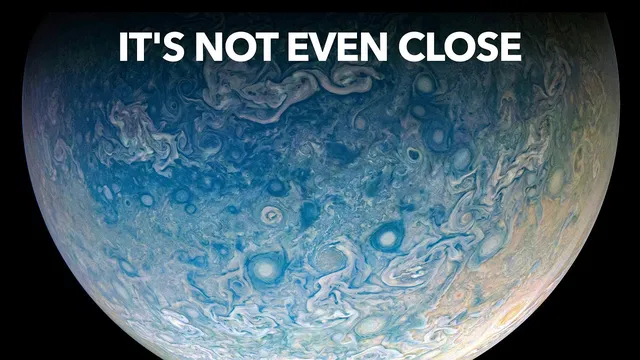
A key way to understand turbulence is through its structure and scale. Turbulent motion consists of many interacting swirls—eddies or vortices—spanning a huge range of sizes. In air, that range runs from micrometers to meters; on the Sun it appears as convection cells; on Jupiter it includes massive vortices such as the Great Red Spot; and even interstellar dust shows turbulent motion that contributes to astronomical “twinkling.”
Experiments also pin down when turbulence appears. In 1883, Osborne Reynolds passed dye through pipes and observed a transition: at low flow rates the dye stayed as a steady stream (laminar), but beyond a critical point it spread throughout the pipe (turbulent). Reynolds identified turbulence as diffusive—mixing momentum, heat, and dye—and found that the transition depends on both flow speed and fluid properties. The Reynolds number, defined as velocity times a characteristic length divided by kinematic viscosity, captures this: higher Reynolds numbers make turbulence more likely. That’s why everyday flows are usually turbulent—air in lungs, blood in major arteries, and near-surface atmospheric flow.
Turbulence also has a practical downside: it is dissipative. Energy enters through large eddies, cascades to smaller ones, and ultimately dissipates as heat. Maintaining turbulence therefore requires a continuous energy source, which is why it commonly forms around moving objects. The discussion then connects turbulence to drag through boundary layers. Near a surface, fluid slows due to friction, forming a boundary layer; if it stays laminar, skin friction is lower. But fast flow or long surfaces can trigger a turbulent boundary layer that swirls and mixes, increasing skin friction and producing significantly more drag—one reason clean, smooth surfaces reduce fuel costs.
Yet the same mechanism can be beneficial. Planes use small vortex generators to deliberately induce turbulence, keeping airflow attached at higher angles of attack and delaying stall. Golf balls use dimples to trip the boundary layer into turbulence, reducing pressure drag by limiting the size of the wake; the drag coefficient can drop by nearly a factor of two when the boundary layer becomes turbulent.
Finally, turbulence isn’t only about mixing—it can create usable patterns. Flow around cylinders can transition to periodic vortex shedding, forming a von Karman vortex street. Researchers study how organisms might exploit turbulent wakes, including experiments suggesting fish can swim upstream in the wake of obstacles.
The takeaway is a reframing: turbulence is everywhere, often unavoidable, and frequently useful. Laminar flow may look neat, but turbulence is the regime that powers real-world performance—from rain to flight to the distance a ball travels.
Cornell Notes
Turbulent flow is chaotic and hard to predict, but it’s also the dominant and most consequential kind of fluid motion in nature and engineering. It features interacting eddies (vortices) across a wide range of sizes, and it mixes and diffuses momentum, heat, and dye. A key control knob is the Reynolds number: higher values (from higher speed, larger length scales, or lower viscosity) make turbulence more likely, which is why most everyday flows are turbulent. Turbulence is also dissipative, transferring energy from large eddies down to smaller scales where it becomes heat—raising drag when it forms near surfaces. Still, designers often induce turbulence on purpose, such as vortex generators on wings and dimples on golf balls, to delay separation and reduce pressure drag.
Why is turbulence considered “unpredictable,” and what does that mean for modeling?
What did Osborne Reynolds observe in 1883 that helped define the laminar-to-turbulent transition?
How does the Reynolds number predict whether flow becomes turbulent?
Why does turbulence usually increase drag near surfaces, even though it can be useful?
How do vortex generators on aircraft wings use turbulence to improve performance?
How do golf ball dimples change the flow and reduce drag?
Review Questions
- What physical processes make turbulence both difficult to predict and effective at mixing momentum and heat?
- How does the Reynolds number connect flow speed, geometry, and viscosity to the onset of turbulence?
- Give two examples where inducing turbulence improves real-world outcomes, and explain the mechanism in each case.
Key Points
- 1
Turbulence is chaotic and often requires statistical treatment because small initial differences can produce large outcome changes.
- 2
Turbulent flow consists of interacting eddies (vortices) spanning micrometer-to-meter scales in air, and similarly vast ranges across astrophysical settings.
- 3
The Reynolds number—velocity times characteristic length divided by kinematic viscosity—predicts when flow transitions from laminar to turbulent.
- 4
Turbulence is diffusive and dissipative: it mixes properties throughout the fluid and transfers energy from large eddies down to smaller scales where it becomes heat.
- 5
Turbulent boundary layers increase skin friction and drag, which is why smooth, clean surfaces can improve fuel efficiency.
- 6
Engineers sometimes induce turbulence on purpose: vortex generators help delay wing stall, and golf ball dimples reduce pressure drag by delaying separation.
- 7
Periodic vortex shedding (von Karman vortex street) shows how turbulence-related transitions can create structured patterns that researchers study for potential energy-harvesting and biological advantages.