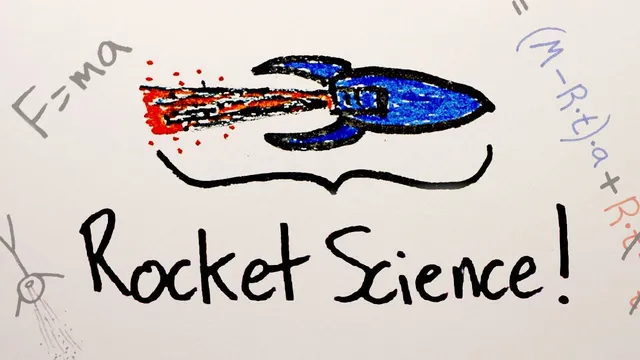
Tutorial: Rocket Science! (plus special announcement)
Based on minutephysics's video on YouTube. If you like this content, support the original creators by watching, liking and subscribing to their content.
Model rocket propulsion by treating fuel as a variable-mass system: rocket mass decreases as exhaust mass increases.
Briefing
Rocket propulsion can be reduced to a simple momentum-and-mass story: as fuel is expelled downward, the rocket accelerates upward against gravity. The setup starts with a rocket plus fuel system of total mass M on Earth. Before ignition, gravity provides a downward force F = Mg, giving an acceleration of about −9.8 m/s² (negative because it points downward). Once the engine fires, fuel leaves the rocket, so the system’s mass is no longer constant: the rocket mass decreases while the exhaust mass increases as it streams away.
To track the changing masses, the dynamics are written as a sum of “mass times acceleration” terms for both the remaining rocket and the expelled exhaust. The rocket’s mass becomes M − Rt, where R is the fuel mass-loss rate (kilograms per second) and t is time. Meanwhile, the exhaust mass is Rt. The exhaust’s acceleration comes from a velocity change: it starts moving with the rocket at upward velocity V, then leaves with downward exhaust speed Ve. That velocity change is −Ve relative to the rocket’s original motion, so the acceleration term for the exhaust reflects that drop in velocity over time.
The key practical question is how much fuel is needed to just barely hover—meaning the rocket’s velocity and acceleration are both zero. Setting acceleration to zero collapses the full rocket-plus-exhaust equation into a single balance between gravity and the momentum carried away by the exhaust. The result is a compact hovering condition: m g = R Ve, where m is the rocket’s total mass (rocket plus remaining fuel at the hovering moment), g is gravitational acceleration, R is the exhaust mass flow rate, and Ve is the exhaust speed relative to the rocket.
That equation still contains two unknowns, R and Ve, so the transcript links them through geometry and incompressibility. The rocket’s bottom opening has area a, and the expelled liquid forms a stream. In one second, material moving at speed Ve travels a distance Ve, creating a cylindrical volume of exhaust roughly equal to a Ve. Because water and milk are treated as incompressible, the mass flow rate R is proportional to this volume flow rate: R equals 1000 times the volume per second (using the fact that 1 kilogram of water occupies about 1 liter, and 1 cubic meter equals 1000 liters). With R expressed in terms of a and Ve, the hovering condition can be solved for the required exhaust volume (and thus the required amount of liquid to expel).
The punchline is intentionally playful: by measuring total mass m and the nozzle area a, a person can estimate how much milk or water must be expelled to counter gravity and achieve hovering—then share a “personalized levitation inducing” rate. Behind the joke sits a real physics workflow: write the variable-mass dynamics, impose the hover condition (zero acceleration), and convert mass flow into a measurable volumetric flow through the nozzle’s area and the exhaust speed.
Cornell Notes
Hovering requires a balance between gravity and the momentum carried away by expelled fuel. Starting from variable-mass rocket dynamics, the condition for “just barely beat gravity” sets the rocket’s acceleration to zero, collapsing the system to m g = R Ve. Here m is the rocket’s mass, g is 9.8 m/s², R is the fuel mass-loss rate (kg/s), and Ve is the exhaust speed. To connect R and Ve to something measurable, the exhaust is modeled as an incompressible stream leaving through an opening of area a, forming a volume flow rate about a Ve per second. Using water’s density (1 kg per liter), R becomes 1000 times that volume rate, letting the required exhaust volume be solved from the hovering equation.
Why does the rocket’s mass change once the engine ignites, and how does that affect the equations of motion?
What does “hovering” mean mathematically, and how does it simplify the variable-mass rocket equation?
How is the exhaust speed Ve defined in this framework?
How does the nozzle area a connect to the fuel mass-loss rate R?
What measurements are needed to estimate the amount of liquid required to hover?
Review Questions
- In the hovering condition m g = R Ve, what physical process does each term represent?
- How does incompressibility and nozzle area a turn a velocity-based exhaust model into a mass-loss rate R?
- Why does setting acceleration to zero eliminate most of the variable-mass complexity?
Key Points
- 1
Model rocket propulsion by treating fuel as a variable-mass system: rocket mass decreases as exhaust mass increases.
- 2
Gravity provides a constant downward force F = Mg, but the mass being accelerated changes after ignition.
- 3
Write the dynamics as contributions from both the remaining rocket mass and the expelled exhaust mass.
- 4
Impose the hover condition (velocity and acceleration both zero) to reduce the system to m g = R Ve.
- 5
Relate exhaust mass flow rate R to nozzle geometry using incompressible flow: the exhaust volume per second is about a Ve.
- 6
Use water’s density approximation (1 kg per liter) to convert volume flow into mass flow: R ≈ 1000 × (a Ve).
- 7
Solve for the required exhaust volume rate using the hovering balance and measured mass and nozzle area.