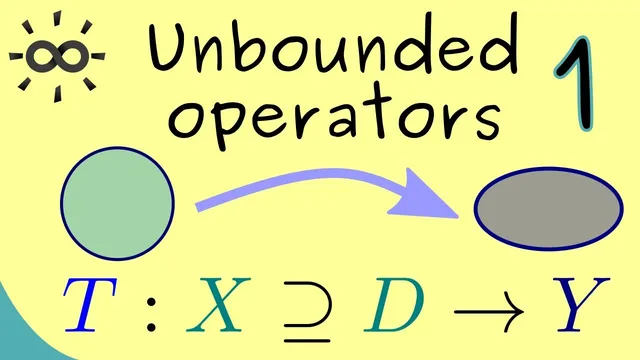
Unbounded Operators 1 | Introduction and Definitions
Based on The Bright Side of Mathematics's video on YouTube. If you like this content, support the original creators by watching, liking and subscribing to their content.
Unbounded operators are necessary for modeling quantum mechanics and arise naturally in the mathematics of partial differential equations.
Briefing
Unbounded operators sit at the center of functional analysis because they are unavoidable in the mathematics of partial differential equations and quantum mechanics—yet they cannot be handled using the usual “bounded operator” framework. In quantum theory, position and momentum are represented by operators whose order matters: the composition XP differs from PX, with their difference tied to the identity operator (up to a factor involving the imaginary unit). That commutation behavior cannot be reproduced if only bounded operators are allowed, forcing a broader notion of linear operators—one that can be unbounded.
The course begins by setting up the basic objects needed to define unbounded operators rigorously. Two normed vector spaces, X and Y, are fixed over a common field F, which is either the real numbers or the complex numbers (with complex spaces suggested as the default mental model). Unlike bounded operators, an unbounded operator does not necessarily act on all of X. Instead, it is defined on a subspace D ⊂ X called the domain, and maps elements of D into Y via a linear rule T: D → Y. This “domain plus action” viewpoint matters because many notational conventions in the literature compress these two ingredients—sometimes writing T ⊂ X → Y, sometimes writing T with an explicit domain, and sometimes using shorthand like D(T).
A key class for the upcoming theory is “densely defined” operators. The operator T is densely defined when its domain D is dense in X, meaning the closure of D equals the whole space X. This density requirement is only genuinely interesting in infinite-dimensional spaces: in finite dimensions, a proper subspace cannot be dense, so the distinction collapses.
To prepare for later results, the course recalls standard operator subspaces—range and kernel—while explicitly accounting for the domain. The range of T consists of all outputs T(x) with x in D, forming a subspace of Y. The kernel consists of all x in D such that T(x) = 0, forming a subspace of X.
The transition to boundedness is then made precise. A linear operator T is bounded if there exists a finite constant C > 0 such that for every x in D, the norm of T(x) in Y is at most C times the norm of x in X. In that case, the operator norm stays finite. If no such finite C exists—equivalently, if the operator norm becomes infinite—then T is called unbounded. The course also emphasizes an important equivalence from functional analysis: for linear maps, boundedness is equivalent to continuity at all points in the domain. Therefore, unbounded operators are necessarily discontinuous everywhere on their domain.
The practical takeaway is clear: unbounded operators are not a pathological corner case. They are required by the structure of quantum mechanics and appear naturally in PDEs, and their defining feature is that they act on dense domains while failing to be continuous—something that can only happen in infinite-dimensional settings. The next step is to move from definitions to concrete examples.
Cornell Notes
Unbounded operators extend the usual notion of bounded linear maps because important applications—especially quantum mechanics and partial differential equations—cannot be expressed using only bounded operators. The setup uses two normed spaces X and Y over a field F (real or complex) and defines an operator T as a linear map from a subspace D ⊂ X (its domain) into Y. A central class is densely defined operators, where D is dense in X (closure of D equals X), a distinction that matters only in infinite-dimensional spaces. Boundedness means there is a finite constant C with ||T x|| ≤ C||x|| for all x in D; unboundedness means no such finite C exists. For linear operators, boundedness is equivalent to continuity on the domain, so unbounded operators are discontinuous everywhere on D.
Why do position and momentum force the use of unbounded operators in quantum mechanics?
What is the formal definition of an operator in this course’s setting?
What does “densely defined” mean, and why is it only interesting in infinite dimensions?
How are range and kernel defined when the operator has a restricted domain?
What exactly distinguishes bounded from unbounded operators here?
How does boundedness relate to continuity, and what does that imply for unbounded operators?
Review Questions
- What role does the domain D play in defining an unbounded operator, and why can’t T be assumed to act on all of X?
- State the criterion for an operator to be densely defined and explain why this matters only in infinite-dimensional spaces.
- Explain the relationship between boundedness, continuity, and unboundedness for linear operators.
Key Points
- 1
Unbounded operators are necessary for modeling quantum mechanics and arise naturally in the mathematics of partial differential equations.
- 2
A linear operator T is defined as a map T: D → Y where D is a subspace of the normed space X; the domain cannot be ignored.
- 3
Densely defined operators have domains D whose closure equals the whole space X, a distinction that only becomes meaningful in infinite-dimensional settings.
- 4
The range of T is {T(x): x ∈ D} and the kernel is {x ∈ D: T(x)=0}, both treated as subspaces with the domain restriction built in.
- 5
Boundedness requires a finite constant C such that ||T x||_Y ≤ C||x||_X for all x in the domain.
- 6
Unboundedness corresponds to the failure of any finite bound, making the operator norm infinite.
- 7
For linear operators, boundedness is equivalent to continuity on the domain, so unbounded operators must be discontinuous everywhere on their domain.