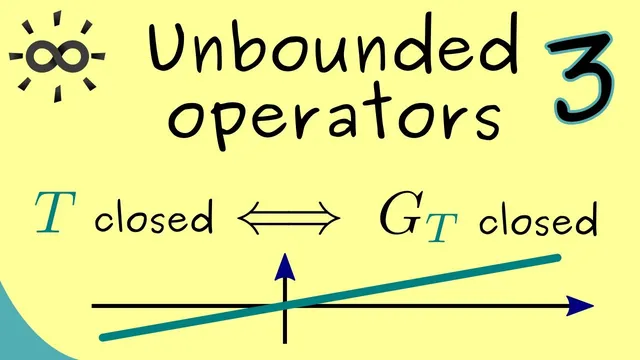
Unbounded Operators 3 | Closed Operators
Based on The Bright Side of Mathematics's video on YouTube. If you like this content, support the original creators by watching, liking and subscribing to their content.
An operator T: D(T)⊂X→Y is represented by its graph G_T={(x,Tx): x∈D(T)} inside the product space X×Y.
Briefing
Closed operators are defined by a simple geometric/topological rule: an operator T between normed spaces is “closed” exactly when its graph is a closed subset of the product space X×Y. This matters because many unbounded operators fail to be continuous, so continuity can’t be used as the guiding principle; closedness becomes the right replacement. The graph of T is built from all pairs (x,Tx) where x lies in the domain D(T), and the graph lives inside X×Y equipped with the norm ‖(x,y)‖=‖x‖+‖y‖. With that norm in place, the usual notion of closed sets in normed spaces applies, letting closedness be checked using limits.
A key payoff is an equivalent, sequence-based characterization that mirrors how closed sets behave in metric spaces. Take any sequence (x_n) in D(T) such that x_n converges in X to some x, and simultaneously Tx_n converges in Y to some y. If T is closed, then the limit pair (x,y) must still lie on the graph of T—meaning x must belong to D(T) and Tx must equal y. In other words, whenever inputs approach a limit and the corresponding outputs approach a limit, the operator cannot “break” at the limit: the limiting output must match the operator applied to the limiting input.
This sequence criterion is presented as the practical way to think about closed operators. It is derived directly from the general fact that a set is closed if and only if it contains the limits of all convergent sequences drawn from it. Applying that to the graph G_T, any convergent sequence of graph points has the form (x_n,Tx_n). If (x_n,Tx_n)→(x,y) in X×Y, then closedness of G_T forces (x,y)∈G_T, which unpacks to x∈D(T) and Tx=y. The convergence in the product space is equivalent to convergence in each component, so the operator-level statement matches the componentwise assumptions.
The discussion also connects the new concept back to familiar territory. If T is bounded and defined on all of X (so D(T)=X), then T is automatically a closed operator. That observation frames closed operators as a generalization of bounded operators: boundedness plus full domain guarantees closedness, while unbounded operators require the graph-closedness condition instead. The groundwork is laid for later material—examples and the closed graph theorem—where these structural properties of closed operators become powerful tools for analyzing when unbounded operators behave well.
Cornell Notes
An operator T: D(T)⊂X→Y between normed spaces is called closed when its graph G_T={(x,Tx): x∈D(T)} is a closed subset of the product space X×Y (with norm ‖(x,y)‖=‖x‖+‖y‖). Closedness can be checked equivalently using sequences: if x_n∈D(T), x_n→x in X, and Tx_n→y in Y, then x must lie in D(T) and Tx=y. This sequence criterion is the operator analogue of “closed sets contain limits of convergent sequences.” The concept matters because unbounded operators are generally not continuous, so closedness replaces continuity as the key regularity condition. Bounded operators with full domain D(T)=X are automatically closed, linking the new definition to the standard bounded-operator setting.
How is the graph of an operator defined when the operator may be unbounded and not defined on all of X?
What does it mean for an operator to be “closed” in this framework?
Why does the sequence condition capture closedness of the graph?
What is the practical “closed operator” test using sequences?
How does this relate to bounded operators from earlier functional analysis courses?
Review Questions
- State the definition of a closed operator in terms of the graph and explain what space the graph lives in.
- Give the sequence-based characterization of a closed operator and interpret what it forces at the limit.
- Why are bounded operators with D(T)=X automatically closed under this definition?
Key Points
- 1
An operator T: D(T)⊂X→Y is represented by its graph G_T={(x,Tx): x∈D(T)} inside the product space X×Y.
- 2
Closedness of T means G_T is a closed subset of X×Y when X×Y is equipped with the norm ‖(x,y)‖=‖x‖+‖y‖.
- 3
A sequence test characterizes closed operators: if x_n∈D(T), x_n→x in X, and Tx_n→y in Y, then x∈D(T) and Tx=y.
- 4
The sequence characterization follows from the general metric-space fact that closed sets contain limits of convergent sequences.
- 5
Closed operators generalize bounded operators because bounded operators with full domain D(T)=X are always closed.
- 6
The closed-operator framework is designed to replace continuity when dealing with unbounded operators that are not continuous.