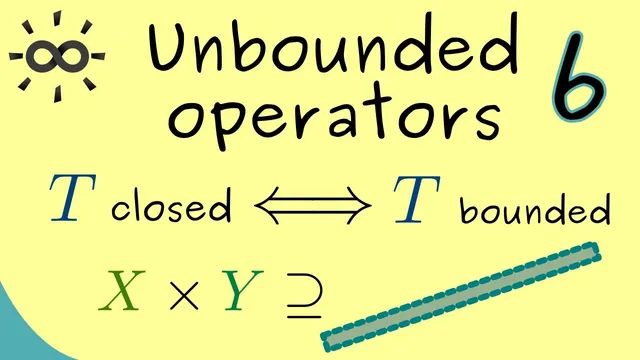
Unbounded Operators 6 | Closed Graph Theorem
Based on The Bright Side of Mathematics's video on YouTube. If you like this content, support the original creators by watching, liking and subscribing to their content.
For a linear operator T: DT → Y between Banach spaces, T is bounded if and only if its graph is closed, provided DT is a Banach space (e.g., DT is closed in X).
Briefing
Closed operators on Banach spaces turn out to be automatically bounded once their domains are “large enough.” More precisely, for a linear operator T between Banach spaces X and Y, if the domain DT is a closed subset of X (equivalently, DT is itself a Banach space), then T is closed exactly when it is bounded—so continuity and closedness become the same condition in this setting. That equivalence matters because it explains why genuinely unbounded operators must have “small” domains: a closed unbounded operator cannot be defined on all of a Banach space.
The result is framed as the Closed Graph Theorem for Banach spaces. Start with a linear map T: DT → Y, where DT is assumed to be a Banach space (the transcript notes this can be arranged by restricting to DT). The operator is called closed when its graph GT = {(x, Tx) : x ∈ DT} is closed in the product space X × Y. Under the Banach-space domain assumption, closedness of the graph forces boundedness of T, and conversely boundedness forces closedness.
One direction is straightforward: if T is bounded (hence continuous), then limits pass through T. Concretely, if xn → x in X and Txn → y in Y, continuity gives Tx = y. Since x lies in the domain, the graph contains the limit point (x, y), so the graph is closed.
The harder direction uses the graph itself as a Banach space. If T is closed, then GT is a closed subspace of the Banach space X × Y, so GT is Banach. Two natural projection maps are introduced: PX: GT → X taking (x, Tx) to x, and PY: GT → Y taking (x, Tx) to Tx. The projection PX is linear and bounded, and it is also bijective because every x in X (with DT = X after restriction) appears in exactly one pair in the graph. The bounded inverse theorem (linked to the open mapping theorem) then implies that PX^{-1}: X → GT is bounded.
With PX^{-1} in hand, T can be written as a composition of bounded maps: PY ∘ PX^{-1}. Since PX^{-1} sends x to (x, Tx) and PY extracts the second component, the composition returns Tx. A composition of continuous (equivalently bounded) linear maps is continuous, so T is bounded. This completes the equivalence: for Banach-space domains, “closed graph” and “bounded operator” are the same.
An immediate takeaway for unbounded operators follows: if a linear operator is closed but unbounded, its domain cannot be a Banach space. In particular, a closed unbounded operator cannot have DT = X when X is Banach. This is why analysts spend so much effort specifying domains carefully when working with unbounded operators.
Cornell Notes
For linear operators between Banach spaces, having a closed graph is equivalent to being bounded—provided the operator’s domain is itself a Banach space (e.g., DT is closed in X). If T is bounded, continuity ensures that whenever xn → x and Txn → y, one must have Tx = y, so the graph is closed. If T is closed, its graph GT is a closed subspace of X × Y and hence Banach; projection PX: GT → X becomes a bijective bounded map, so PX^{-1} is bounded by the bounded inverse theorem. Then T can be recovered as PY ∘ PX^{-1}, making T bounded and therefore continuous. This equivalence explains why closed unbounded operators must have non-Banach (proper) domains.
Why does boundedness imply closedness of a linear operator’s graph?
What role does the assumption “DT is a Banach space” play in the closed graph theorem?
How do the projection maps PX and PY help turn closedness into boundedness?
Why is PX bijective in this setup?
What does the theorem imply about closed unbounded operators?
Review Questions
- In the proof that closed graph implies boundedness, where exactly is completeness used?
- How does the identity T = PY ∘ PX^{-1} follow from the definitions of PX and PY?
- Why would a closed unbounded operator be impossible if its domain were all of a Banach space?
Key Points
- 1
For a linear operator T: DT → Y between Banach spaces, T is bounded if and only if its graph is closed, provided DT is a Banach space (e.g., DT is closed in X).
- 2
Boundedness implies closedness because continuity forces Tx = y whenever xn → x and Txn → y.
- 3
If T is closed, its graph GT is a closed subspace of X × Y and therefore Banach, enabling functional-analytic tools.
- 4
The projection PX: GT → X is a bijective bounded linear map, so PX^{-1} is bounded by the bounded inverse theorem.
- 5
The operator T can be reconstructed as T = PY ∘ PX^{-1}, making T continuous and hence bounded.
- 6
A closed unbounded operator cannot have a Banach-space domain; in particular, it cannot be defined on all of a Banach space.