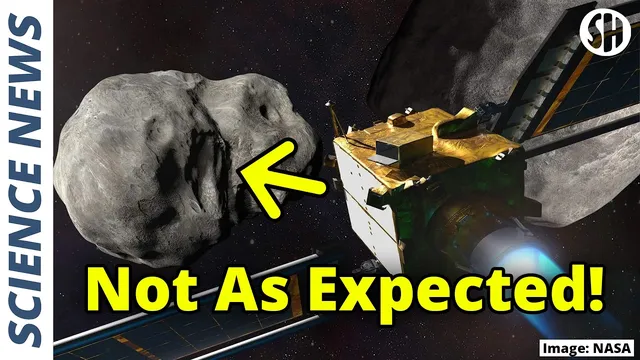
Unexpected Result of NASA’s Asteroid Deflection Test
Based on Sabine Hossenfelder's video on YouTube. If you like this content, support the original creators by watching, liking and subscribing to their content.
DART’s collision with Dimorphos shortened its orbital period around Didymos by about 33 minutes, confirming measurable deflection.
Briefing
NASA’s DART asteroid-deflection test worked—but the physics behind the “kick” turned out far messier than mission planners expected. Instead of mainly ejecting a relatively uniform spray of dust and small pebbles, the impact on Dimorphos appears to have launched large boulder fragments at high speed. Even more consequential, those fragments carried more than three times the momentum of the DART spacecraft itself, meaning the asteroid’s own material contributed disproportionately to the change in motion.
DART—Double Asteroid Redirection Test—launched in November 2021 and struck Dimorphos, the smaller member of the Didymos–Dimorphos binary system, on September 26, 2022. Dimorphos is roughly 160 meters across and orbits Didymos every ~12 hours; the pair sits about 11 million kilometers from Earth, too small for detailed tracking with ordinary telescopes. While the impact was observed from Earth and space, early results mostly confirmed that the collision happened. The key new information came from LICIACube, a small Italian satellite that separated from DART days before impact and flew past the site with two cameras to record the debris trajectories.
Those recordings, now analyzed in a new paper, contradict earlier assumptions drawn in part from NASA’s Deep Impact comet encounter. The DART impact seems to have excavated many boulders—some large—rather than producing only a fine, even ejecta cloud. The momentum boost is striking: the boulder fragments’ momentum exceeded DART’s own by more than a factor of three. The ejecta also didn’t disperse evenly. Instead, fragments clustered into two dominant directions, which the authors attribute to the impact geometry—specifically, that the impact region contained two larger boulders that were effectively “annihilated,” shaping how material was thrown.
Despite the unexpected ejecta behavior, the orbital outcome still matched the broad goal of deflection. Observations so far indicate DART shortened Dimorphos’s orbital period around Didymos by about 33 minutes. That change is small in absolute terms for the overall system trajectory—DART’s mass was under a ton compared with an estimated 500 billion tons for the asteroid—yet it is large enough to demonstrate controllable momentum transfer.
Future missions are expected to resolve what happened at the surface. The European Space Agency’s Hera mission, launched in October 2025, is scheduled to arrive at Didymos in late 2026. Hera will map the crater in high resolution and measure how the binary’s mutual orbits changed, providing a direct test of the ejecta-based momentum model. Separately, China’s planned asteroid impact test aims to send two spacecraft to a ~30-meter asteroid around 2027, with an impact as early as 2028.
Taken together, the new analysis reframes asteroid defense: moving an asteroid is possible, but predicting the exact outcome may require more detailed knowledge of surface structure and impact mechanics. In short, the “planetary defense” concept is working—yet the method is less like a clean shove and more like firing at a target that breaks in complicated ways.
Cornell Notes
NASA’s DART mission successfully altered the orbit of the small asteroid Dimorphos, but the momentum-transfer details came out unexpectedly. New analysis of LICIACube camera data suggests the impact ejected many high-speed boulders rather than a mostly uniform dust-and-pebble spray. The momentum carried by those boulder fragments exceeded DART’s own momentum by more than three times, and the ejecta clustered into two main directions, likely shaped by two large boulders at the impact site. The orbital period of Dimorphos around Didymos shortened by about 33 minutes, confirming deflection occurred. Hera will later map the crater and refine how much the orbits changed, improving predictions for future asteroid-impact tests.
What did DART actually do, and why was the target system chosen?
What new evidence changed expectations about how the impact “kicked” the asteroid?
How did the ejecta momentum compare to DART’s momentum, and why does that matter?
Why didn’t the ejecta spread evenly, and what mechanism was proposed?
What orbital change has been observed so far, and how does it relate to the spacecraft’s size?
What missions are expected to refine the crater and orbital-change measurements?
Review Questions
- What specific assumption about ejecta composition and distribution did the LICIACube data challenge, and what did it replace it with?
- How do the reported momentum and directionality of boulder fragments connect to the observed ~33-minute orbital period reduction?
- Why is the overall system trajectory change described as negligible even though the orbital period change is measurable?
Key Points
- 1
DART’s collision with Dimorphos shortened its orbital period around Didymos by about 33 minutes, confirming measurable deflection.
- 2
New LICIACube camera analysis suggests the impact produced many high-speed boulder fragments rather than a mostly uniform dust-and-pebble spray.
- 3
Boulder fragments carried more than three times the momentum of the DART spacecraft, indicating the asteroid’s material response dominated momentum transfer.
- 4
Ejecta clustered into two main directions, likely reflecting two large boulders at the impact site that were effectively destroyed.
- 5
The deflection effect is small in absolute terms for the whole system because DART’s mass was under a ton versus an estimated 500 billion tons for the asteroid system.
- 6
Hera will map the crater in high resolution and measure orbital changes to improve future prediction models.
- 7
China’s planned two-spacecraft asteroid impact test targets a ~30-meter asteroid to further validate impact-and-deflection outcomes.