Unity Is Changing Course
Based on The PrimeTime's video on YouTube. If you like this content, support the original creators by watching, liking and subscribing to their content.
Unity canceled the runtime fee for game customers effective immediately, aiming to reduce developer uncertainty about costs tied to downloads.
Briefing
Unity’s most consequential shift is the cancellation of its controversial “runtime fee” for game customers, effective immediately—an about-face that signals the company is trying to restore trust after a pricing model that developers feared could turn into an unpredictable tax on downloads. The fee had been tied to self-reported monthly engagement and revenue, with charges kicking in once games crossed specified thresholds. After that, Unity would take the lesser of 2.5% of monthly gross revenue or a per-install-style charge, meaning a high download count could still translate into meaningful costs even for smaller teams.
The backlash wasn’t just about the headline percentage. Developers raised concerns about how the system could be gamed—especially before protections against “denial of wallet” were added. In the transcript’s framing, a single actor could potentially bot-farm installs and trigger charges, creating a worst-case scenario where the runtime fee could become effectively “infinite” for a target studio. Unity later adjusted the approach to reduce that risk by comparing the 2.5% gross-revenue figure against the alternative install-based calculation.
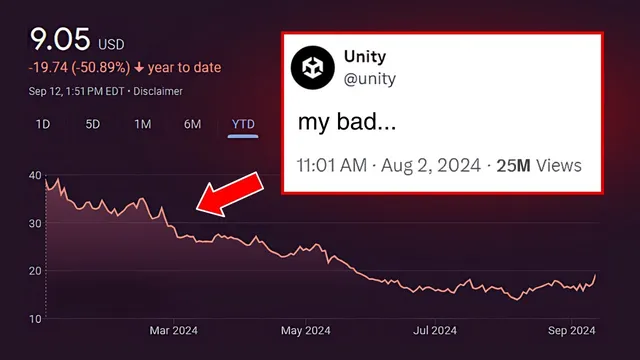
Financial context helps explain why Unity moved. Revenue has been falling, with one cited figure showing Google revenue down nearly 16% year-over-year. Net income improved, but the margin picture still looked weak, and the discussion points to likely cost-cutting such as layoffs and reduced support. That combination—declining top-line growth plus pressure to stabilize cash flow—made the runtime fee a flashpoint rather than a sustainable lever.
The transcript also treats the runtime-fee reversal as part of a broader pricing reset rather than a one-off apology. Unity’s stated plan is to revert to more traditional annual pricing changes and to keep existing editor terms for developers who continue using older versions under previously agreed conditions. For 2025, Unity says it will keep Unity Personal free while doubling the revenue and funding ceiling from $100,000 to $200,000, and it will make the “Made with Unity” splash screen optional for Unity Personal games made with Unity 6.
Meanwhile, Unity Pro and Unity Enterprise pricing increases are scheduled for January 1, 2025. Unity Pro faces an 8% subscription price increase to $2200 USD annually per seat, and it becomes required for customers above $200,000 USD in total annual revenue and funding. Unity Enterprise sees a 25% subscription-based price increase and becomes required above $25 million USD. The discussion interprets this as a deliberate reshaping of Unity’s customer pipeline: expand the hobbyist pool with a more generous free tier, while raising prices on higher-revenue segments that are harder to switch away from.
Overall, the cancellation is presented as damage control—but also as a practical correction driven by market reality. The transcript repeatedly returns to a trust problem: game development is a long commitment, and switching engines is costly, so even perceived untrustworthiness can push studios to plan around alternatives. Unity’s challenge now is whether the new pricing structure and partnership messaging can rebuild confidence fast enough to keep developers from diversifying away from Unity.
Cornell Notes
Unity is canceling its runtime fee for game customers effective immediately, a move aimed at easing developer fears that costs could scale unpredictably with downloads. The runtime fee had been based on self-reported monthly engagement and revenue, charging the lesser of 2.5% of monthly gross revenue or an install-based amount after games crossed thresholds. Unity’s financial pressure—declining revenue and weak growth—frames the reversal as a pivot to regain trust and stabilize its business. In 2025, Unity Personal stays free but raises its revenue/funding cap to $200,000 and makes the “Made with Unity” splash optional for Unity 6 games; Unity Pro and Enterprise face higher subscription pricing and stricter revenue gates.
How did Unity’s runtime fee work, and why did it worry developers?
What “denial of wallet” concern came up, and how did Unity respond?
Why does the transcript connect the runtime-fee reversal to Unity’s financial performance?
What changes are planned for Unity Personal, Unity Pro, and Unity Enterprise in 2025?
How does the transcript interpret the pricing structure as a “pipeline” strategy?
Review Questions
- What specific mechanism tied Unity’s runtime fee to a game’s performance, and what calculation did Unity use once thresholds were met?
- How do the 2025 changes to Unity Personal differ from the changes to Unity Pro and Unity Enterprise in both pricing and eligibility thresholds?
- Why does the transcript argue that trust matters more for game development than for one-time consumer purchases?
Key Points
- 1
Unity canceled the runtime fee for game customers effective immediately, aiming to reduce developer uncertainty about costs tied to downloads.
- 2
The runtime fee was based on self-reported monthly engagement and revenue, charging the lesser of 2.5% of monthly gross revenue or an install-based amount after threshold crossings.
- 3
Concerns included potential abuse scenarios like bot-farming installs (“denial of wallet”), which Unity addressed by changing how charges were calculated.
- 4
Unity Personal stays free but raises its revenue/funding cap from $100,000 to $200,000 and makes the “Made with Unity” splash optional for Unity 6 Personal games.
- 5
Unity Pro pricing rises 8% to $2200 USD annually per seat, and Unity Pro becomes required above $200,000 USD total annual revenue and funding.
- 6
Unity Enterprise pricing rises 25% and becomes required above $25 million USD total annual revenue and funding.
- 7
The transcript frames the shift as both damage control and a pipeline strategy: grow the hobbyist pool while monetizing higher-revenue customers with higher subscription gates.