Unpacking Notemaking: Concept Modeling with Nick Milo
Based on Zsolt's Visual Personal Knowledge Management's video on YouTube. If you like this content, support the original creators by watching, liking and subscribing to their content.
Concept modeling defines terms by placing concepts in boxes (often nouns) and relationships in arrows (often verbs) so connected words read like short sentences.
Briefing
Notemaking gets reframed from “capturing information” into a structured thinking practice: define a clear vocabulary, externalize ideas visually, and build a concept map where each relationship reads like a sentence. The core move is concept modeling—using boxes for concepts (usually nouns) and arrows for relationships (usually verbs)—to turn vague mental impressions into an ambiguity-free set of terms that can be revisited and refined.
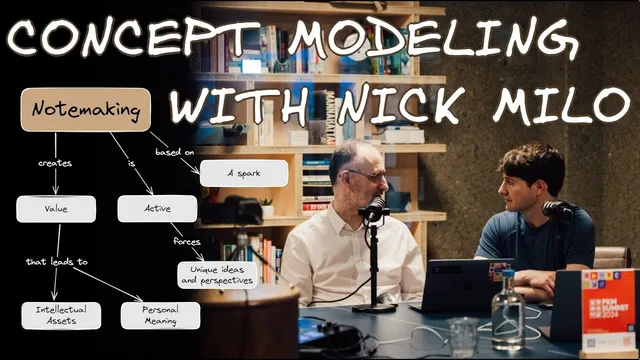
The conversation centers on building a concept model for “note making.” The starting point is a central box labeled “note making,” then adding a key descriptor: “active.” An arrow from “note making” to “active” is treated as a readable statement—following the arrow and the words forms a short sentence that clarifies meaning. From there, the model expands by adding supporting nouns and verbs that explain what note making actually does. The process emphasizes that there’s no single correct diagram; the point is to clarify thinking and then reflect on it. Visual externalization comes before writing, so the vocabulary is cleaner and the eventual prose is less muddled.
A major distinction emerges between note taking and note making. Note taking is framed as taking or clipping information from elsewhere—passive extraction. Note making, by contrast, is portrayed as creating: creating intellectual assets (or intellectual capital), generating insights, and producing personal meaning. The model also introduces “spark” as a foundational input—an energetic, general starting point that can take many forms: an information nugget, an idea, a highlight, a book highlight, or a concept tied to a purpose. In the diagram, “spark” sits as the basis for what the note is made from, connected via arrows to the actions and outcomes.
The practical workflow is also part of the takeaway. A blank drawing is created, the grid is turned on for alignment, and rectangles are added for concepts. A “parking lot” area helps brainstorm additional nouns before connecting them. The diagram’s spatial organization matters because it supports memory and recall. Keyboard shortcuts (like command/undo and arrow creation) speed up iteration, reinforcing the idea that the model is a living artifact rather than a finished artwork.
By the end, the concept model functions as a durable reference: an artifact that can be revisited when writing, communicating, or working on projects. The value of note making is described as unfolding over time—notes reveal their usefulness later by informing future work, conversations, and decisions. The closing sentiment is that mapping clarifies ideas immediately and leaves behind a usable artifact for the long term, with a promise that the resulting framework will appear in a forthcoming book section on note making.
Cornell Notes
Concept modeling is used to define “note making” as an active, value-creating practice rather than passive information capture. In the model, boxes hold concepts (often nouns) and arrows hold relationships (often verbs), so following an arrow reads like a short sentence that clarifies meaning. “Note making” is linked to “active,” and its inputs are framed as a “spark” that can come from ideas, highlights, or other prompts. Outcomes are described as creating value—such as intellectual assets/capital—generating insights, and producing personal meaning. The approach emphasizes externalization and reflection: putting vocabulary and relationships on paper improves later writing and communication.
How does concept modeling turn a fuzzy definition into something usable?
Why does the model treat “note making” as different from “note taking”?
What role does “spark” play in the definition?
What outcomes are attached to note making in the concept model?
How does the process support long-term usefulness?
Review Questions
- In a concept model, what do boxes and arrows represent, and how does that affect the clarity of definitions?
- How does the transcript’s definition of “note making” change when compared with “note taking”?
- Why is “spark” treated as a foundational input, and what kinds of sources can it represent?
Key Points
- 1
Concept modeling defines terms by placing concepts in boxes (often nouns) and relationships in arrows (often verbs) so connected words read like short sentences.
- 2
“Note making” is framed as active and value-creating, not passive information capture.
- 3
“Spark” is used as a general input category for what notes are based on, including ideas and book highlights.
- 4
The model distinguishes note taking (taking/clipping information) from note making (creating value, insights, and personal meaning).
- 5
Externalizing ideas visually supports reflection and leads to cleaner later writing because vocabulary becomes more consistent.
- 6
Spatial organization (including a brainstorming “parking lot”) helps memory and makes the artifact easier to revisit.
- 7
Notes are portrayed as long-term assets whose value often becomes clear only after time and reuse.