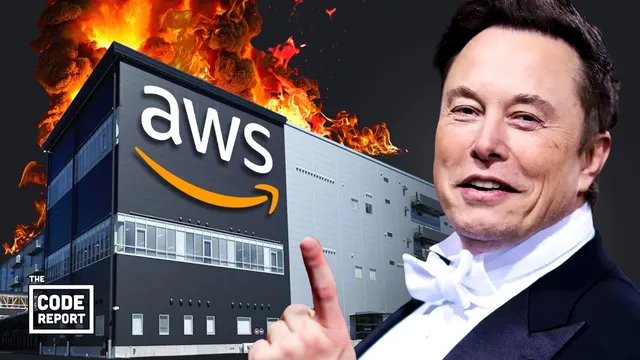
US-EAST-1 is humanity’s weakest link…
Based on Fireship's video on YouTube. If you like this content, support the original creators by watching, liking and subscribing to their content.
US-EAST-1 DNS resolution failures prevented applications from locating critical AWS API endpoints, including those tied to Amazon DynamoDB.
Briefing
A single DNS misconfiguration in AWS’s US-EAST-1 region triggered a cascading failure that knocked out a long list of major consumer and business services—Netflix, Reddit, PlayStation, Roblox, Fortnite, Robin Hood, Coinbase, Venmo, Snapchat, Disney, and many others—highlighting how deeply modern life depends on one cloud provider. The core issue wasn’t that every application was broken at once; it was that many of them rely on AWS for critical backend services. When AWS’s name resolution for API endpoints failed, apps couldn’t reliably find core components like Amazon DynamoDB, turning functioning systems into “instant vaporware” for users.
US-EAST-1 sits in Northern Virginia near major U.S. economic and population centers and is one of AWS’s oldest and most important regions. AWS regions are built from multiple data centers and at least three availability zones designed for redundancy—each zone has its own power, cooling, and networking—so localized damage shouldn’t necessarily take down everything. Yet the outage showed that even well-designed redundancy can’t prevent region-wide failures when the fault sits in a shared control plane function. In this case, AWS reported increased error rates and latency across multiple services at 9:07 p.m. Eastern time, then traced the root problem to DNS resolution for service API endpoints, with Amazon DynamoDB called out as the most notable impacted subsystem.
DNS acts like the internet’s phone book: applications ask DNS where to find the right service endpoint, and then proceed with requests. With DNS broken, AWS couldn’t resolve where the database and related endpoints should be reached, so dependent services failed. Even after AWS fixed the underlying DNS issue within a couple of hours, the damage didn’t end immediately. A backlog of serverless work accumulated during the disruption—Lambda function calls and messages queued through Amazon Simple Queue Service—so many applications continued to experience degraded performance for hours afterward as the queue drained.
The incident also fed a broader reliability argument: concentrating too much infrastructure in a single provider creates systemic risk. The transcript frames this as a reason developers should avoid “one-company centralization,” pointing to other outages and capacity constraints elsewhere (including a claim about Superbase facing extended downtime in EU West 2 due to AWS capacity limits). While blame is left uncertain, the narrative suggests a likely human or deployment error—potentially “bad AI code”—as the kind of mistake that can slip into production.
Finally, the segment pivots to mitigation through better development workflow. It promotes Tracer, described as an agent orchestrator that plans and verifies coding-agent changes, scanning modifications to flag issues before they reach production. The takeaway is less about any single brand’s failure and more about the fragility of global systems when a shared dependency—like US-EAST-1 DNS—goes wrong, and how long recovery can last even after the primary fault is repaired.
Cornell Notes
A DNS misconfiguration in AWS’s US-EAST-1 region caused widespread service outages across many popular apps. AWS traced the problem to broken DNS resolution for API endpoints, with Amazon DynamoDB identified as a key impacted subsystem. Even after AWS fixed the issue within a couple of hours, queued serverless workloads (including AWS Lambda calls and Amazon Simple Queue Service messages) piled up and kept many services impaired for hours. The incident underscores how region-wide control-plane failures can bypass availability-zone redundancy and how heavy reliance on one cloud provider increases systemic risk. It also argues for stronger development safeguards and better orchestration/verification to prevent bad changes from reaching production.
Why did a DNS problem in US-EAST-1 take down so many unrelated apps?
What role do availability zones and multiple data centers play, and why didn’t they prevent this outage?
What was the timeline of the incident as described?
Why did services remain impaired after the DNS issue was fixed?
What reliability lesson does the transcript draw about cloud concentration?
How does Tracer fit into the mitigation narrative?
Review Questions
- What is the relationship between DNS resolution and the ability of applications to reach services like Amazon DynamoDB?
- How can an outage tied to a shared subsystem in one AWS region persist even after the primary fault is corrected?
- Why might availability zones fail to prevent a region-wide incident when the underlying issue is not localized to a single zone?
Key Points
- 1
US-EAST-1 DNS resolution failures prevented applications from locating critical AWS API endpoints, including those tied to Amazon DynamoDB.
- 2
Availability-zone redundancy can’t fully protect against region-wide control-plane failures that affect shared service discovery.
- 3
AWS reported increased errors and latency at 9:07 p.m. Eastern time before narrowing the issue to DNS resolution for API endpoints.
- 4
Even after the DNS fix, queued serverless workloads (AWS Lambda and Amazon Simple Queue Service messages) kept services degraded for hours.
- 5
The outage illustrates systemic risk from heavy dependence on a single cloud provider and a small number of major regions.
- 6
Stronger pre-production verification for code changes—such as the workflow described for Tracer—aims to reduce the chance of faulty deployments causing outages.