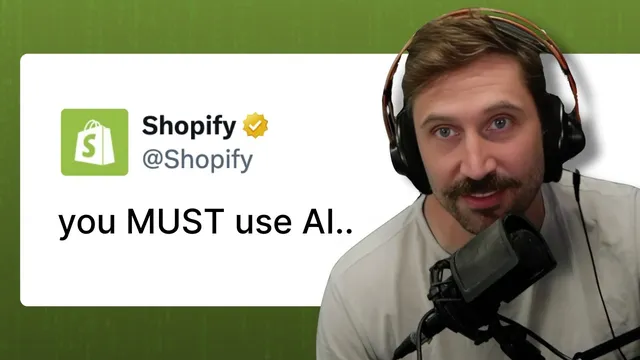
"Use AI Now!" Prime Reacts
Based on The PrimeTime's video on YouTube. If you like this content, support the original creators by watching, liking and subscribing to their content.
Shopify’s internal messaging frames AI as a baseline expectation, emphasizing “reflexive” use rather than occasional experimentation.
Briefing
Shopify is pushing AI into everyday work—so hard that “reflexive AI usage” is framed as a baseline expectation rather than an optional productivity hack. The leaked internal memo positions AI as a step-function change for merchants and entrepreneurs, arguing that AI won’t just help with consultation but will increasingly do parts of the work itself, reducing the complexity of entrepreneurship and speeding up execution.
Inside the company, the memo’s message is that AI becomes a core skill: using it well is treated like a craft that must be learned, practiced, and integrated into performance expectations. It also claims AI functions as a multiplier for top performers, with some teams using AI to accomplish work that previously took far longer—figures like “100x” appear, though skepticism surfaces around whether such numbers are credible or meaningful. The practical examples offered in the discussion center on coding workflows: tools like Cursor Tab (and comparisons to GitHub Copilot) are described as especially effective at generating boilerplate, accelerating the “get thoughts out of the head” phase, and reducing repetitive typing.
A major tension runs through the conversation: AI can raise short-term output, but it may also erode long-term skill. The discussion draws a line between productivity and learning. If developers lean on AI to skip hard fundamentals—like shader work or other complex domains—they may avoid the learning curve now, but later pay a “ceiling” cost when they can’t modify or debug what the model produced. The argument isn’t that AI is bad; it’s that over-reliance can lead to “learned helplessness,” where people become dependent on what large language models generate rather than building the competence to steer outcomes.
The memo’s proposed cultural and operational changes include adding AI usage questions to performance and peer review, dedicating time to AI integration in monthly business reviews and product development cycles, and encouraging teams to demonstrate where AI can’t help. It also emphasizes shared learning: using internal resources like chatshopify.io, adopting pre-tooled AI coding environments (including Cursor Cloud and other copilots), and sharing prompts and outcomes—along with “W’s and L’s” as teams experiment.
Still, the conversation challenges the idea that AI should replace the learning process entirely. There’s a call to use AI most heavily during prototyping—when speed matters and prototypes are meant to be thrown away—while preserving the hard-skill development needed for production-grade work. The discussion also predicts a market side effect: if companies optimize for fast output, software quality may suffer, leading to more fragile systems and more annoying bugs. In the end, the stance is nuanced: AI is likely permanent in software development, but the best path may be “expert beginners” who use AI as an accelerator while staying responsible for understanding, decision-making, and long-term competence.
Cornell Notes
Shopify’s internal messaging frames AI as a baseline expectation, not an optional tool—pushing merchants and employees toward faster execution and AI-assisted work. The memo emphasizes that using AI well is a learnable skill, and it proposes concrete management changes like AI questions in performance reviews and dedicated time for AI integration in business cycles. Coding examples focus on AI’s strength at generating boilerplate and accelerating early ideation, with Cursor Tab cited as more satisfying than Copilot for some workflows. A key warning is that productivity gains can come at the cost of learning: relying too heavily on AI may cap future ability and create “learned helplessness,” especially when prototypes become production. The suggested compromise is to lean on AI for prototyping and exploration while still building the hard skills needed for real engineering work.
Why does the memo treat AI usage as a “baseline expectation” rather than a discretionary advantage?
What’s the practical case for AI in day-to-day coding, according to the discussion?
How does the conversation distinguish productivity from learning, and why does that matter?
What compromise is proposed for using AI effectively without sacrificing long-term skill?
What management and culture changes are described as part of the AI push?
What skepticism is raised about big performance claims like “100x”?
Review Questions
- What specific mechanisms make AI coding tools feel like a “multiplier” for some tasks, and where do they create new friction?
- How does the productivity-versus-learning distinction change the way someone should plan AI usage across prototyping and production?
- Which memo-style management practices (performance reviews, business cycles, team requirements) are intended to reinforce AI adoption, and what risks do critics associate with that approach?
Key Points
- 1
Shopify’s internal messaging frames AI as a baseline expectation, emphasizing “reflexive” use rather than occasional experimentation.
- 2
AI is positioned as more than a consultation aid—expectations include AI doing parts of the work for merchants and teams.
- 3
AI coding tools are praised for accelerating boilerplate-heavy workflows (with Cursor Tab highlighted), but they can also generate incorrect or frustrating output.
- 4
A central warning is that heavy reliance can trade away learning for short-term productivity, leading to a future competence ceiling and “learned helplessness.”
- 5
The proposed best practice is to use AI most aggressively during prototyping and exploration, while preserving hard-skill development needed for production.
- 6
Shopify’s adoption plan includes AI questions in performance/peer review, dedicated AI integration time in business reviews, and prompts for teams to justify where AI can’t be used.
- 7
Critics question extreme claims like “100x,” arguing that more modest, measurable gains may be more realistic and less misleading.