Use AI to get BETTER prompts for DALL-E 2 Midjourney & Stable Diffusion! - Type Stitch
Based on MattVidPro's video on YouTube. If you like this content, support the original creators by watching, liking and subscribing to their content.
Type Stitch generates multiple copy-ready prompt variations from a short keyword seed, adding character traits, props, and action/setting details.
Briefing
Type Stitch positions itself as a prompt “idea generator” for text-to-image models—turning a few keywords into multiple, more descriptive prompt variations that better capture character, setting, and story beats. The practical payoff is straightforward: instead of wrestling with keyword craft, users can start with a short phrase (like “coca-cola character”) and quickly get several ready-to-copy prompts that add visual details such as facial expression, props, lighting, and action.
In a live test, Type Stitch produced five distinct prompt directions from the same minimal input. One result leaned into a friendly “friendly and bubbly” character dancing in the sun while holding a Coca-Cola can; another placed a cheerful character at a ranch with cowboy styling; a third combined a mischievous vibe with a character sitting on the hood of an old car and drinking Coca-Cola; a fourth focused on sunglasses and reflective highlights; and a fifth went for a high-detail, contradictory character concept—an imposing armored figure with a kind inner soul who still loves iced Coca-Cola. The prompts weren’t just longer—they often added narrative structure (“greeting guests,” “sitting on the hood,” “hiding behind an intimidating facade”) and specific visual cues (“bright eyes,” “big smile,” “reflecting brightly,” “dancing around in the sun”).
To see whether those richer prompts actually improve outputs, the workflow was tested across DALL·E and DreamStudio (Stable Diffusion). With DALL·E, the base keyword prompt (“coca-cola character”) already produced Coca-Cola-branded characters and a working logo, but Type Stitch’s expanded prompts made the scenes feel more intentional—especially when the prompt included both character expression and action. One notable limitation emerged: DALL·E sometimes treated the “Coca-Cola character” concept more like an advertisement-style character, and in at least one case the Coca-Cola element didn’t fully carry through when the prompt omitted it.
Stable Diffusion generally tracked the prompt details more closely, particularly for the “bright eyes + big smile + holding Coca-Cola” style direction. The “mischievous on the hood of an old car” concept landed more coherently in DALL·E, while Stable Diffusion showed stronger adherence to the character-and-prop framing in other cases. For the most complex prompt—an armored, masked figure with a gentle inner personality—the models struggled with the full nuance, but still generated interesting armor-and-Coca-Cola imagery, suggesting the tool’s value is often in sparking workable variations rather than guaranteeing perfect semantic control.
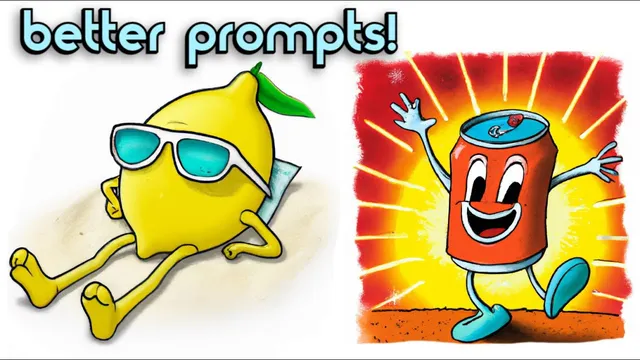
A second test used a “lemon character” baseline prompt (including a Pixar-like 3D render style) and then fed Type Stitch variations such as “wearing sunglasses,” “sunlight glistens off its skin,” and “enjoying the sun and surf.” Type Stitch consistently added extra descriptive texture—sometimes shifting the look toward more cartoony 2D-like rendering in DALL·E, while Stable Diffusion handled some details better than others. The overall conclusion: Type Stitch is most useful as a prompt-ideation layer that produces multiple, copy-ready prompt candidates, which can then be iterated in different image generators.
Pricing and credits were also reviewed. The site follows a credit system similar to DALL·E-style usage: users start with 100 credits, and generating prompt sets consumes credits quickly. The tool is framed as expensive for pure prompt generation compared with generating images directly in some image platforms, but the free trial helps users test whether the prompt quality and variety justify the cost. The creator also indicated future plans—an integrated image generator and merch/T-shirt printing—aimed at making the credit system more aligned with a broader end-to-end workflow.
Cornell Notes
Type Stitch turns a short set of keywords into multiple, more detailed prompt options for text-to-image models. In tests using DALL·E and DreamStudio (Stable Diffusion), the generated prompts often improved scene clarity by adding character traits (bright eyes, big smiles), actions (dancing, greeting guests, sitting on a car hood), and visual specifics (sunglasses reflections, sun lighting). Stable Diffusion tended to follow prompt details more closely in some cases, while DALL·E sometimes shifted toward ad-like character styling. The tool’s main value is speed and variety: it gives several copy-ready prompts to iterate on rather than forcing users to learn prompt “keyword craft” from scratch.
How does Type Stitch change a minimal prompt into something more usable for image generation?
What differences showed up between DALL·E and Stable Diffusion when using Type Stitch prompts?
Why did the most detailed prompt (armored, masked figure with a kind soul) not fully land as intended?
What happened when the same Type Stitch approach was applied to a “lemon character” baseline?
What practical limitation did the tester encounter while using Type Stitch?
Review Questions
- When you start with only two keywords, which types of added details from Type Stitch (expression, action, lighting, props) seem most likely to improve results in DALL·E versus Stable Diffusion?
- How would you simplify a highly detailed, contradictory prompt (like the armored gentle soul who loves Coca-Cola) to increase the chance of a coherent output?
- Given the credit system, what strategy would you use to decide whether Type Stitch is worth paying for versus generating prompts directly in an image model workflow?
Key Points
- 1
Type Stitch generates multiple copy-ready prompt variations from a short keyword seed, adding character traits, props, and action/setting details.
- 2
DALL·E can produce strong, coherent character scenes from Type Stitch prompts, but may sometimes shift toward ad-like styling or drop elements when the prompt omits them.
- 3
Stable Diffusion often tracks prompt details more closely, especially when the prompt clearly specifies character expression plus a specific prop or action.
- 4
Very dense prompts with contradictions (e.g., menacing armor paired with a gentle inner personality) may not fully resolve, but can still yield useful partial matches for iteration.
- 5
Type Stitch’s input may reject non-alphanumeric characters such as commas, so prompt formatting matters.
- 6
The credit-based pricing can feel expensive for prompt generation alone, making the free trial important for evaluating value.
- 7
Future features mentioned include an integrated image generator and merch/T-shirt printing, which could better justify the credit system.