Use Anti-Fragile Thinking to Create the Life You Want
Based on Ali Alqaraghuli, PhD's video on YouTube. If you like this content, support the original creators by watching, liking and subscribing to their content.
Treat failure as inevitable within iteration cycles, and design actions to reach the breaking point quickly rather than avoiding it.
Briefing
Success, in this framework, comes less from obsessing over the “right” outcome and more from engineering a faster path to failure—so learning arrives sooner. Most self-help advice starts with clarity: visualize the dream, write the goal down, and focus on what you want. The counterintuitive shift here is to treat failure as inevitable and to build an “anti-fragile system” that asks a different question: not “How do I succeed?” but “How do I fail as fast as possible in the next step so I can learn and iterate?”
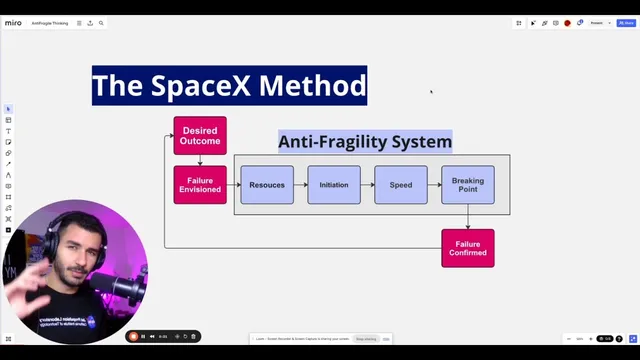
The approach borrows from how SpaceX is described as operating: failure is expected within an iteration loop, and the goal is to reach the breaking point quickly. When someone tries to scale a business—say targeting monthly revenue like $10K, $20K, or $30K—the instinct is often to reduce risk by getting the strategy “right” before spending. The anti-fragile method flips that logic. It assumes the market is dynamic, the method will likely break, and the unknowns are too large to eliminate risk upfront. Instead of trying to avoid waste, it focuses on initiating experiments with enough resources to begin, then moving quickly once the experiment is underway.
The process is laid out in phases. First comes resource gathering and initiation: confirm there’s enough skill and capability to start, then begin rather than waiting for perfection. Second is speed at the breaking point: once the experiment is likely to fail, the system leans into that moment so the failure becomes “confirmed” evidence—what didn’t work, what broke, and what can be adjusted. Third is repetition: use what’s learned to iterate and run the next cycle.
This mindset is framed as especially useful for solopreneurs and anyone lacking external accountability. Perfectionism, fear, and scarcity can paralyze decision-making—particularly when money is limited and experiments (like ad spend) feel risky. The anti-fragile system treats those emotions as signals to expect disruption rather than as reasons to delay action. Instead of running life like a controlled simulation where everything goes right, it prepares for variables that can’t be counted in advance.
A personal example reinforces the idea. Early on, the creator’s engineering channel growth is described as slow, with perfectionism delaying output because of fear that videos wouldn’t perform. Later, a shift toward indifference about whether individual attempts succeed—paired with a commitment to teach something valuable—reduced hesitation. The same logic is applied to engineering work at NASA, where tests may need to be repeated dozens of times; progress comes from accepting that things will fail during trials and using each failure as confirmation that the system is being stress-tested.
Ultimately, the core claim is that expecting things to go wrong makes people faster and more resilient. Confidence and courage come from facing breakdowns directly, learning from them, and iterating—so the long-term “getting it right” happens through many short cycles of breaking, learning, and rebuilding.
Cornell Notes
The anti-fragile framework shifts goal-setting from “visualize success” to “engineer faster learning through failure.” It treats failure as inevitable within iteration loops and reframes the central question from how to succeed to how to fail quickly in the next step. The method emphasizes three phases: gather enough resources to start, initiate despite uncertainty, and then move fast at the breaking point so failure produces actionable feedback. Repeating that cycle builds speed and resilience, particularly for solopreneurs who lack accountability and are prone to perfectionism, fear, and scarcity-driven delay.
How does the anti-fragile mindset change the way someone approaches a goal like scaling a business?
What are the three phases of the anti-fragile system, and why does each matter?
Why does the framework argue that expecting failure can make someone more productive?
How does the NASA testing example support the anti-fragile idea?
What does the creator’s channel-growth story illustrate about perfectionism?
Review Questions
- When scaling a business, what specific question does the anti-fragile framework replace, and what does that change in practice?
- Describe the difference between initiation, speed at the breaking point, and repetition. How does each stage reduce paralysis?
- Why might a solopreneur be more vulnerable to the failure-avoidance loop, and how does the anti-fragile system counter it?
Key Points
- 1
Treat failure as inevitable within iteration cycles, and design actions to reach the breaking point quickly rather than avoiding it.
- 2
Replace “How do I succeed?” with “How do I fail fast in the next step so I can learn?”
- 3
Start only when there’s enough capability to initiate; perfectionism often prevents people from even beginning.
- 4
Move with speed once an experiment is underway, so failure produces confirmed feedback instead of lingering uncertainty.
- 5
Use each failure as actionable evidence, then repeat the cycle to build long-term improvement through short iterations.
- 6
Expect dynamic conditions (especially in markets and methods) so surprises don’t derail decision-making.
- 7
For solopreneurs, counter fear and scarcity-driven delay by planning experiments as learning loops, not as one-shot bets.