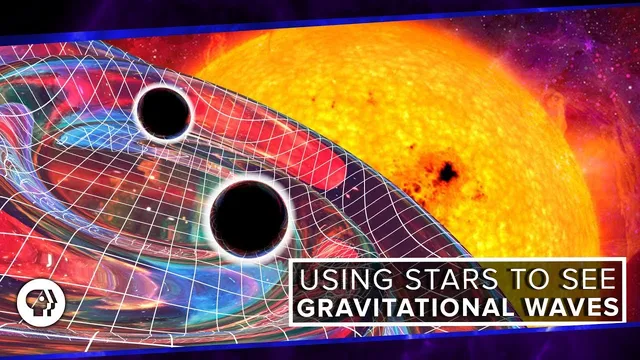
Using Stars to See Gravitational Waves
Based on PBS Space Time's video on YouTube. If you like this content, support the original creators by watching, liking and subscribing to their content.
LIGO’s early catalog includes five confident black hole–black hole mergers with inferred component masses that are larger than expected from simple stellar-evolution models.
Briefing
Gravitational-wave astronomy is entering a “golden age,” but the biggest story right now isn’t just more detections—it’s how those signals are forcing physicists to rethink what black holes and the early universe can look like. LIGO’s first two and a half years have produced five confident black hole–black hole mergers, yet the masses inferred from those events don’t fit standard expectations. If the black holes formed from the deaths of massive stars, they should typically land in the roughly 5–15 solar-mass range (about 20 at most). Instead, three mergers involve components well above 20 solar masses, and the remaining two push past 30 solar masses. That mismatch has triggered a wave of explanations, from revised stellar-evolution pathways to growth inside dense environments like globular clusters. Other proposals go further—suggesting primordial black holes from the Big Bang or black holes that gained mass by being swept up and fed inside quasar accretion disks.
One recent idea shifts the focus from the black holes themselves to the space between them: gravitational lensing. General relativity predicts that gravitational fields can warp the paths of gravitational waves, amplifying the signal and stretching its effective wavelength. If lensing boosts a merger that truly sits in the 5–15 solar-mass band, it could masquerade as a much heavier event in LIGO’s data. That lensing possibility matters because it changes how astronomers infer the population statistics of black holes—how many exist, how they form, and how often they merge.
The field’s most consequential confirmation so far came from the first observed neutron star–neutron star merger with a multiwavelength counterpart. After the gravitational-wave trigger, a gamma-ray burst and then an afterglow across the electromagnetic spectrum were detected, prompting observatories worldwide to track the event. Those observations don’t just enrich neutron-star physics; they also help identify when gravitational-wave sources are likely to be lensed, since the electromagnetic counterpart provides an independent handle on the event’s location and environment. Virgo’s participation was crucial for narrowing the origin, and the network is set to expand with LIGO-India (IndIGO), planned to begin operations in 2024.
Looking beyond today’s detectors, the frequency of the gravitational waves determines what kind of universe can be heard. LIGO’s four-kilometer arms make it sensitive to roughly 1 hertz to 10 kilohertz—frequencies associated with the final orbits of stellar-mass binaries. Supermassive black hole mergers, by contrast, radiate at far lower frequencies (about 0.1 millihertz to 0.1 hertz), demanding an interferometer with arms millions of kilometers long. That mission is LISA, the European Space Agency’s Laser Interferometer Space Antenna, scheduled for a 2034 launch with 2.5 million-kilometer arms. LISA is also expected to detect the long, faint “hum” from thousands of compact binaries—white dwarfs, neutron stars, and black holes—long before they merge.
Even longer wavelengths push past what any interferometer could directly measure. For that, nature provides a timing array: pulsars. The international pulsar timing array monitors dozens of millisecond pulsars across thousands of light-years, searching for tiny shifts in the arrival times of their pulses caused by passing gravitational waves. This galaxy-scale observatory is already setting limits on the gravitational-wave background and may offer a route to probing epochs close to the Big Bang. Finally, researchers are exploring how gravitational waves might interact with stars themselves—resonantly exciting stellar oscillations that could heat and brighten stars, or potentially contribute to explosive outcomes in white dwarf systems. The common thread is clear: gravitational waves are no longer just a new detection channel; they’re becoming a tool that can reshape astrophysical assumptions and potentially reach back toward the universe’s earliest moments.
Cornell Notes
LIGO has detected five black hole–black hole mergers whose inferred masses are unexpectedly large compared with what standard stellar evolution predicts. One proposed fix is gravitational lensing: intervening gravity could amplify and stretch gravitational-wave signals, making ordinary mergers appear heavier in LIGO’s data. The field also scored a landmark neutron star–neutron star detection where the gravitational-wave event was matched by a gamma-ray burst and a broadband electromagnetic afterglow, with Virgo helping localize the source. Future observatories will target different frequency bands: LISA will listen for supermassive black hole mergers and a long-lived “hum” from many compact binaries, while pulsar timing arrays probe ultra-low-frequency gravitational-wave backgrounds. Together, these approaches aim to decode both astrophysical populations and possibly signals from the early universe.
Why do LIGO’s early black hole mass estimates look “too big” compared with expectations from stellar deaths?
How could gravitational lensing make a normal merger look like a heavier one?
What made the neutron star–neutron star merger a turning point for gravitational-wave astronomy?
Why does detector size determine which gravitational-wave sources can be detected?
How can pulsars act as a gravitational-wave observatory when interferometers can’t reach those frequencies?
What is the “sticky bead” idea, and how does it motivate searching for gravitational-wave effects in stars?
Review Questions
- What observational mismatch in black hole masses has driven multiple competing explanations, and how does gravitational lensing offer a distinct alternative?
- How do frequency bands connect to source types (stellar-mass binaries vs supermassive black holes vs the gravitational-wave background), and which instruments target each regime?
- What does multi-messenger follow-up (gamma rays and afterglows) add to gravitational-wave detections beyond measuring the wave signal itself?
Key Points
- 1
LIGO’s early catalog includes five confident black hole–black hole mergers with inferred component masses that are larger than expected from simple stellar-evolution models.
- 2
Several explanations are being tested for the mass anomaly, including revised stellar evolution, growth in globular clusters, primordial black holes, and mass gain in quasar accretion disks.
- 3
Gravitational lensing is a leading alternative framing: intervening gravity can amplify and stretch gravitational-wave signals, making lower-mass mergers appear heavier.
- 4
The first neutron star–neutron star merger with an electromagnetic counterpart produced a gamma-ray burst and a broadband afterglow, enabling multi-messenger localization with Virgo’s help.
- 5
LIGO’s 1 hertz to 10 kilohertz sensitivity matches the late inspiral of stellar-mass binaries, while LISA’s million-kilometer arms target the 0.1 millihertz to 0.1 hertz band for supermassive black hole mergers.
- 6
The international pulsar timing array uses correlated timing shifts across dozens of millisecond pulsars to probe gravitational-wave backgrounds at 1–100 nanohertz.
- 7
Resonant interactions may let gravitational waves transfer energy to stars, potentially producing observable heating or even contributing to explosive behavior in compact binaries like white dwarfs.