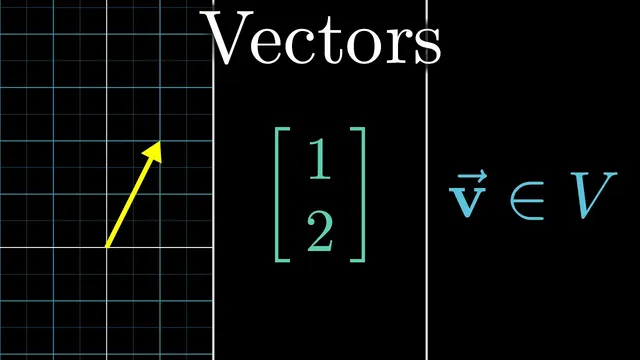
Vectors | Chapter 1, Essence of linear algebra
Based on 3Blue1Brown's video on YouTube. If you like this content, support the original creators by watching, liking and subscribing to their content.
Vectors can be treated as arrows, ordered lists, or more abstract objects, as long as the same operations remain valid.
Briefing
Linear algebra’s foundation is the vector—understood in three closely related ways—and the two operations that make vectors useful: adding vectors and scaling them by numbers. The practical payoff is that once vectors are defined consistently, the same arithmetic can be interpreted geometrically (movement in space), numerically (lists of numbers), and computationally (data transformations), letting analysts, physicists, and graphics programmers translate between viewpoints without losing meaning.
The discussion starts with a warning about how easily “vectors” can be misunderstood. From a physics perspective, vectors are arrows in space: their meaning comes from both direction and length. Even if an arrow is shifted to a different location, it still represents the same vector as long as its direction and magnitude match. From a computer science perspective, vectors behave like ordered lists: a two-dimensional vector is a pair of numbers, while a three-dimensional vector is a triple. The order matters—like recording each house as (area in square feet, price)—so the pair is not just two numbers, but a structured object whose components have specific roles.
Mathematicians generalize further: vectors can be “anything” that supports two operations—addition with another vector and multiplication by a scalar (a single number). The geometric convention used to make this concrete is the coordinate system. In 2D, the origin is the reference point, with the x-axis horizontal and the y-axis vertical. A vector is then represented by coordinates that tell how to move from the origin to the arrow’s endpoint: the first number gives the x displacement (positive right, negative left), and the second gives the y displacement (positive up, negative down). To distinguish vectors from points, the coordinate pair is written in square brackets.
In 3D, the same idea extends by adding a z-axis perpendicular to x and y. A vector becomes a list of three numbers, each specifying how far to move along its axis. With this setup, vector addition is defined in a way that matches both geometry and list arithmetic. To add two vectors, the second vector is moved so its tail starts where the first vector ends; the resulting “head-to-tail” arrow is the sum. Numerically, this becomes component-wise addition: if one vector is (1, 2) and the other is (3, −1), the sum is (1+3, 2+(-1)) = (4, 1). The same logic generalizes to longer lists in higher dimensions.
Scaling by a number is the other core operation. Multiplying a vector by 2 stretches it to twice its length; multiplying by 1/3 shrinks it to one-third. A negative scalar flips the direction and then scales the magnitude accordingly (e.g., −1.8 reverses direction and multiplies length by 1.8). In list terms, scaling means multiplying every component by that same number.
Finally, the value of linear algebra is framed as more than any single interpretation of vectors. The real advantage is the ability to switch between geometric intuition, numerical representation, and computational use. That interchangeability is what makes vectors a powerful language for data analysis, physics, and computer graphics—especially when coordinate transformations determine where pixels should go on a screen. The groundwork here—vectors plus addition and scaling—sets up later concepts like vector stretching, unit vectors, and linear combinations.
Cornell Notes
Vectors are defined in multiple but compatible ways: as arrows (direction and length), as ordered lists of numbers (pairs or triples), and in the most general mathematical sense as objects that support two operations. Those operations are vector addition and scaling by a scalar (a single number). In coordinates, a 2D vector [x, y] means moving x along the x-axis and y along the y-axis from the origin; in 3D, [x, y, z] adds a z displacement. Vector addition corresponds to adding components: [x1, y1] + [x2, y2] = [x1+x2, y1+y2]. Scaling multiplies every component by the same number, stretching, shrinking, or reversing direction when the scalar is negative.
Why does shifting an arrow in space not change the vector it represents?
How does the ordered-list viewpoint explain why (area, price) is different from (price, area)?
What is the coordinate-system rule for interpreting a 2D vector [x, y]?
How does vector addition work both geometrically and numerically?
What does multiplying a vector by a scalar do, especially for negative scalars?
Review Questions
- In 2D, what do the signs of x and y in [x, y] tell you about the direction of the vector?
- Compute the sum and explain it geometrically: [2, −3] + [−5, 4].
- What changes when scaling a vector by −2 compared with scaling by +2?
Key Points
- 1
Vectors can be treated as arrows, ordered lists, or more abstract objects, as long as the same operations remain valid.
- 2
A 2D vector [x, y] encodes horizontal displacement x and vertical displacement y from the origin, with sign indicating direction.
- 3
A 3D vector [x, y, z] extends the same idea by adding displacement along a perpendicular z-axis.
- 4
Vector addition is defined by head-to-tail geometry and matches component-wise addition in coordinates.
- 5
Scaling by a scalar multiplies every component by the same number, stretching/shrinking magnitude and flipping direction for negative scalars.
- 6
The practical power of linear algebra comes from translating between geometric intuition, numerical representation, and computational transformations.