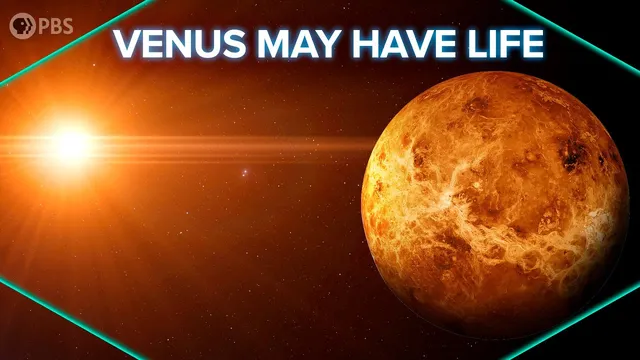
Venus May Have Life!
Based on PBS Space Time's video on YouTube. If you like this content, support the original creators by watching, liking and subscribing to their content.
Phosphine (PH3) has been detected in Venus’s upper atmosphere, and its abundance is difficult to reconcile with known non-biological chemistry.
Briefing
Venus may be harboring life in its clouds, after astronomers detected phosphine (PH3) in Venus’s upper atmosphere—an atmospheric chemical that is difficult to produce in large quantities through known non-biological chemistry. The finding matters because it targets one of the most promising categories of evidence in the search for extraterrestrial life: biosignatures—molecules whose presence and abundance are hard to explain without biology.
Phosphine is a simple phosphorus-and-hydrogen molecule that can be generated by some microbes as a metabolic byproduct, but it is also chemically possible to form without life under certain conditions. The key difference on Venus is persistence. Phosphine is expected to be rapidly destroyed in Venus’s acidic environment, especially as it oxidizes. That means any abiotic (non-living) source would need to replenish it faster than it disappears. Researchers estimate that known non-biological pathways—such as production near the hot, dense surface, lightning-driven chemistry in the cloud layers, or cosmic-ray processing in the upper atmosphere—cannot account for the observed abundance, because material produced at the surface would take too long to reach the upper atmosphere before most of it is destroyed.
The detection itself rests on two independent observing campaigns. A team led by Jane Greaves used the James Clerk Maxwell Telescope to look for phosphine absorption features and then followed up with ALMA (the Atacama Large Millimeter/submillimeter Array) to confirm phosphine in Venus’s upper atmosphere. Seeing the same spectral signature with both instruments strengthens the case that the signal is real, though astronomers still note a remaining possibility: both telescopes could, in principle, have coincidentally sampled a spectral dip at the exact location where phosphine absorbs.
If phosphine is confirmed, the next question becomes whether life is the most plausible explanation. The most likely candidate organisms would be microbes floating in Venus’s cloud region, where temperature and pressure are closer to Earth’s surface conditions—around 50 km altitude—despite the clouds’ harsh sulfuric-acid environment. A proposed scenario from Sara Seager and collaborators imagines microbes living inside tiny droplets of hydrochloric acid (with substantial water content), surviving only within a narrow atmospheric height band. As droplets grow they fall, evaporate, and force the organisms into a dormant spore state—similar in concept to bacterial spores on Earth—so they can endure drying and extreme conditions. Updrafts would then carry spores back to the altitude where droplets form again, allowing the microbes to reactivate and potentially produce phosphine.
Skepticism remains warranted because the central unknown is whether life can truly evolve and function in such concentrated acids. Venus’s current hellscape is also relatively young—on the order of hundreds of millions of years—suggesting any atmospheric life would have had to adapt from earlier, more water-rich conditions after the runaway greenhouse transformed the planet.
The immediate path forward is observational: longer and repeated measurements to verify phosphine and search for additional absorption features and other biosignatures. Longer term, the most decisive step would be a mission that returns Venus atmospheric samples to Earth for direct laboratory study. A confirmed biosignature—or even actual microbes—would dramatically shift estimates of how common life may be across the universe, turning Venus from a cautionary tale of habitability into a potential neighbor in the search for life beyond Earth.
Cornell Notes
Astronomers have reported phosphine (PH3) in Venus’s upper atmosphere, a molecule that could be linked to life because it is hard to maintain in Venus’s acidic clouds. Phosphine can form without biology, but calculations suggest known abiotic sources—surface chemistry, lightning, and cosmic rays—should produce far too little and/or lose it before it reaches the altitude where it was detected. The signal was observed with the James Clerk Maxwell Telescope and then confirmed with ALMA, making the detection more credible, though further observations are needed to rule out coincidental spectral artifacts. If phosphine persists after follow-up, the leading biological idea is floating microbes in the cloud layer that survive in acid droplets and cycle through a spore-like dormant phase as droplets evaporate and re-form.
Why is phosphine such a big deal as a potential biosignature on Venus?
What makes the detection more convincing than a single telescope seeing a spectral feature?
How do scientists argue that abiotic production rates are too low?
What kind of life could plausibly exist in Venus’s clouds?
What uncertainty still blocks a confident conclusion that life is present?
Review Questions
- What Venus-specific chemical constraint makes phosphine especially suggestive compared with many other molecules?
- How do diffusion time and oxidation in Venus’s atmosphere affect the plausibility of abiotic phosphine production?
- What lifecycle features would a cloud-dwelling microbe need to survive droplet evaporation and re-formation in Venus’s atmosphere?
Key Points
- 1
Phosphine (PH3) has been detected in Venus’s upper atmosphere, and its abundance is difficult to reconcile with known non-biological chemistry.
- 2
Venus’s acidic environment should destroy phosphine quickly, so any explanation must replenish it faster than abiotic pathways can manage.
- 3
Two independent observatories—the James Clerk Maxwell Telescope and ALMA—reported the phosphine absorption feature, increasing confidence while still requiring confirmation.
- 4
Known abiotic sources (surface chemistry, lightning, cosmic rays) are estimated to be 10,000 to 1,000,000 times too weak to explain the observed phosphine levels.
- 5
A leading biological model places microbes in Venus’s cloud layer, surviving in acid droplets and using a spore-like dormant phase during droplet evaporation.
- 6
Follow-up observations aim to verify phosphine with longer measurements and to search for additional biosignatures.
- 7
A future mission that returns Venus atmospheric samples to Earth would be the most decisive route to directly test for living material.