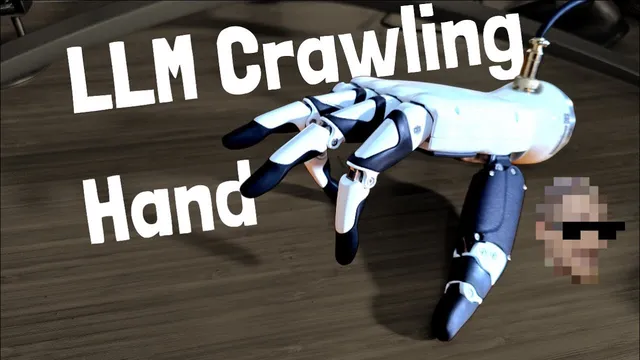
Vibe Coding a Robotic Hand to Crawl (Inspire RH56DFQ)
Based on sentdex's video on YouTube. If you like this content, support the original creators by watching, liking and subscribing to their content.
LLM-assisted code generation can drive the Inspire RH56DFQ to execute gestures like point, thumbs-up, and pinch without relying on explicitly documented “gesture presets.”
Briefing
A robotic hand built for grasping and pointing can be driven into surprisingly complex, human-like behaviors—without hand-coding every gesture—by using a large language model to generate and run control sequences for the Inspire RH56DFQ. The most striking result is a “crawl” demo: starting palm-down with fingers extended, the hand repeatedly repositions its grip and lifts parts of itself to move forward across a surface, covering roughly two and a half feet in a single run. The success hinges on mechanical realities the operator highlights: the hand can bend inward strongly, but opening back up is limited by the rubber-band-like force available from the actuators, so forward motion requires coordinated lifting and re-gripping rather than brute-force opening.
The workflow centers on “vibe coding” with an LLM—prompting for gesture logic, then executing the generated code through a command-line interface and a Python module for the Inspire hand. Along the way, the operator pushes back on common criticisms: using an LLM isn’t meant to replace learning for its own sake, and it can still be valuable even when the model doesn’t know every low-level robotics detail. When the hand misbehaves, the operator treats it as diagnostic information—asking why a failure occurred so the next attempt can avoid the same failure mode.
A key early insight is that the model can produce gestures like point, pinch, and thumbs-up even when those exact motions aren’t explicitly present as predefined “spec gestures” in the available documentation. The operator notes that for a gesture like “point,” the system must implicitly understand what “a point” looks like, then translate that concept into the hand’s joint commands. Even when the first attempt at a gesture is slightly off, later attempts improve, suggesting the model is mapping abstract intent to the Inspire hand’s specific kinematics.
To validate the approach, the operator runs a series of CLI-driven tests: basic open/close, then named gestures (point, rock-paper-scissors shapes), and finally a more demanding multi-step crawling sequence. The rock-paper-scissors segment also reveals practical friction—connection handling, module usage, and the need to manage thumb positioning to avoid fingers getting stuck or “flicked” open. Those mechanical quirks matter because the crawl depends on preventing fingers from binding during the opening phase.
The crawl itself is built as a scripted sequence with parameters for step count, and it works by alternating phases that effectively shift weight and reposition the fingers for the next contact point. The operator repeatedly resets to a known open state, then runs a longer sequence (e.g., eight steps) while monitoring balance, cable constraints, and whether the hand remains stable enough to continue. The final takeaway is less about any single gesture and more about proof-of-concept: an LLM-assisted control loop can generate nontrivial, multi-step locomotion-like behavior for hardware that was not designed for walking—turning a grasping device into something that can “crawl” on demand.
Cornell Notes
The Inspire RH56DFQ robotic hand can perform complex gestures and even a crawl-like motion when an LLM generates control code that’s executed through a Python module/CLI. The crawl succeeds because it respects the hand’s mechanics: inward bending/closing is strong, but opening is weak (rubber-band-like), so forward movement requires coordinated lifting and re-gripping rather than simply opening wider. The operator also finds that gestures such as point and thumbs-up can be produced even without explicit “pre-made gesture” definitions, implying the model maps abstract intent to joint commands. Practical issues—thumb positioning, connection/module handling, and cable constraints—still matter, but the demos show “zero-shot” style generation can reach impressive, multi-step behaviors.
Why does the crawl motion require more than repeatedly opening and closing the hand?
What does the operator learn from the fact that “point” and other gestures work even without obvious predefined gesture entries?
How does the operator handle failures or unexpected behavior during LLM-driven robotics?
What practical engineering issues show up when running LLM-generated control scripts?
What evidence suggests the crawl demo is genuinely multi-step and not just a single lucky movement?
Review Questions
- What mechanical limitation of the Inspire hand makes coordinated lifting/re-gripping necessary for forward crawling?
- How does the operator’s approach to debugging differ from “learning for learning’s sake” in LLM-assisted robotics?
- What kinds of practical failures (software or physical) can derail LLM-generated gesture control, and how are they mitigated?
Key Points
- 1
LLM-assisted code generation can drive the Inspire RH56DFQ to execute gestures like point, thumbs-up, and pinch without relying on explicitly documented “gesture presets.”
- 2
The crawl demo works because it accounts for asymmetric strength: closing/bending inward is effective, while opening outward is weak and can cause binding.
- 3
Multi-step locomotion-like motion requires coordinated phases that lift and reposition fingers rather than brute-force opening.
- 4
Thumb positioning is a recurring mechanical constraint; incorrect thumb movement can lead to fingers getting stuck or being flicked open.
- 5
Software reliability depends on correct module usage and stable connection handling; running the wrong path can lead to “not connected to hand” behavior.
- 6
Physical constraints—cable management and available space—become critical during longer sequences.