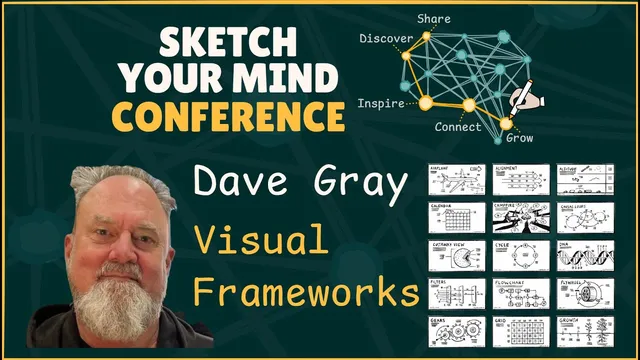
Visual Frameworks with Dave Gray - Session 7 at the Sketch Your Mind Conference, 2025
Based on Zsolt's Visual Personal Knowledge Management's video on YouTube. If you like this content, support the original creators by watching, liking and subscribing to their content.
Visual frameworks are designed to evoke mental models, helping people switch representations when their current model is insufficient.
Briefing
Visual frameworks are not slide templates—they’re mental tools for switching between the models people use to interpret a situation. Dave Gray’s core claim is that thinking runs on models that operate largely in the background: people compare the present to past experience to understand, predict, influence, and control what happens. When the model doesn’t fit, confusion follows. Visual frameworks help by evoking alternative models, making it easier to break out of a stuck way of seeing and to search for a better representation of the problem.
Gray frames models as inherently partial and imperfect. No model can be “perfect” because language and concepts are built from what’s already known; new situations must be described using old words, leaving gaps, overlaps, and hidden aspects. That imperfection is not a bug—it’s what allows infinite ways to think about anything new. In practice, feeling lost often signals that the current model is insufficient. Gray points to his framework library—available at visualframeworks.com—as a practical response: there’s no claim of completeness, because new experiences keep arriving and new frameworks keep being added.
The talk then distinguishes models from metaphors and from the cards themselves. Metaphors are comparisons between two models—like “the world is a stage”—that reveal certain features (actors, audience, performance) while hiding others (the world isn’t literally made of wood or curtains). Visual framework cards are designed to evoke models rather than replace them. Gray describes them as an index-card catalog for a mental library: each card has a label, an image, and small “handles” that act like grappling hooks for applying the model to a challenge. He argues that progress in learning and problem-solving can be reduced to finding better models.
A bank IT case study illustrates the mechanism. A workshop participant couldn’t draw the problem, so Gray prompted a shift in mental framing using everyday roles like chef or sea captain. The participant landed on a powerful metaphor: the IT department is like a restaurant with no menu—every customer request forces custom work, driving cost and delays. Once the restaurant model clicked, the solution became obvious. Gray treats this as a pattern: mapping one model onto another can make the path forward appear.
To make the idea actionable, Gray runs an exercise that asks participants to reinterpret their own stuck situation through different “problem shapes” (maze, puzzle, fog, bottleneck, archaeological dig, iceberg/onion, pendulum, tournament, solar system, momentum, courage). The point isn’t that every problem becomes solvable, but that cycling models can break a mental lock.
The most concrete payoff comes during a guided card-picking session with Aditi Paul, who coaches clients trying to communicate expertise to non-technical immigration officers without diluting seriousness. Gray has Paul “prime” the problem, then select frameworks intuitively from categories like predicaments, processes, structures, approaches, and analysis/decision-making. Paul’s chosen cards are organized into a narrative grid: a communication gap (gap), juggling competing demands (juggling), oscillating between expert and novice roles (crossroads), and using zoom-in/zoom-out plus cutaway/exploded-view/gears to show depth and downstream impact. Paul reports that the exercise surfaced the “feeling dimension” alongside the “thinking dimension,” turning an abstract communication challenge into a structured story.
By the end, Gray emphasizes that frameworks can be used solo, with one partner, or in teams—often with different outcomes. Individually, people can browse tags and “people who like this card also like…” suggestions; collaboratively, they can cluster cards on a shared board to triangulate perspectives quickly. The session closes with the reminder that frameworks are starting points, not universal Legos—useful for clarifying thought, generating options, and aligning faster, even across different languages and cultures.
Cornell Notes
Dave Gray argues that visual frameworks are tools for switching between mental models, not presentation templates. People continuously model situations to understand, predict, and influence outcomes, but models are partial—when the current model doesn’t fit, confusion and stuckness follow. Visual framework cards are designed to evoke models you already carry, helping you map one representation onto another (often through metaphor) until a better framing makes the next step obvious. In a live exercise, Aditi Paul used the cards to craft a communication strategy for immigration cases, selecting frameworks that represented a communication gap, competing responsibilities, and a “zoom in/zoom out” approach to show expertise without dumbing it down. The practical takeaway: cycling through model-shaped lenses can unlock progress even when the original problem feels amorphous.
How does Gray connect models, confusion, and visual frameworks?
What’s the difference between a model, a metaphor, and a visual framework card?
Why does Gray say “the world is nothing until we describe it,” and what does that imply for problem-solving?
How did the restaurant metaphor change the bank IT problem?
What frameworks did Aditi Paul select, and how did they map to her communication challenge?
How can visual frameworks be used differently solo versus in a team?
Review Questions
- Pick a situation you’re currently stuck on. Which “problem shape” (maze, bottleneck, iceberg/onion, pendulum, tournament, solar system, momentum, courage) best matches your current model—and what would change if you switched to a different shape?
- Explain how a metaphor can reveal and hide aspects of reality. Give one example metaphor and list at least two revealed features and two hidden features.
- Why might “finding the right question” be less effective than “finding the right representation” in Gray’s framework-based approach?
Key Points
- 1
Visual frameworks are designed to evoke mental models, helping people switch representations when their current model is insufficient.
- 2
Models are inherently partial; feeling lost often signals a mismatch between the model and the situation.
- 3
Metaphors are comparisons between models and work by revealing some features while hiding others.
- 4
Progress in learning and problem-solving can be treated as a search for better models and better representations.
- 5
In real cases, reframing can make solutions obvious—such as the “restaurant with no menu” model for custom IT work.
- 6
Cycling through different model-shaped lenses (maze, bottleneck, iceberg, pendulum, etc.) can break a mental lock even when not every problem is solvable.
- 7
Frameworks can be used solo (via browsing tags and recommendations) or collaboratively (via shared clustering on boards) with different outcomes.