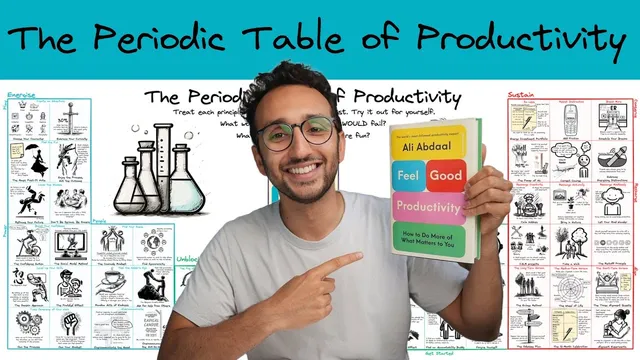
VISUAL SUMMARY: Feel-Good Productivity by Ali Abdaal - The Periodic Table of Productivity
Based on Zsolt's Visual Personal Knowledge Management's video on YouTube. If you like this content, support the original creators by watching, liking and subscribing to their content.
Treat productivity as an experiment: test small strategies, observe emotional and performance effects, and iterate.
Briefing
Feel-good productivity is built around a simple premise: playfulness and positive emotion aren’t distractions from getting things done—they can make work more effective. The framework at the center of this approach treats productivity like an experiment, encouraging people to test small strategies, observe what improves their mood and output, and iterate without turning life into a joyless checklist. Instead of chasing an empty inbox or obsessing over task management, the method aims for “the right amount of friction,” using structure to create mental space while staying human.
The system is organized into three pillars—play, power, and people—each broken down into three principles, and each principle supported by strategies and experiments. Play targets engagement and sincerity. It recommends creating an “adventure” mindset for tasks, finding the fun in routine work, and lowering the stakes by reframing failure as part of the process. The underlying idea is that curiosity and joy make effort feel more sustainable, not less.
Power focuses on self-efficacy and ownership. Confidence is built through positive self-talk and adopting a “confident mindset,” alongside learning from role models. Skill growth comes from a “beginner’s mindset” and teaching others, which reinforces understanding. Ownership is about taking charge of the process even when outcomes are uncertain—choosing autonomy in decisions and actions rather than waiting for perfect control.
People addresses the energy effects of relationships. It emphasizes finding your “scene” by tapping the collective brilliance of creative communities, seeking help through a “helpers high” dynamic that boosts mood and energy, and communicating in a constructive way. That includes “capitalization,” celebrating wins, and candid feedback inspired by Kim Scott’s Radical Candor—cheering people on while also addressing challenges directly.
Procrastination is handled next through three core blockers: uncertainty, fear, and inertia. Uncertainty is reduced by clarifying the why and how behind actions (“fog of uncertainty”) and using “nice goals” that prioritize near-term, input-based steps rather than distant outcomes. Fear is tackled by understanding its origins, reducing its grip through cognitive reappraisal and starting anyway, and confronting failure fear via identity shifts—using an alter ego to embody the traits needed for action. Inertia is countered by reducing friction, defining the next step to create momentum, and supporting progress with systems, accountability, and self-forgiveness.
Sustaining well-being completes the model. Burnout is framed in three forms—overexertion, depletion, and misalignment—and addressed through conserve, recharge, and align. Conserve manages energy by doing less, resisting distraction (including the “begin again” mindset after slips), and scheduling breaks. Recharge centers on deliberate rest: creative hobbies, time in nature (or nature indoors), and guilt-free mind wandering. Align combats misalignment by repeatedly checking whether goals match authentic priorities across three time horizons—deathbed clarity for the long term, 12-month targets for the mid term, and daily alignment quests for the short term.
The practical takeaway is a scientific, feel-good loop: experiment with play, power, and people; unblock action by targeting uncertainty, fear, and inertia; then protect energy and meaning through conserve, recharge, and align. The result is productivity designed to improve both performance and well-being, not trade one for the other.
Cornell Notes
The “Periodic Table of Feelgood Productivity” reframes productivity as a set of experiments aimed at improving mood and output together. It organizes action into three pillars—Play, Power, and People—then tackles procrastination through uncertainty, fear, and inertia. Long-term sustainability comes from managing burnout with conserve (energy), recharge (rest), and align (values and priorities). The approach repeatedly pushes for clarity on what’s controllable, identity-based courage, and small steps that reduce friction. It matters because it replaces empty-inbox obsession with a method that supports consistent progress while protecting mental well-being.
How does “play” change the way tasks are approached, and what are the concrete tactics?
What does “power” mean in this framework, and how is confidence built without relying on outcomes?
Why does teaching others function as a productivity strategy here, and what experiment is highlighted?
How does the model address procrastination without treating it as a character flaw?
What are the three ways to prevent burnout in the long run, and how do they differ?
What does “align” require across time horizons, and what does it look like day to day?
Review Questions
- Which procrastination blocker (uncertainty, fear, or inertia) do you most often experience, and what specific strategy from the framework would you test first?
- How would you redesign one recurring task using the “adventure,” “find the fun,” or “lower the stakes” tactics?
- What would a “daily alignment quest” look like for your current 12-month priorities in health, work, and relationships?
Key Points
- 1
Treat productivity as an experiment: test small strategies, observe emotional and performance effects, and iterate.
- 2
Use play to make work feel like curiosity and sincerity rather than pressure—adventure mindset, find-the-fun, and lowering the stakes.
- 3
Build power through confidence (positive self-talk and role models), skill growth (beginner mindset and teaching), and process ownership (autonomy over controllables).
- 4
Counter procrastination by targeting uncertainty (clarify why/how and use nice goals), fear (reappraise and start; use identity shifts), and inertia (reduce friction and take the next step).
- 5
Sustain progress by managing energy with conserve (do less, resist distraction, schedule breaks) and recharge (creative rest, nature, guilt-free mind wandering).
- 6
Prevent misalignment by aligning goals across long-, mid-, and short-term horizons, turning values into daily alignment quests.
- 7
Strengthen productivity through people: build community (“scene”), seek help (“helpers high”), and communicate constructively with capitalization and Radical Candor-style feedback.