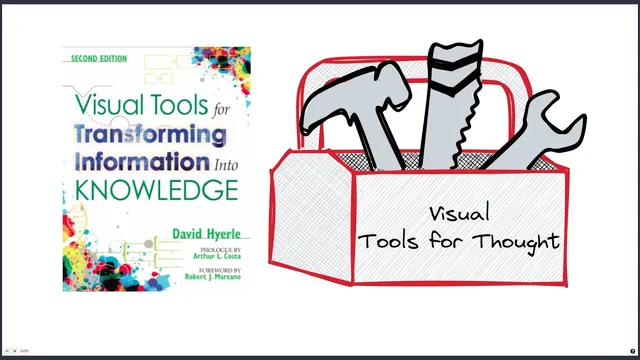
Visual tools for transforming information into knowledge
Based on Zsolt's Visual Personal Knowledge Management's video on YouTube. If you like this content, support the original creators by watching, liking and subscribing to their content.
Choose visual tools based on the thinking task—creative, analytical, or reflective—rather than treating diagrams as interchangeable decoration.
Briefing
Visual thinking tools matter because they help people convert raw information into structured knowledge—matching how the brain naturally organizes experience into interconnected networks. The core claim is that linear text often forces ideas into a one-way stream, while understanding typically requires mapping relationships, categories, and feedback loops. That mismatch shows up in everyday learning: a quick scene described in words can blur before meaning lands, while an image can deliver the gist fast—especially when the goal is to grasp the “shape” of a situation rather than just its details.
The framework centers on choosing the right visual method for the kind of thinking required: creative, analytical, or reflective. For creative thinking, the emphasis is on flexibility and independent idea generation. Brainstorming webs—usually built from a central focus question—support unrestrained exploration and later refinement. A key warning is to avoid stopping too early: clustering and reorganizing the web into more focused structures is what turns scattered ideas into clearer directions for writing or building a product. Mind mapping is presented as a creativity-and-memory technique associated with Tony Buzan, using specific graphic conventions to deepen links between creative and logical work while still allowing personal style.
Analytical thinking tools shift the goal from generating possibilities to managing data precisely and communicating it clearly. Graphic organizers are treated as structured containers for either content-specific tasks (like story organizers for literature) or process-specific skills. The transcript distinguishes these categories explicitly: content-specific organizers are not easily transferable, while process organizers are designed for recurring ways of thinking. Examples include goal-setting templates that break large objectives into sprints and tasks, Venn diagrams for category overlap (traced to John Venn’s 1898 logic work), and fishbone (Ishikawa) diagrams for cause-and-effect analysis. The fishbone method is laid out as a step-by-step workflow: identify the effect, name categories of causes, generate and privately rank candidates, remove duplicates, and then justify the final ordering.
Reflective thinking tools aim at metacognition—thinking about thinking—by building context and applying past knowledge to new situations. Here, conceptual maps become the centerpiece, grounded in a hierarchical view of knowledge: facts at the base leading up through topics, concepts, principles, and finally theoretical claims. The transcript highlights several conceptual mapping approaches. The inductive tower (from John Clark) reverses the usual “start with the main idea” pattern by building categories upward from detailed information. Dialogue and argument mapping using issue-based information systems (IBIS) visualizes “wicked problems” through linked issues, positions, and arguments, growing into a network as debates accumulate. Systems thinking is introduced through feedback loops, used to represent dynamic interrelationships among variables. Finally, mindscaping uses metaphorical drawings—turning an abstract idea into a concrete everyday image (like a path or building) whose parts correspond to conceptual components—then iterating with color, words, and revision.
Taken together, the message is practical: visual tools aren’t interchangeable decorations. They are specialized instruments for different thinking tasks, and deliberate selection is what turns information into durable understanding and usable knowledge—whether in classrooms, workplaces, or personal knowledge management systems.
Cornell Notes
The transcript argues that learning becomes more effective when information is transformed into knowledge through visual mapping rather than left as a linear stream of text. It organizes visual methods into three thinking modes—creative, analytical, and reflective—each with tools designed for different cognitive jobs. Creative tools like brainstorming webs and mind mapping prioritize flexible idea generation and later clustering. Analytical tools such as story organizers, goal-setting templates, Venn diagrams, and fishbone diagrams emphasize structured reasoning, categorization, and cause-and-effect analysis. Reflective tools use conceptual maps—inductive towers, IBIS argument maps, feedback loops, and mindscaping—to build context, support metacognition, and handle complexity.
Why does mapping ideas visually outperform purely linear note-taking for understanding?
What makes brainstorming webs more than a one-time warm-up exercise?
How do analytical graphic organizers differ by purpose—content-specific vs process-specific?
What is the step-by-step workflow for a fishbone (Ishikawa) cause-and-effect analysis?
How does IBIS help structure debate on “wicked problems”?
What does mindscaping add to conceptual mapping?
Review Questions
- Which thinking mode (creative, analytical, reflective) best matches a task like prioritizing causes for a failure, and what visual tool would fit it?
- How do brainstorming webs change from early exploration to later clarity, and what common mistake interrupts that progression?
- Explain how IBIS represents wicked problems using issues, positions, and arguments, and describe how the map evolves over time.
Key Points
- 1
Choose visual tools based on the thinking task—creative, analytical, or reflective—rather than treating diagrams as interchangeable decoration.
- 2
Use visual mapping to convert linear information into structured relationships that match how the brain builds interconnected networks.
- 3
For creative work, build brainstorming webs from a focus question, then cluster and revise them instead of moving straight to final drafting.
- 4
For analytical work, distinguish content-specific organizers (like story organizers) from process-specific organizers (like goal templates, Venn diagrams, and fishbone diagrams).
- 5
Apply the fishbone (Ishikawa) workflow to manage cause-and-effect reasoning: generate, privately review, rank, deduplicate, vote, and justify.
- 6
For reflective work, use conceptual maps to build context and support metacognition, including inductive towers, IBIS argument maps, feedback loops, and mindscaping metaphors.