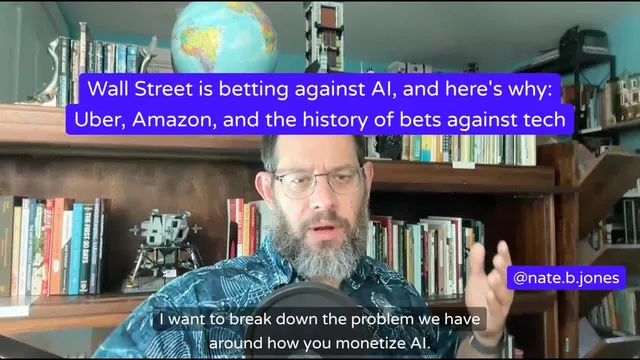
Wall Street is betting against AI, and here's why: Uber, Amazon and the history of bets against tech
Based on AI News & Strategy Daily | Nate B Jones's video on YouTube. If you like this content, support the original creators by watching, liking and subscribing to their content.
AI monetization is unclear despite massive spending, creating a widening revenue gap for investors.
Briefing
Wall Street’s biggest blind spot in AI isn’t the technology—it’s monetization. With AI spending potentially reaching around a trillion dollars in the next few years, investors expecting conventional returns (often framed as 5–10x) face a brutal math problem: that level of capital expenditure implies trillions in revenue must materialize. So far, the money is concentrating at the “picks and shovels” layer—especially chipmakers like Nvidia—while companies further up the stack that actually sell AI-powered products at scale remain comparatively scarce. That gap is widening as more firms pour in on hopes of future returns, turning AI into a high-spend, low-clarity bet.
The comparison to earlier tech cycles is central. Uber’s early growth was fueled by massive subsidies—about $30 billion over a decade—to reshape consumer behavior away from taxis. Once habits shifted, Uber could later rely on price increases and profitability drivers like Uber Eats, which became a major margin engine. The same pattern may be playing out in AI: heavy investment today could eventually unlock durable demand, but the revenue path isn’t obvious yet. The transcript frames AI as being in the “Amazon Web Services / Prime” phase—where costs and benefits weren’t initially legible to Wall Street, yet demand expanded once the pricing friction was removed.
Three historically plausible revenue sources are offered to close the “AI revenue gap.” First is breakthrough productivity driven by AI creativity. Large language models are portrayed as unusually strong at creative tasks, not just logical ones—opening the door to top-line gains rather than only cost-cutting. The example is a drug discovery breakthrough: if AI accelerates the creation of an entirely new drug class, the payoff could be enormous (hundreds of billions), directly attacking the revenue side that efficiency-only narratives often miss.
Second is efficiency gains—but with a twist. The transcript argues that efficiency doesn’t automatically translate into layoffs or lower spending. Instead, lower costs can expand demand and enable “cooler” or more ambitious work, meaning companies may get more done and cover more territory with the same workforce. That matters because it suggests productivity improvements might not show up as dramatic labor cost reductions; many workers operate with an “infinite to-do list,” so AI may help them reach 60% of tasks instead of 40%, without shrinking the overall workload. Anecdotal layoffs are described as mostly anticipatory and concentrated among already-struggling firms, rather than a broad, hard-edged productivity-driven wave.
Third is new markets and new devices. The transcript highlights that AI has mostly arrived through chat interfaces, but the next monetization wave could come from pairing language models with household robotics—an entirely new device category that could become as ubiquitous as smartphones once were. It also points to Apple’s AI push as a signal that AI may become embedded in consumer devices, potentially making language models an “operating system” layer that powers future hardware rollouts.
In the end, the core stance is cautious but actionable: the revenue gap is real, chipmakers are benefiting immediately, and the most credible monetization routes are (1) creativity-led breakthroughs, (2) efficiency that expands demand rather than just cutting jobs, and (3) device-driven new markets. Whether these threads add up to the implied trillion-to-multi-trillion revenue math remains uncertain—but the search for where the money will come from is now the defining question for AI investors.
Cornell Notes
AI monetization is lagging behind AI spending. With capital expenditures potentially reaching around a trillion dollars soon, investors need revenue at a scale that has not yet materialized beyond “picks and shovels” suppliers like Nvidia. The transcript frames the situation as a familiar pattern from earlier tech cycles (Uber, AWS, Amazon Prime): heavy investment can reshape habits and unlock demand before profits become obvious. It proposes three plausible revenue sources: creativity-driven breakthroughs that create new products (e.g., drug classes), efficiency gains that expand demand rather than mainly causing layoffs, and new markets enabled by AI-powered devices such as household robots. The key implication: productivity improvements may not show up as lower labor costs, so Wall Street may be looking for the wrong signals.
Why does AI spending create a “revenue gap” problem for investors?
What does Uber’s history suggest about how AI might monetize later?
How does “AI creativity” differ from the usual efficiency narrative?
Why might efficiency gains not lead to layoffs or lower costs as expected?
What role could new devices play in turning AI into a revenue engine?
Review Questions
- What specific mismatch between AI spending and revenue expectations is described, and why does it matter for public markets?
- Which of the three monetization routes—creativity breakthroughs, efficiency-driven demand expansion, or new devices—seems most likely to produce revenue quickly, and what evidence from the transcript supports that view?
- How does the “infinite to-do list” idea change how you would interpret productivity gains in financial statements?
Key Points
- 1
AI monetization is unclear despite massive spending, creating a widening revenue gap for investors.
- 2
Chipmakers like Nvidia are capturing immediate profits, while scaled AI application revenue remains limited.
- 3
Uber’s subsidy-to-habit-shift history is used as a model for how AI may monetize after usage patterns change.
- 4
Creativity-led breakthroughs could drive top-line revenue far more than efficiency-only narratives.
- 5
Efficiency gains may expand demand and output rather than primarily causing layoffs or lower labor costs.
- 6
Anecdotal AI-related layoffs are described as mostly anticipatory and concentrated among already struggling firms.
- 7
New devices—especially AI-powered household robotics—could turn language models into a platform layer for new markets.