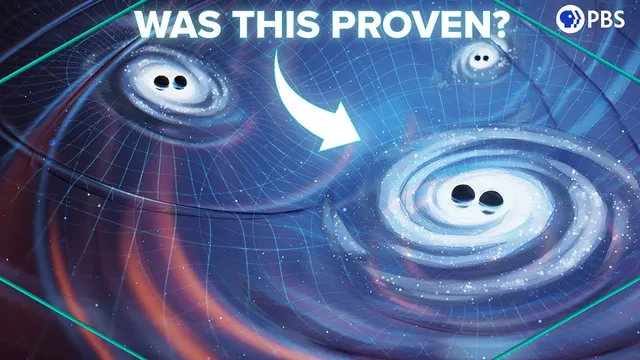
Was the Gravitational Wave Background Finally Discovered?!?
Based on PBS Space Time's video on YouTube. If you like this content, support the original creators by watching, liking and subscribing to their content.
Pulsar timing arrays search for a stochastic gravitational-wave background by measuring correlated deviations in pulse arrival times across many millisecond pulsars.
Briefing
A growing set of pulsar-timing results is pointing to a “stochastic gravitational wave background”—a faint, universe-wide hum of gravitational waves—detected not by a single event but through correlated timing shifts across many millisecond pulsars. The significance is twofold: it extends gravitational-wave astronomy to much lower frequencies than LIGO can reach, and it opens a new observational window on the population and evolution of supermassive black hole binaries across cosmic time.
The path to this result starts with general relativity’s prediction that spacetime carries waves. LIGO confirmed that idea in 2016 by measuring the tiny stretching and squishing of space caused by merging stellar-mass black holes. But those mergers generate gravitational waves with wavelengths tied to their orbital periods—too short for Earth-bound detectors to probe the longest, slowest waves. To reach those low frequencies, astronomers rely on nature’s own clocks: pulsars. Millisecond pulsars spin hundreds of times per second and emit radio pulses with extreme regularity. Because the speed of light is constant, any gravitational wave passing between Earth and a pulsar slightly changes the distance light travels, shifting pulse arrival times. Individual waves are still hard to isolate; instead, multiple collaborations have spent more than 15 years monitoring dozens of pulsars to detect the statistical imprint of many overlapping, very weak waves.
The key discriminant is correlation. Noise sources—like intrinsic pulsar spin changes or delays from ionized gas along the line of sight—tend to affect pulsars independently or in ways tied to specific sky directions. Gravitational waves, by contrast, stretch and squeeze spacetime in a pattern that links how timing residuals behave for pairs of pulsars. For a background of gravitational waves, the expected relationship between the timing residuals of two pulsars depends on their angular separation on the sky, summarized by the Hellings–Downs curve: strong correlation for closely separated pulsars, a distinct level of correlation near 180° separation, and anticorrelation around 90°.
NANOgrav’s published analysis uses timing data from 67 pulsars over 15 years and examines every pulsar pair. The measured pairwise correlations match the Hellings–Downs prediction closely, with a claimed significance of roughly 3.5 to 4 sigma depending on the statistical method. That falls short of a definitive 5-sigma discovery, meaning random noise still has a non-negligible chance of producing a similar pattern—but the agreement with the theoretical correlation is increasingly difficult to dismiss. Similar signals have also been reported by other pulsar timing array experiments, though with varying confidence.
Assuming the background is real, the most likely source is a population of binary supermassive black holes in galaxy centers. Their masses—millions to billions of Suns—imply low-frequency gravitational waves that persist long enough to overlap into a stochastic background. The observed correlations also encode information beyond the Hellings–Downs shape: the frequency spectrum of the background can hint at how quickly binaries spiral together. NANOgrav’s spectrum is broadly consistent with simple growth-and-merger models, but there are hints of either excess high-frequency power or a deficit at the lowest frequencies. One proposed explanation is that interactions between black hole binaries and surrounding stars could accelerate the inspiral. Another possibility is that the background is stronger than expected, implying more massive binaries or a larger number of them.
The next step is straightforward: keep watching. Longer baselines add more pulsars and increase sensitivity to the largest-scale, lowest-frequency waves, which should tighten the statistical case and help pinpoint the background’s origin. If the signal solidifies, pulsar timing arrays could become a galaxy-scale observatory for the cosmic events that churn spacetime itself.
Cornell Notes
Pulsar timing arrays are accumulating evidence for a stochastic gravitational wave background: a weak, universe-wide “hum” made of many overlapping gravitational waves. The strongest clue comes from how timing residuals correlate between different pulsars on the sky, matching the Hellings–Downs curve expected for gravitational waves. NANOgrav’s 15-year dataset covering 67 pulsars finds correlations consistent with that prediction at about 3.5–4 sigma, not yet a full 5-sigma slam dunk. If confirmed, the background likely comes from binary supermassive black holes in galaxy centers, and the measured frequency spectrum may reveal how those binaries evolve and merge. Continued monitoring should increase the number of pulsars and improve confidence, turning this tentative detection into a more definitive measurement.
Why can’t astronomers just look for a single gravitational-wave “event” in pulsar timing data?
What makes gravitational-wave-induced timing shifts stand out from other pulsar timing noise?
What is the Hellings–Downs curve, and what does it predict?
What exactly did NANOgrav report, and how strong is the evidence?
Why are binary supermassive black holes the leading explanation for the background?
How can the frequency spectrum of the background inform what happens to black hole binaries?
Review Questions
- What correlation pattern across pulsar pairs would you expect from a gravitational-wave background, and how does it differ from uncorrelated noise?
- How does the Hellings–Downs curve relate angular separation on the sky to the sign and strength of timing residual correlations?
- If the low-frequency part of the spectrum is weaker than a simple SMBH binary model predicts, what physical mechanisms could account for that discrepancy?
Key Points
- 1
Pulsar timing arrays search for a stochastic gravitational-wave background by measuring correlated deviations in pulse arrival times across many millisecond pulsars.
- 2
The Hellings–Downs curve provides the expected angular dependence of timing-residual correlations for a gravitational-wave background, including both correlated and anticorrelated regimes.
- 3
NANOgrav’s 15-year analysis of 67 pulsars finds correlations consistent with the Hellings–Downs prediction at about 3.5–4 sigma, short of a definitive 5-sigma discovery.
- 4
The most likely origin of the background is a population of binary supermassive black holes, whose low-frequency waves overlap into a universe-wide hum.
- 5
The measured frequency spectrum can probe binary evolution, with possible hints that stellar interactions may accelerate inspiral or that the SMBH population is more massive or numerous than simple models assume.
- 6
Longer observing baselines and larger pulsar samples should increase sensitivity and make the detection more statistically robust.
- 7
If confirmed, pulsar timing arrays could function as a galaxy-scale gravitational-wave observatory for events that shape spacetime across cosmic history.