Was the Milky Way a Quasar?
Based on PBS Space Time's video on YouTube. If you like this content, support the original creators by watching, liking and subscribing to their content.
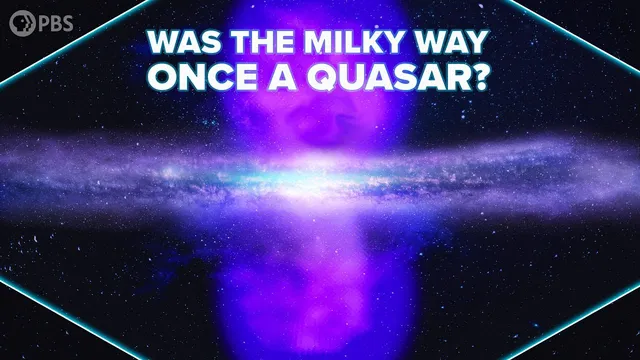
The Fermi Bubbles are two sharp-edged gamma-ray structures extending more than 25,000 light-years above and below the Milky Way’s disk.
Briefing
The Milky Way’s central black hole, Sagittarius A*, may have had a much more recent “active” episode than astronomers assumed—one that could have re-energized the galaxy’s enormous, bubble-shaped gamma-ray structures. Those features, called the Fermi Bubbles, extend more than 25,000 light-years above and below the Milky Way’s disk and shine in high-energy gamma rays with sharp edges. Their existence forces a rethink of how and when the galactic center can inject energy into the surrounding interstellar medium, and it raises the possibility that similar outbursts could happen again.
The trail begins in 2010, when researchers using the Fermi Gamma-ray Space Telescope searched for gamma rays that might arise from dark matter annihilations near the Milky Way’s center. Dark matter models predict a diffuse, centrally thickened glow. Instead, the team found something starkly different: two massive gamma-ray bubbles with uniform, high-energy emission and edges that stand out against the galaxy’s background. The Milky Way’s disk itself produces gamma rays—largely from cosmic rays accelerated by supernovae colliding with interstellar gas, creating neutral pions that decay into gamma rays. That “gamma-ray fog” initially hides the bubbles, but the Fermi Bubbles reveal themselves because their spectrum stays strong at higher energies where the diffuse emission fades.
Inside the bubbles, the gamma rays are attributed to Inverse Compton Scattering: extremely energetic electrons boost lower-energy light into the gamma-ray regime. Estimating the electron energy content suggests an energy budget comparable to about 100,000 supernova explosions. Timing comes from the bubbles’ expansion speed—about 9,000 km/s measured with the Hubble Space Telescope—implying growth over only a few million years. That places the event as geologically recent on a galactic timescale, far more recent than the Milky Way’s roughly 10-billion-year age.
Two single-cause explanations run into problems. A starburst—rapid star formation triggered by a disturbance—would generate many supernovae, potentially carving bubble-like cavities. But the required supernova rate would leave too many compact remnants (like pulsars) to match what’s observed. Direct black-hole activity fares no better as a standalone mechanism: energizing the bubbles would require only a “snack” rather than a quasar-scale feast, and jets alone are expected to produce more structured, wedge-like features than the smooth, uniformly bright bubbles seen.
The leading synthesis combines both. A mini AGN phase could be triggered by gas inflow or a massive star wandering too close to Sagittarius A*. Jets and/or winds would drive shocks that compress gas and ignite a burst of star formation. The subsequent supernova cascade would then smooth and distribute the energy into the bubble morphology. Recent observations add a related clue: MeerKAT discovered smaller, radio-emitting bubble structures above and below the galactic plane, likely younger versions of the Fermi Bubbles. Those radio bubbles are powered by synchrotron-emitting electrons and require far less energy, but they point toward the same coupled black-hole-and-star-formation engine.
Whether the Milky Way will repeat the process remains uncertain. Earth’s atmosphere blocks most incoming gamma rays, but the starburst and supernova phase that likely helped create the Fermi Bubbles could have been visible to the naked eye millions of years ago. Meanwhile, new evidence suggests Sagittarius A*’s X-ray activity has been rising over the past four years—hinting that the galactic center’s tantrums may still be active, even if a full “new Fermi Bubbles” event is unlikely soon.
Cornell Notes
The Milky Way’s center hosts two enormous gamma-ray structures—the Fermi Bubbles—extending over 25,000 light-years above and below the galactic plane. They were discovered in 2010 when high-energy gamma-ray data revealed sharp-edged bubbles that dark-matter searches expected to be diffuse. The bubbles’ gamma rays come from Inverse Compton Scattering by very energetic electrons, and the total energy is roughly equivalent to about 100,000 supernovae. Their expansion speed implies the event occurred only a few million years ago, meaning the Milky Way’s violent phase was more recent than previously thought. The best explanation combines a mini AGN episode from Sagittarius A* with a triggered starburst and supernova cascade, and MeerKAT’s smaller radio bubbles support that coupled scenario.
Why didn’t the 2010 gamma-ray search for dark matter find what models predicted?
What makes the Fermi Bubbles stand out against the Milky Way’s gamma-ray “fog”?
What physical process likely produces the Fermi Bubbles’ gamma rays?
How do astronomers estimate when the bubbles formed?
Why do starburst-only and jet-only explanations struggle, and what’s the combined solution?
What does MeerKAT add to the story?
Review Questions
- What observational feature of the gamma-ray spectrum allows the Fermi Bubbles to be separated from the Milky Way’s diffuse gamma-ray emission?
- How do expansion speed measurements translate into a formation timescale for the Fermi Bubbles?
- Why does the smooth morphology of the Fermi Bubbles make a jet-only origin less convincing?
Key Points
- 1
The Fermi Bubbles are two sharp-edged gamma-ray structures extending more than 25,000 light-years above and below the Milky Way’s disk.
- 2
Their discovery in 2010 relied on spectral differences: the bubbles stay bright at higher gamma-ray energies where the diffuse disk emission weakens.
- 3
Gamma rays in the bubbles are attributed to Inverse Compton Scattering by very energetic electrons, with a total energy budget comparable to about 100,000 supernovae.
- 4
Expansion speeds near 9,000 km/s imply the bubbles formed over only a few million years, making the Milky Way’s violent phase more recent than expected.
- 5
A starburst-only explanation conflicts with the expected number of compact remnants, while a jet-only explanation struggles with the bubbles’ smooth, uniform appearance.
- 6
The leading scenario couples a mini AGN episode from Sagittarius A* with a triggered starburst and supernova cascade that smooths the bubble structure.
- 7
MeerKAT’s smaller radio bubbles support the idea of recurring or staged activity near the galactic center, potentially related to the same mechanism.