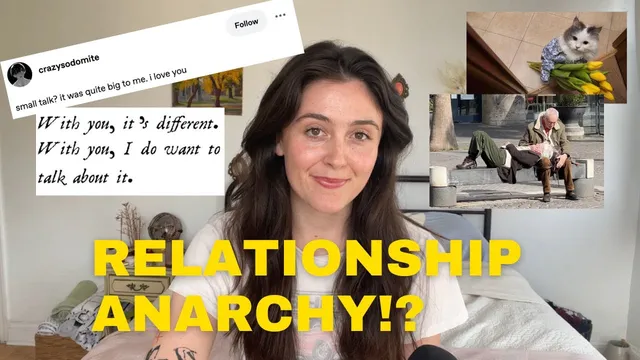
Watch This If You're Ready to Rethink Romantic Relationships
Based on Anna Howard's video on YouTube. If you like this content, support the original creators by watching, liking and subscribing to their content.
Treating relationship behavior as a clinical checklist can replace empathy with control and objectification.
Briefing
Romantic relationships get worse when people treat love like a diagnostic category—then try to “fix” partners through labels, ownership language, and rigid scripts. The core claim is that changing the words and metaphors used around love can shift relationship behavior, because language shapes what people think is normal, what they believe they’re entitled to, and how they interpret conflict.
A major target is “pathologizing desire”: the reflex to spot a flaw and immediately label it as clinical dysfunction. The transcript contrasts common internet shortcuts—like equating a crush with “lying,” or calling a bad-time bond a “trauma bond,” or treating introversion as avoidance—with the harm of turning relationships into checklists of disorders. Jamila Bradley’s critique is used to argue that diagnosing friends and partners objectifies them, replaces empathy with arbitration, and can become a rude power play—even when the person doing it believes they’re helping. The same dynamic shows up in attachment-style talk, where “avoidant” becomes a moral verdict and people are treated as if they must be “healed enough” before they’re allowed to be in community or receive care.
Underneath the labeling is a deeper issue: possession. The transcript argues that romance in Western culture often carries an ownership undercurrent—“mine” language, marriage as “have and to hold,” and even the way commitment gets framed as being trapped or controlled. A play line (“They love you.” / “They have me.”) is used to sharpen the distinction between being understood and being possessed. Chelsea Cutler’s lyric (“Someone will get you, someone will have me”) reinforces the idea that “have” implies control, while “get” implies recognition.
The discussion then reframes commitment and love through alternative metaphors. MuseGuided’s essay “Love is Not Enough” is cited to separate love’s poetic, surrendering energy from commitment’s steadier, character-revealing work—commitment as staying through storms, not signing someone into a lease. Hanife Abdurak’s critique of comparing love to war adds another layer: battlefield metaphors weaponize sadness and normalize power dynamics, tracing how “love as war” runs deep historically (including references to Ovid).
From there, the transcript sketches a simplified Western timeline: love outside marriage in ancient eras, marriage as civic duty in the Middle Ages, the Enlightenment’s emphasis on choosing partners, the romantic era’s “soulmate” framing, Freud’s view of love as a mirror of damage, and later democratization (birth control, divorce laws, civil rights) that increased choice while also increasing fear of choosing wrongly. The takeaway is that it’s hard to separate love from possession when love has been historically packaged inside institutions built around control.
To move forward, the transcript pivots to equity and communication. Jamila Bradley’s “Fake Fairness” concept identifies three patterns—shrinking yourself, mutual deprivation, and performative restriction—where partners pretend not to need what they need, turning “compromise” into scarcity and choreography. The proposed fix is asking better questions: not “what would make this equal?” but “what would make this satisfying for both of us?”
Finally, “relationship anarchy” is introduced as a framework distinct from polyamory: no hierarchy, individual definitions, fluid boundaries, and emphasis on autonomy and authentic connection. A tool associated with Insta Georges (“relationship anarchy smorgesborg”) is described as a structured way to name wants and needs, clarify what’s truly chosen versus socially imposed, and map compatibility—sometimes overlap is small (shared politics or sex), sometimes it’s broader, and sometimes it’s not a fit at all. The overarching message: relationships should reflect real people, not inherited scripts of ownership, war, or diagnostic certainty.
Cornell Notes
The transcript argues that romantic harm often comes from the language people use: labeling partners with psychological diagnoses, treating love as possession, and relying on metaphors that frame intimacy as control or battle. Changing that language matters because it changes what people believe they’re allowed to demand, how they interpret needs, and whether empathy survives conflict. It critiques “pathologizing desire,” especially the internet habit of turning relationship behavior into disorder checklists, and it links that impulse to ownership thinking. It then offers an equity-based alternative (Jamila Bradley’s “fake fairness”) focused on satisfying needs through intentional questions rather than pretending not to want. Finally, it introduces relationship anarchy as a non-hierarchical way to define boundaries and compatibility based on each person’s chosen wants and needs.
Why does “pathologizing desire” damage relationships, beyond being inaccurate?
How does the transcript distinguish love from possession in everyday language?
What role do metaphors like war play in shaping relationship expectations?
What is “fake fairness,” and how does it show up in real relationship behavior?
How does relationship anarchy differ from polyamory in the transcript’s description?
What does the “relationship anarchy smorgesborg” tool aim to do?
Review Questions
- Which specific language habits does the transcript link to ownership dynamics, and what alternative framing does it suggest?
- How do “fake fairness” patterns (shrinking, mutual deprivation, performative restriction) differ from healthy compromise?
- What questions does the transcript recommend asking to make commitment satisfying for both people rather than “equal” in a rigid way?
Key Points
- 1
Treating relationship behavior as a clinical checklist can replace empathy with control and objectification.
- 2
Internet shorthand that re-labels ordinary experiences (crushes, affection, introversion, discomfort) can distort how people understand each other.
- 3
Ownership language (“mine,” “have and hold”) and possession metaphors can turn commitment into fear of being trapped.
- 4
Equity in relationships means meeting different needs differently, not forcing identical care or identical desires.
- 5
“Fake fairness” shows up when people shrink themselves, agree to mutual deprivation, or practice performative restriction to avoid conflict.
- 6
Better conversations start with intentional questions aimed at satisfaction for both partners, not equality as sameness.
- 7
Relationship anarchy offers a non-hierarchical framework for defining boundaries and compatibility based on chosen wants and needs rather than social templates.