We Already Have Evidence Of Dark Matter, Researchers Say
Based on Sabine Hossenfelder's video on YouTube. If you like this content, support the original creators by watching, liking and subscribing to their content.
Dark matter is usually detected indirectly via gravity, but a new proposal seeks a non-gravitational signature in the Milky Way’s central molecular zone.
Briefing
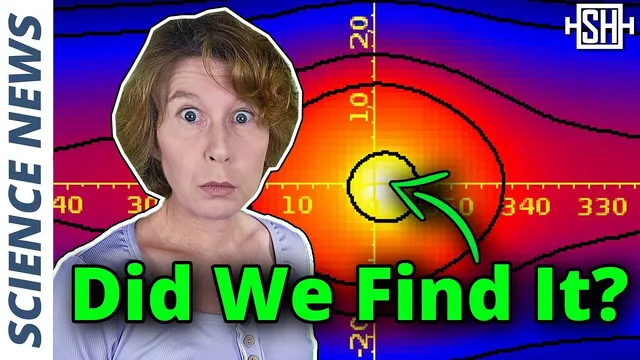
Dark matter may already be leaving a detectable fingerprint in the Milky Way’s center—specifically through an unusual infrared absorption feature tied to H3+—and the same mechanism could also connect to the long-mysterious 511 keV gamma-ray line. The core claim is that dark matter particles in a “medium-mass” range could annihilate into electrons and positrons, which then ionize hydrogen gas. That ionization would promote the formation of H3+, producing the observed signal in the central molecular zone (the galaxy’s inner “downtown” region), where astronomers have measured an H3+ abundance roughly an order of magnitude higher than expected.
Astrophysicists have long relied on dark matter’s gravitational effects—faster galaxy rotation and stronger gravitational lensing—because dark matter doesn’t emit or absorb light like ordinary matter. A competing explanation, modified gravity, can reproduce some of the same large-scale observations, so the field has lacked a decisive “smoking gun” that distinguishes particle dark matter from altered gravity. The new proposal tries to supply that missing link by pointing to a specific, measurable byproduct of dark matter interactions.
The observational starting point is infrared spectroscopy. Hydrogen gas normally forms H2, which has characteristic vibrational absorption patterns in the infrared. But the absorption feature seen toward the Milky Way’s center doesn’t match H2; it requires a species with at least three atoms that can vibrate. From the absorbed infrared frequencies, researchers argue the culprit is H3+—a hydrogen molecule with three protons and one missing electron. The measured H3+ signal is about 100 times higher than standard expectations.
To account for that excess, the paper’s authors propose dark matter made of a medium-mass particle with mass in the mega–electron volt (MeV) range. That mass window is lower than what large colliders like the Large Hadron Collider can probe directly, but higher than what typical axion searches target. In this scenario, dark matter annihilations are rare because the dark matter density is low, yet each annihilation can still matter: the process yields electrons and positrons. Those charged particles ionize hydrogen; ionized hydrogen then favors H3+ formation, amplifying the infrared absorption.
The same dark matter mechanism is also linked to the 511 keV line, a narrow gamma-ray emission from the galactic center observed since the 1970s. A 511 keV photon energy is the hallmark of electron–positron annihilation into two photons, so the line strongly suggests positrons are present. The proposal argues that dark matter-produced positrons could contribute to at least part of that signal.
Skepticism remains warranted. Earlier “dark matter” anomalies—such as a positron excess in cosmic rays and an excess of very energetic cosmic rays from the galactic center—were later reinterpreted as astrophysical sources like supernovae or active galactic nuclei, or as effects from millisecond pulsars. The proposed way forward is to test whether the spatial distribution of the H3+ and 511 keV signals tracks the dark matter density expected from stellar motions in the Milky Way. If the pattern matches, the case strengthens; if not, modified gravity or conventional astrophysics may still win. Even so, the idea that particle dark matter could leave a direct chemical/ionization signature in the galactic center would mark a major shift from purely gravitational evidence.
Cornell Notes
The Milky Way’s central molecular zone shows an infrared absorption feature consistent with H3+ that appears far more abundant than expected. A proposed explanation ties that excess to dark matter: medium-mass (MeV-scale) dark matter particles could annihilate into electrons and positrons, which ionize hydrogen and drive H3+ formation. The same annihilation products could also contribute to the narrow 511 keV gamma-ray line, long associated with electron–positron annihilation. Because modified gravity can mimic some gravitational observations, matching the *spatial distribution* of these signals to the dark matter density profile is presented as a key test. Past dark-matter “signals” have often turned out to be astrophysical, so confirmation requires careful cross-checks.
Why does H3+ matter for dark matter searches in the Milky Way’s center?
How does the proposed dark matter mechanism turn annihilation into an H3+ signal?
What is the connection to the 511 keV gamma-ray line?
Why is modified gravity still a serious alternative?
What mass range is proposed, and why does it matter for experiments?
How could astronomers test whether the signals really trace dark matter?
Review Questions
- What observational feature in the infrared spectrum is used to infer H3+ toward the Milky Way’s center, and why is it not consistent with H2?
- Describe the chain of events proposed to link MeV-scale dark matter annihilation to both H3+ formation and the 511 keV gamma-ray line.
- What spatial-distribution test could distinguish a dark matter origin from astrophysical sources or modified gravity?
Key Points
- 1
Dark matter is usually detected indirectly via gravity, but a new proposal seeks a non-gravitational signature in the Milky Way’s central molecular zone.
- 2
An infrared absorption feature toward the galactic center is argued to correspond to H3+, with an abundance roughly 100 times higher than expected.
- 3
The proposed explanation uses MeV-scale dark matter particles that annihilate into electrons and positrons, which ionize hydrogen and boost H3+ formation.
- 4
The same positron production could contribute to the long-known narrow 511 keV gamma-ray line associated with electron–positron annihilation.
- 5
Modified gravity remains a viable alternative because it can mimic some large-scale gravitational observations without dark matter particles.
- 6
Past “dark matter” anomalies have often been reinterpreted as astrophysical processes, so confirmation requires distribution-based and multi-signal consistency checks.