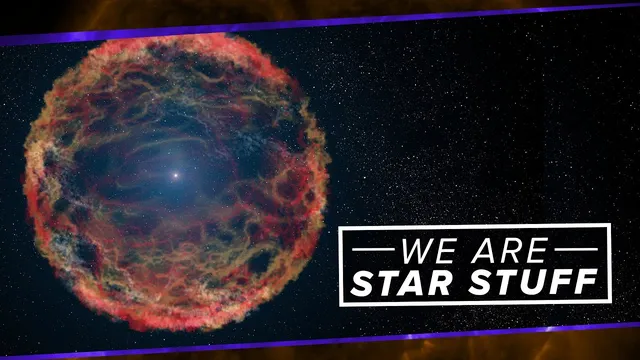
We Are Star Stuff
Based on PBS Space Time's video on YouTube. If you like this content, support the original creators by watching, liking and subscribing to their content.
Primordial nucleosynthesis produced most of the early helium-4 within about 20 minutes after the Big Bang, with smaller fractions of deuterium, lithium, and beryllium.
Briefing
The matter that makes up people, planets, and Earth traces back to a chain of cosmic “element factories,” starting with the first nuclei forged after the Big Bang and continuing through the lifecycles of stars and their explosions. The core insight is that the periodic table isn’t just a catalog of substances—it’s a record of how gravity, nuclear physics, and stellar death redistributed energy and atoms across the universe, turning simple beginnings into the complex chemistry needed for life.
In the earliest moments, the universe was hot and dense enough for primordial nucleosynthesis. Within roughly 20 minutes, protons fused into helium-4 nuclei, with smaller fractions of deuterium, lithium, and beryllium. The process works because once nucleons are close enough, the strong nuclear force overcomes electrostatic repulsion, lowering the system’s energy; the mass difference between reactants and products is released as light and neutrinos. Hydrogen then becomes the long-lived baseline fuel: its proton constituents are bound so effectively that the relationship outlasts nearly all other non-elementary particles.
As the universe cools and structures form, stars take over as the dominant element forges. During the main sequence, stars like the Sun convert hydrogen into helium over millions to billions of years. When hydrogen runs out, the Sun expands into a red giant and its core heats to fuse helium into carbon and oxygen. But carbon and oxygen generally don’t reach the temperatures needed to fuse into heavier elements, so much of that material ends up locked in white dwarfs unless later stellar events disperse it.
The heavy-element story accelerates in massive stars. Stars above about eight solar masses build up “onion shells” of burning elements. Fusion proceeds up a ladder—carbon to oxygen to neon to magnesium and beyond—until the core becomes iron. Iron is the turning point because it is the most stable nucleus: fusing toward heavier elements or breaking lighter ones toward iron both require energy rather than releasing it. Once iron forms, the core can no longer resist gravity; it collapses in about a tenth of a second, shrinking from roughly Earth-size to city-size and producing a neutron star. The surrounding layers rebound off this dense core, triggering a supernova that blasts newly made elements into interstellar space, seeding future stars, planetary systems, and the raw materials of biology.
For elements heavier than iron, the transcript highlights a shift from a single mechanism to multiple astrophysical sources. Historically, many heavy nuclei were attributed to supernova shockwaves, where neutrons are driven into existing nuclei to build up heavier species such as lead, gold, and uranium. Yet not all heavy elements may come from typical supernovae. One alternative involves a white dwarf in a binary system: as it accretes matter, runaway fusion obliterates the star and spreads heavy elements.
More recent research adds another contender—neutron star collisions. As two neutron stars spiral together via gravitational-wave emission, their merger can form a black hole while ejecting heavy matter and gamma rays. The account notes that such events could produce substantial quantities of heavy elements, including gold, potentially on the order of a significant fraction of Earth’s mass. Together, these pathways reinforce the same conclusion: the universe is an element factory, and “starstuff” is not a metaphor but a physical origin story for the atoms in human bodies.
Cornell Notes
The transcript traces how the atoms in living things were forged: first by primordial nucleosynthesis shortly after the Big Bang, then by stellar fusion, and finally by explosive events that spread those products. Early on, about 20 minutes after the Big Bang, protons fused into helium-4 (with smaller amounts of deuterium, lithium, and beryllium) as the strong nuclear force overcame electrostatic repulsion. Over millions to billions of years, stars like the Sun fuse hydrogen into helium and later helium into carbon and oxygen, but heavier elements require massive-star evolution and supernovae. When massive stars build iron, fusion stops being energy-producing, the core collapses into a neutron star, and a supernova disperses elements. For elements heavier than iron, mechanisms may include supernova shock processing, white-dwarf explosions in binaries, and neutron star mergers that can eject heavy material such as gold.
Why does helium-4 form so early, and why does the process stop there?
What role do stars play in building elements, and why doesn’t the Sun make everything heavier than oxygen?
Why does an iron core trigger collapse in massive stars?
How does a supernova spread the elements needed for later star and planet formation?
What mechanisms are proposed for elements heavier than iron, and why are multiple sources plausible?
How can the universe’s expansion exceed the speed of light without violating relativity?
Review Questions
- What physical condition makes early fusion into helium-4 possible, and what changes as the universe expands that prevents further rapid buildup?
- Trace the sequence from hydrogen fusion to iron formation in massive stars, and explain why iron is the point where energy production fails.
- Compare the proposed origins of heavy elements beyond iron: supernova shock processing, white-dwarf binary explosions, and neutron star mergers—what’s the key difference among them?
Key Points
- 1
Primordial nucleosynthesis produced most of the early helium-4 within about 20 minutes after the Big Bang, with smaller fractions of deuterium, lithium, and beryllium.
- 2
The strong nuclear force enables fusion when nucleons get close enough to overcome electrostatic repulsion, lowering the system’s energy and releasing light and neutrinos.
- 3
Stars build elements over long timescales: main-sequence stars fuse hydrogen into helium, while later stages can fuse helium into carbon and oxygen.
- 4
Massive stars create heavier elements in successive burning shells until an iron core forms, at which point fusion becomes energy-consuming rather than energy-releasing.
- 5
Iron cores collapse because they can no longer provide outward pressure; the collapse produces a neutron star and triggers a supernova that disperses newly made elements.
- 6
Elements heavier than iron likely come from more than one astrophysical pathway, including supernova shock processing, white-dwarf explosions in binaries, and neutron star collisions.
- 7
Cosmic expansion can outpace light speed because relativity constrains motion through space, while general relativity allows space itself to expand so distant regions separate faster than light.