We Finally Got Precise Human Video (HuMo) | Latest AI Advancements!
Based on MattVidPro's video on YouTube. If you like this content, support the original creators by watching, liking and subscribing to their content.
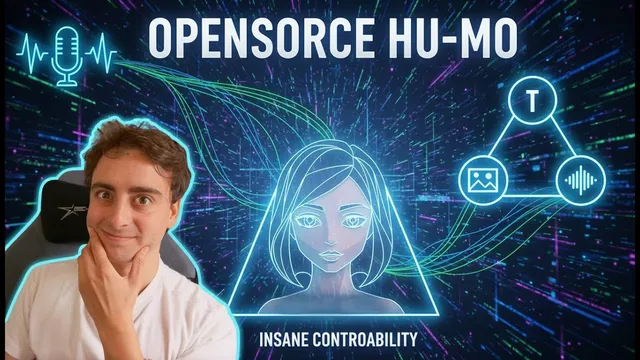
HuMo by Bite Dance combines photo references, audio references, and text to produce steerable, character-consistent video outputs with strong lip syncing.
Briefing
Human-centric video generation just took a major leap in controllability, with Bite Dance’s HuMo (Human centric video generation via collaborative multimodal conditioning) delivering steerable outputs that can lock onto photo references, audio references, and text direction in a single pipeline. The standout capability isn’t just “video from an input image,” but the way HuMo appears to keep character identity while matching uploaded audio—especially through notably strong lip syncing—and then lets users edit what happens via additional prompts (like changing costumes or swapping faces). That combination matters because most current AI video tools either struggle with identity consistency, can’t reliably follow audio, or offer limited control over what changes from one generation to the next.
HuMo is also positioned as unusually open for a model with this level of control: it’s released under Apache 2.0 and built atop a stack of open-source AI projects. The tradeoff is duration. HuMo generates up to about 4 seconds, which falls short of the ~15 seconds many creators consider the minimum for “usable” AI video—particularly when the workflow depends on audio adherence and reference steering. Still, the model’s multimodal conditioning approach suggests a path toward longer, more reliable generations: longer clips will likely require community work on efficiency and inference speed, plus better hosting and tooling so people can run it without specialized setups.
The rest of the week’s AI news reinforced the same theme—speed and controllability—though with different strengths and limitations. Decart AI’s Lucy 14B is pitched as a fast image-to-video model available exclusively through Fall AI, producing short clips in roughly five seconds and handling complex prompts (like a wizard casting a lemon spell or a person juicing lemons). It’s cheap and steerable, but not open source and quality can drop on more complex scenes, with some hallucination and visible detail loss.
On audio generation, Stability AI’s Stable Audio 2.5 targets enterprise-grade sound production and performs well for sound effects, following prompts quickly and producing more cinematic results in music samples. For lyrics, the guidance remains to use Suno or Udio, since Miniax’s Music 1.5—also accessible via Fall AI—was described as less competitive in quality and more restrictive in its interface.
Several “platform” updates landed too. OpenAI added MCP support for tools in ChatGPT developer mode, enabling connectors that can trigger write actions and Zapier-style flows—but a reported snag is that enabling developer-mode tools can disable regular ChatGPT capabilities like web search. On the model front, Google’s Gemini website added audio upload support for summarizing or explaining recordings, and a smaller Gemini 3.0 Flash variant was described as potentially smarter than the current 2.5 Pro.
Taken together, the week’s biggest signal is clear: AI video is moving from impressive demos toward controllable, reference-anchored production—while audio and tool integrations are catching up enough to make those workflows practical. HuMo is the clearest example so far, even with the short-clip limitation.
Cornell Notes
HuMo by Bite Dance pushes AI video generation toward real creative control by combining multiple inputs—photo references, audio references, and text—into one output. The model appears highly steerable, maintaining character consistency and delivering strong lip syncing to uploaded audio, while also supporting edits like costume changes and face swaps via prompts. HuMo is released under Apache 2.0, making it unusually open for a model with this level of multimodal control. The main constraint is length: it generates up to about 4 seconds, while many creators want closer to 15 seconds for practical use. Even so, its design suggests a credible route to longer, more reliable controllable video as the community improves speed and hosting.
What makes HuMo’s approach different from typical image-to-video systems?
How does HuMo handle edits after the initial references are provided?
What is the biggest practical limitation of HuMo right now?
Why is HuMo’s open-source status important, despite the short clip length?
How do other models in the update compare on speed and control?
What tool-integration change affects how developers can use ChatGPT?
Review Questions
- HuMo’s multimodal inputs include which three reference types, and how does each one contribute to the final video control?
- What tradeoff does HuMo make compared with longer-form AI video creation, and why does that matter for real projects?
- Compare the strengths and weaknesses of Lucy 14B versus HuMo based on speed, steerability, openness, and quality stability.
Key Points
- 1
HuMo by Bite Dance combines photo references, audio references, and text to produce steerable, character-consistent video outputs with strong lip syncing.
- 2
HuMo supports prompt-driven edits such as costume changes and face swaps while keeping reference identity stable.
- 3
HuMo is released under Apache 2.0, which should enable community optimization and broader adoption beyond closed platforms.
- 4
HuMo’s current generation limit is about 4 seconds, leaving a gap versus the ~15 seconds many creators consider usable for production.
- 5
Lucy 14B (Decart AI) delivers very fast image-to-video results via Fall AI, but it is not open source and can show quality loss or hallucinations on complex scenes.
- 6
Stable Audio 2.5 from Stability AI performs especially well for sound effects, while lyric-focused generation is still recommended to rely on Suno or Udio.
- 7
OpenAI’s MCP tool support in ChatGPT developer mode enables connector-based write actions, but enabling custom tools may disable built-in capabilities like web search.