We Live In Between Two HUGE Dark Matter Voids
Based on Sabine Hossenfelder's video on YouTube. If you like this content, support the original creators by watching, liking and subscribing to their content.
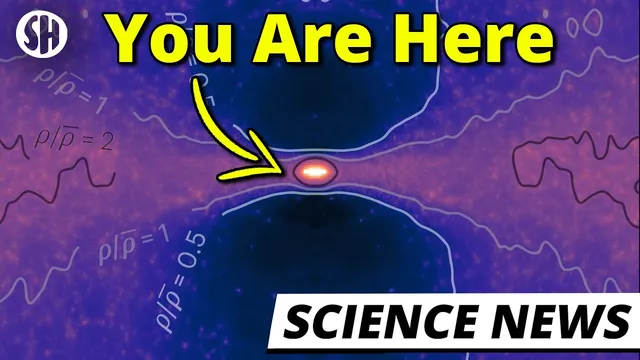
A new claim places our surrounding galaxy cluster near the center of a thin, pancake-like dark-matter structure bordered by two large voids.
Briefing
A new analysis of large-scale cosmic structure suggests that our region of the universe sits in a highly specific geometry: a thin, pancake-like concentration of dark matter bordered by two enormous, nearly empty voids. The claim matters because it reframes dark matter from a broadly “invisible mass” component into something that may have an unusually structured distribution around us—an outcome that, if confirmed, would tighten constraints on what dark matter can be and how it behaves under gravity.
The discussion begins with the persistent problem at the heart of modern cosmology: dark matter is inferred because it seems to make up about 80% of all matter, yet decisive evidence for its particle nature remains missing. Over the past decade, researchers have repeatedly adjusted the dark-matter picture to accommodate tensions with observations. For example, dark matter models tend to produce clumping patterns in galactic centers that don’t match what astronomers see, and they also predict far more small satellite galaxies around large galaxies like the Milky Way than observations currently show. Additional discrepancies emerged around how galaxies grow over cosmic time; early-universe growth predicted by standard models conflicted with findings associated with the James Webb Space Telescope.
Against that backdrop, the new paper argues that observations “strongly indicate” a remarkable arrangement of dark matter around our cosmic neighborhood. Instead of a smooth halo or generic filamentary web, the preferred configuration is a thin mirror-like plane (described as a “mirror axis” in the account) with two huge void regions on either side. The claim is not that the solar system is special in isolation, but that the surrounding cluster of galaxies is positioned near the center of this structure.
Because dark matter itself can’t be directly observed, the method relies on simulations. Starting from tiny initial density fluctuations after the Big Bang, gravity amplifies them into a cosmic network of filaments and voids. The simulations used here follow the standard cosmological model lambda CDM, but they don’t include normal visible matter directly. Instead, visible matter is assigned afterward by assuming it responds to the gravitational pull of the dark matter, scaled by the fact that dark matter dominates the matter budget.
The key filtering step is selection: only those simulated universes are kept where the resulting distribution of visible matter matches observational data. From that narrowed set, the authors conclude that reproducing what we see requires dark matter to adopt the odd “pancake plus two voids” shape around us.
Statistical significance is treated cautiously. Earlier estimates for living in such an atypical location were quoted as roughly 2.5 to 3.3 sigma—about a 1 in 100 to 1 in 1,000 chance—meaning it’s unusual but not decisively ruled out. The account also criticizes the paper for not quantifying how likely this configuration is, and it notes a broader concern: as more observations are forced to fit dark matter, the model can start to resemble “creative writing” rather than a predictive framework. The deeper hope is that resolving the dark-matter riddle could also illuminate quantum gravity, since the cosmic web ultimately traces back to quantum fluctuations stretched across billions of years.
Cornell Notes
The analysis claims that our cosmic neighborhood lies near the center of a thin, pancake-like concentration of dark matter, with two large, nearly empty voids on opposite sides. Because dark matter can’t be directly measured, the result comes from structure simulations in the standard lambda CDM framework, where tiny early density fluctuations grow into filaments and voids under gravity. Visible matter is added afterward by assuming it follows the gravitational influence of dark matter. Simulated universes are then filtered to keep only those that reproduce observed visible-matter patterns, and the surviving cases tend to require the “pancake plus two voids” geometry. Earlier estimates suggest such a location could be statistically rare (about 2.5–3.3 sigma), but the account argues the paper doesn’t fully quantify that rarity.
Why does the “pancake with two voids” idea hinge on simulations rather than direct dark-matter measurements?
What role does lambda CDM play in the claim, and what does “filtering” accomplish?
What tensions with observations have made dark matter models feel increasingly “strained” in recent years?
How unusual is it, according to the account, to find ourselves in such a special region?
What criticism is raised about the new paper’s statistical treatment?
Why does the discussion connect dark matter structure to quantum gravity?
Review Questions
- What simulation steps are necessary to infer dark-matter geometry when dark matter itself can’t be directly observed?
- How do the cited observational tensions (galactic cores, satellite counts, early galaxy growth) motivate skepticism about standard dark-matter modeling?
- What does a 2.5–3.3 sigma estimate imply about the typicality of our location, and why does the account still call for more statistical clarity?
Key Points
- 1
A new claim places our surrounding galaxy cluster near the center of a thin, pancake-like dark-matter structure bordered by two large voids.
- 2
The argument relies on structure simulations because dark matter cannot be directly measured; visible matter is matched indirectly through gravity.
- 3
Simulations use the standard lambda CDM framework, starting from small post–Big Bang density fluctuations that evolve into filaments and voids.
- 4
Only simulated universes that reproduce observed visible-matter patterns are kept, and that selection tends to produce the “pancake plus two voids” geometry.
- 5
Earlier estimates suggest such a special location could be rare (about 2.5–3.3 sigma), but the account criticizes the new work for not quantifying that rarity.
- 6
Repeated observational mismatches have made dark-matter modeling feel increasingly adjustable, raising concerns about predictive power.
- 7
Resolving dark matter may also inform quantum gravity, since the cosmic web traces back to early quantum fluctuations.