We Might Find Alien Life In 1827 Days
Based on Veritasium's video on YouTube. If you like this content, support the original creators by watching, liking and subscribing to their content.
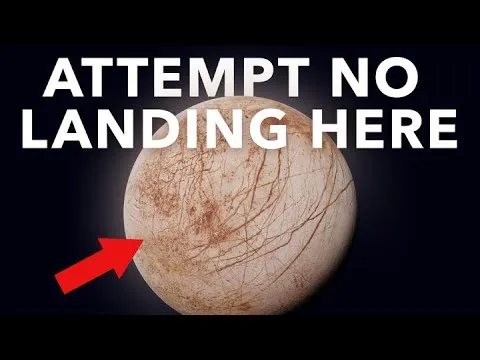
Europa’s low crater count suggests its ice shell is being renewed on relatively recent geological timescales.
Briefing
Europa has become the solar system’s most compelling target in the search for alien life because it combines three ingredients: a likely global ocean, ongoing internal heating that can keep that ocean liquid, and chemical pathways that could support microbes. The central reason this matters now is that NASA’s Europa Clipper—scheduled to launch in October 2024 after weather delays—will finally gather the kinds of measurements needed to test those claims, without landing on the moon’s lethal radiation environment.
Jupiter’s system is hostile in a very specific way. Jupiter’s immense magnetic field—about 20,000 times stronger than Earth at the same distance—traps charged particles sourced from Io’s volcanoes. Sulfur dioxide from Io gets ionized, accelerated to speeds over 300 kilometers per second, and then slams into other moons, feeding a chain reaction that builds massive radiation belts. Past missions such as Pioneer 10 and Voyager suffered instrument glitches and corrupted data, and even modern spacecraft shielding would only allow roughly three months inside the belts. Europa Clipper’s strategy is built around that constraint: it will not orbit Europa. Instead, it will loop around Jupiter from a safer distance and make 49 rapid flybys of Europa, using the long gaps between encounters to transmit data back to Earth.
The case for Europa starts with its surface. Voyager 1’s 1979 images showed an unusual lack of impact craters compared with other moons, implying the ice shell has been repeatedly resurfaced on geologically recent timescales. Galileo later detected a conductive layer beneath the surface—likely tens of kilometers down—by observing how Jupiter’s wobbling magnetic field induces a magnetic response in Europa. That conductivity points toward a salty ocean under an ice crust. Spectral observations of Europa’s reddish-brown regions match signatures expected from hydrated salts and sulfuric acid, and JPL experiments suggest that radiation can turn sea-salt material brown in a way similar to what’s seen on Europa.
Keeping an ocean liquid is the next hurdle. Europa receives only about 4% of the sunlight Earth gets, leaving the surface far below freezing. The heat source is tidal flexing driven by orbital resonance among Io, Europa, and Ganymede. As Europa is stretched and squeezed by Jupiter’s gravity, friction from that tidal motion can generate enough internal heat to prevent the ocean from freezing. The same flexing should leave measurable fingerprints in gravity data and surface cracking patterns, including arcuate “cycloid” features thought to form when cracks propagate under the changing stress field.
If an ocean exists, the next question is whether it can sustain life. On Earth, hydrothermal vents provide energy and chemical building blocks in the dark. Europa’s tidal activity could push heat and magma toward the seafloor, allowing mineral-rich water to circulate and potentially create vent-like environments. The search for evidence will focus on chemistry and plume activity: Europa Clipper carries infrared and ultraviolet instruments to map salts and look for active plumes, plus a mass spectrometer to analyze their composition if it can fly through them. Even if Europa’s ocean remains hidden, the mission aims to detect the chemical “fingerprints” that would be hard to fake.
Europa is also compared with Enceladus, where plumes have been directly observed and a subsurface ocean is considered nearly certain. Europa draws extra attention because radiation may help drive complex chemistry on the surface, producing molecules such as formaldehyde and hydrogen peroxide that could act as fuel if they reach the ice and ocean. First results are expected from distant observations around 2030, with higher-resolution data beginning in 2031. The mission’s design—built to survive Jupiter’s radiation while repeatedly sampling Europa—turns a long-standing hypothesis into a testable plan.
Cornell Notes
Europa is the leading target for finding alien life in the solar system because it likely hosts a salty, global ocean under an ice shell and has internal heating that can keep that ocean liquid. Jupiter’s radiation makes direct operations near Europa dangerous, so Europa Clipper will not orbit the moon; it will perform 49 fast flybys from a safer trajectory. Evidence for the ocean includes Europa’s resurfaced-looking surface (few craters), Galileo’s detection of a conductive layer tens of kilometers deep, and spectral clues consistent with salts and radiation-altered sea-salt material. Tidal flexing from orbital resonance with Io and Ganymede provides the heat, and plume/chemical measurements are the main way to search for biosignature-relevant chemistry without drilling.
Why is Europa such a strong candidate for life compared with other moons?
What makes Jupiter’s environment so dangerous for spacecraft, and how does Europa Clipper avoid it?
How do scientists infer a subsurface ocean from observations of Europa’s surface and magnetic environment?
What keeps Europa’s ocean from freezing despite low sunlight?
How will Europa Clipper search for signs of life without drilling through kilometers of ice?
Why does radiation from Jupiter potentially strengthen Europa’s habitability case?
Review Questions
- What observational evidence supports the idea that Europa has a conductive layer and a resurfaced ice shell?
- How does Europa Clipper’s flyby strategy address the radiation-belt survival problem posed by Jupiter’s magnetosphere?
- Which measurements (gravity, spectroscopy, plumes) are most central to testing Europa’s ocean and habitability hypotheses?
Key Points
- 1
Europa’s low crater count suggests its ice shell is being renewed on relatively recent geological timescales.
- 2
Jupiter’s magnetic field traps charged particles from Io’s volcanism, creating radiation belts that can quickly damage spacecraft electronics.
- 3
Europa Clipper avoids orbiting Europa by making 49 rapid flybys while staying outside the most lethal radiation regions and using downtime to transmit data.
- 4
Galileo’s magnetometer results point to a conductive layer tens of kilometers deep, consistent with a salty ocean beneath Europa’s ice crust.
- 5
Tidal flexing driven by orbital resonance with Io and Ganymede can generate enough internal heat to keep the ocean from freezing despite minimal sunlight.
- 6
Europa Clipper’s instrumentation focuses on chemical signatures and plume sampling (infrared/ultraviolet spectroscopy and mass spectrometry) rather than drilling.
- 7
Radiation-driven chemistry on Europa’s surface may create potential “fuel” molecules that could reach the subsurface ocean if transport mechanisms exist.