We Were WRONG About the Quantum Eraser! ft. @LookingGlassUniverse
Based on PBS Space Time's video on YouTube. If you like this content, support the original creators by watching, liking and subscribing to their content.
Alice’s unsorted detection data in a quantum eraser setup matches a single-slit-like distribution; interference appears only after post-selection using Bob’s measurement outcomes.
Briefing
Delayed-choice quantum eraser experiments can look like “information from the future” reshapes where a photon landed in the past—but a cleaner accounting of what each side can actually sort and later compare removes the need for retrocausality. The core claim is that Alice’s screen always yields a single-slit-like distribution on its own; only after Bob later measures (or effectively labels) which subset of photons his partner photons belong to can interference fringes be reconstructed. The apparent backward-in-time influence comes from treating that later sorting as if it acted directly on Alice’s already-recorded hits.
The explanation starts with the double-slit baseline. A photon’s wavefunction can be in a superposition of passing through both slits, producing an interference pattern on the detection screen. If a “which-way” measurement is made at the slits (or equivalently, information is extracted early enough), the superposition is effectively collapsed into a single path, and the interference disappears. Even then, photons don’t behave like classical bullets: measuring which slit they traversed changes the pattern into single-slit diffraction rather than a simple two-pile outcome.
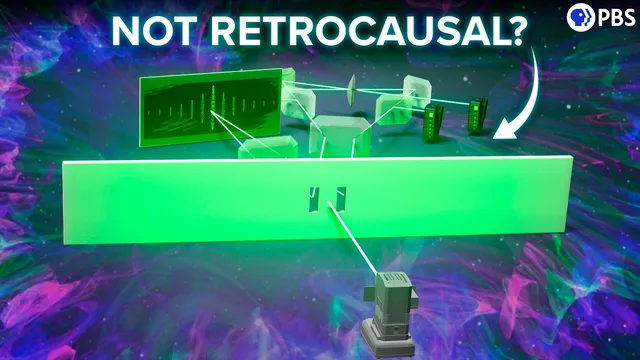
The delayed-choice quantum eraser ups the strangeness by using entanglement. In the best-known 1999 Kim et al. setup, a BBO crystal converts each incoming photon into a pair of near-identical photons entangled in a way that carries which-way information. One photon (A) goes to Alice, where the hits are recorded. The other photon (B) goes to Bob, who can either measure which path information is present or erase it by recombining the relevant alternatives. When Bob performs the erasing measurement, Alice’s data can be sorted into two interference patterns—often described as “plus” and “minus” fringes—yet when all of Alice’s hits are lumped together without that sorting, the result looks like a featureless blob consistent with single-slit interference.
The crucial bookkeeping point is that Bob’s choice doesn’t magically turn Alice’s already-recorded positions into interference in real time. Instead, Bob’s measurement determines how Alice’s photons should be partitioned after the fact. Alice can only see the double-slit fringes once she knows which of Bob’s outcomes correspond to which subset of her detections. Without that post-selection, the interference terms cancel.
The transcript then presents a home-analog experiment using a calcite (CaCO3) crystal and polarization filters to mimic the “which-way” marking and its erasure without producing entangled photons. With calcite oriented one way, polarization effectively labels which slit the light came from, yielding single-slit-like patterns. Rotating the calcite by 45° scrambles that labeling, erasing which-way information and restoring double-slit interference after appropriate data sorting. The observed offset between the reconstructed “plus” and “minus” patterns matches the idea that two complementary interference patterns sit on top of each other to form the single-slit-like distribution.
Finally, the retrocausal narrative is flipped: if Alice’s outcome is fixed first, it constrains which eraser detector Bob’s photon can land in, and the correlations follow. Changing path lengths can swap which detection happens first in a given frame, producing the same observable correlations either way. The remaining “mystery” is not a literal causal arrow from future to past, but the underlying rule that determines how photons get sorted into the two complementary detector bins—an issue promised for a later episode.
Cornell Notes
Delayed-choice quantum eraser results don’t require retrocausality. Alice’s raw detection screen always shows a single-slit-like distribution when her photons are not sorted by Bob’s later measurement outcome. Bob’s measurement (which-way vs eraser) determines how Alice’s already-recorded hits should be partitioned into two complementary subsets (“plus” and “minus”), each of which reveals double-slit interference. When those two interference patterns are recombined, the fringes cancel back into the featureless single-slit-like blob. A home analog using polarization marking plus a calcite crystal reproduces the same logic: rotate the calcite to switch between which-way information and its erasure, then reconstruct the interference by post-selection.
Why does a standard which-way measurement remove double-slit interference?
What makes the delayed-choice quantum eraser seem retrocausal in the first place?
What is the “critical point” about what Alice can see without Bob’s post-selection?
How does the home analog using calcite mimic which-way and erasure?
Why does the transcript argue that causality doesn’t have to point from Bob to Alice?
Review Questions
- In the delayed-choice quantum eraser, what observable changes for Alice when Bob chooses eraser versus which-way—her raw hit distribution or the partitioning of her data?
- Why do two complementary interference patterns (“plus” and “minus”) cancel when combined, and how does that relate to single-slit-like results?
- In the calcite-based home analog, what role does rotating the calcite by 45° play in terms of which-way information?
Key Points
- 1
Alice’s unsorted detection data in a quantum eraser setup matches a single-slit-like distribution; interference appears only after post-selection using Bob’s measurement outcomes.
- 2
Bob’s “eraser” choice doesn’t directly rewrite where photon A already landed; it determines how Alice’s recorded hits should be grouped to reveal interference.
- 3
In the entangled-photon version, the BBO crystal creates photon pairs carrying which-way information, and Bob’s measurement either preserves or erases that information for the purpose of later sorting.
- 4
The two reconstructed interference patterns are complementary and offset; summing them cancels fringes back into a featureless blob.
- 5
A calcite-based DIY analog can reproduce the same logic by using polarization to mark paths and rotating the calcite to switch between which-way labeling and its scrambling.
- 6
Changing path lengths can swap which detections occur first in a given frame, yet the same correlations appear, weakening any simple “future-to-past” causal story.