Weierstrass M-Test
Based on The Bright Side of Mathematics's video on YouTube. If you like this content, support the original creators by watching, liking and subscribing to their content.
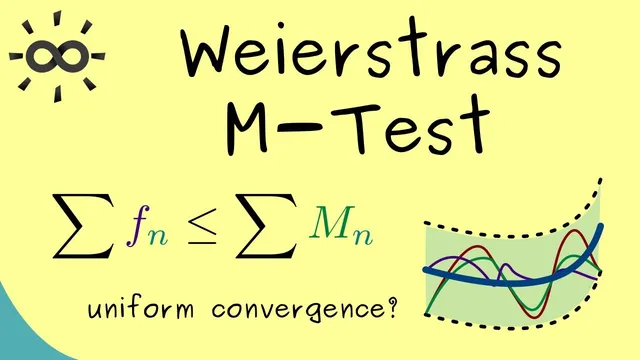
Uniform convergence of follows if for all and if converges.
Briefing
The Weierstrass M-test provides a clean, practical way to prove uniform convergence for series of functions. If a series of functions can be dominated by a single convergent numerical series , then the function series converges uniformly on the whole domain—no point-by-point checking required. The payoff is substantial: uniform convergence is strong enough to guarantee that the limit function is well-defined and behaves predictably under operations like taking absolute values and (in many contexts) differentiating term-by-term.
Concretely, the test starts with a common domain for all functions , which may be real- or complex-valued. One assumes there exist constants such that for every and every , the inequality holds. The second requirement is that the numerical series converges (so its partial sums approach a finite limit). Under these two conditions, the series converges for every , and—crucially—it converges uniformly on .
Uniform convergence is framed using the supremum norm: if denotes the pointwise limit, then the partial sums satisfy as . Intuitively, the graphs of the partial sums eventually stay inside any chosen “-tube” around the graph of , uniformly across all .
The proof relies on the Cauchy (Cauchy–Koshi) criterion for series, using completeness of or . Since converges, its tails become arbitrarily small: for any , there exists such that for all , . For any fixed , the tail of the function series satisfies , so the same -control holds uniformly. Taking the supremum over preserves the bound, yielding . The test also applies to , giving uniform convergence of the absolute-value series as well.
A standard application illustrates the method: let on . Since , one has . The numerical series converges, so converges uniformly on . That uniform convergence is especially useful in Fourier-related settings, including justifying operations like differentiation of related series.
Cornell Notes
The Weierstrass M-test gives a sufficient condition for uniform convergence of a function series on a domain . If there are constants with for every and if the numerical series converges, then converges uniformly on . The limit function is well-defined, and the tail becomes small in the supremum norm: . The same domination also yields uniform convergence of .
What two conditions make the Weierstrass M-test work for ?
How does the test connect uniform convergence to the supremum norm?
Why does convergence of imply that is Cauchy uniformly?
What does the M-test guarantee about ?
How does the example fit the M-test?
Review Questions
- State the Weierstrass M-test precisely, including the role of and the convergence requirement.
- Explain why the inequality leads to a bound on that is independent of .
- Given on , what additional information about is needed to conclude uniform convergence of ?
Key Points
- 1
Uniform convergence of follows if for all and if converges.
- 2
The supremum-norm criterion is the uniform convergence target.
- 3
The proof uses the Cauchy (Cauchy–Koshi) criterion for series and the triangle inequality to control tails.
- 4
Because the domination is pointwise and independent of , the same -tail bound holds uniformly across the entire domain.
- 5
The M-test also yields uniform convergence of under the same assumptions.
- 6
For , the bound and convergence of guarantee uniform convergence on .